


Neuropsychological function and suicidal behavior: attention control, memory and executive dysfunction in suicide attempt
- PMID: 22781400
- PMCID: PMC3767483
- DOI: 10.1017/S0033291712001419
Neuropsychological function and suicidal behavior: attention control, memory and executive dysfunction in suicide attempt
Abstract
Background: Executive dysfunction, distinct from other cognitive deficits in depression, has been associated with suicidal behavior. However, this dysfunction is not found consistently across samples.
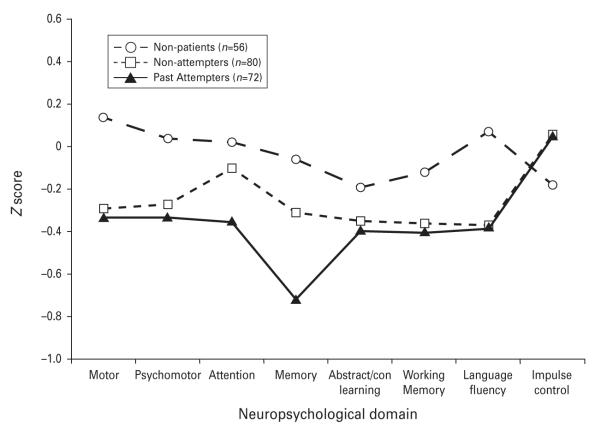
Method: Medication-free subjects with DSM-IV major depressive episode (major depressive disorder and bipolar type I disorder) and a past history of suicidal behavior (n = 72) were compared to medication-free depressed subjects with no history of suicidal behavior (n = 80) and healthy volunteers (n = 56) on a battery of tests assessing neuropsychological functions typically affected by depression (motor and psychomotor speed, attention, memory) and executive functions reportedly impaired in suicide attempters (abstract/contingent learning, working memory, language fluency, impulse control).
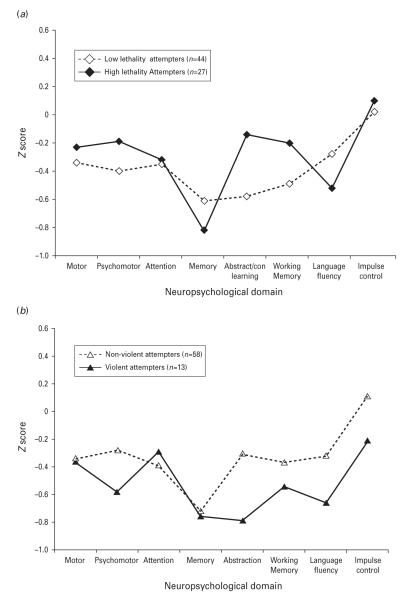
Results: All of the depressed subjects performed worse than healthy volunteers on motor, psychomotor and language fluency tasks. Past suicide attempters, in turn, performed worse than depressed non-attempters on attention and memory/working memory tasks [a computerized Stroop task, the Buschke Selective Reminding Task (SRT), the Benton Visual Retention Test (VRT) and an N-back task] but not on other executive function measures, including a task associated with ventral prefrontal function (Object Alternation). Deficits were not accounted for by current suicidal ideation or the lethality of past attempts. A small subsample of those using a violent method in their most lethal attempt showed a pattern of poor executive performance.
Conclusions: Deficits in specific components of attention control, memory and working memory were associated with suicidal behavior in a sample where non-violent attempt predominated. Broader executive dysfunction in depression may be associated with specific forms of suicidal behavior, rather than suicidal behavior per se.
Figures
References
-
- Arie M, Apter A, Orbach I, Yefet Y, Zalzman G. Autobiographical memory, interpersonal problem solving, and suicidal behavior in adolescent inpatients. Comprehensive Psychiatry. 2008;49:22–29. - PubMed
-
- Audenaert K, Goethals I, Van Laere K, Lahorte P, Brans B, Versijpt J, Vervaet M, Beelaert L, Van Heeringen K, Dierckx R. SPECT neuropsychological activation procedure with the Verbal Fluency Test in attempted suicide patients. Nuclear Medicine Communications. 2002;23:907–916. - PubMed
-
- Badre D, Wagner AD. Left ventrolateral prefrontal cortex and the cognitive control of memory. Neuropsychologia. 2007;45:2883–2901. - PubMed
-
- Baer RA. Mindfulness training as a clinical intervention: a conceptual and empirical review. Clinical Psychology: Science and Practice. 2003;10:125–143.
-
- Bartfai A, Winborg IM, Nordström P, Asberg M. Suicidal behavior and cognitive flexibility: design and verbal fluency after attempted suicide. Suicide and Life-Threatening Behavior. 1990;20:254–266. - PubMed
Publication types
MeSH terms
Grants and funding
LinkOut - more resources
Full Text Sources
Medical
Miscellaneous
