. 2012 Sep 7;287(37):31185-94.
doi: 10.1074/jbc.M112.375691. Epub 2012 Jul 10.

A retroelement modifies pre-mRNA splicing: the murine Glrb(spa) allele is a splicing signal polymorphism amplified by long interspersed nuclear element insertion

Affiliations

A retroelement modifies pre-mRNA splicing: the murine Glrb(spa) allele is a splicing signal polymorphism amplified by long interspersed nuclear element insertion

Kristina Becker et al. J Biol Chem. .

Abstract

The glycine receptor-deficient mutant mouse spastic carries a full-length long interspersed nuclear element (LINE1) retrotransposon in intron 6 of the glycine receptor β subunit gene, Glrb(spa). The mutation arose in the C57BL/6J strain and is associated with skipping of exon 6 or a combination of the exons 5 and 6, thus resulting in a translational frameshift within the coding regions of the GlyR β subunit. The effect of the Glrb(spa) LINE1 insertion on pre-mRNA splicing was studied using a minigene approach. Sequence comparison as well as motif prediction and mutational analysis revealed that in addition to the LINE1 insertion the inactivation of an exonic splicing enhancer (ESE) within exon 6 is required for skipping of exon 6. Reconstitution of the ESE by substitution of a single residue was sufficient to prevent exon skipping. In addition to the ESE, two regions within the 5' and 3' UTR of the LINE1 were shown to be critical determinants for exon skipping, indicating that LINE1 acts as efficient modifier of subtle endogenous splicing phenotypes. Thus, the spastic allele of the murine glycine receptor β subunit gene is a two-hit mutation, where the hypomorphic alteration in an ESE is amplified by the insertion of a LINE1 element in the adjacent intron. Conversely, the LINE1 effect on splicing may be modulated by individual polymorphisms, depending on the insertional environment within the host genome.


Figures
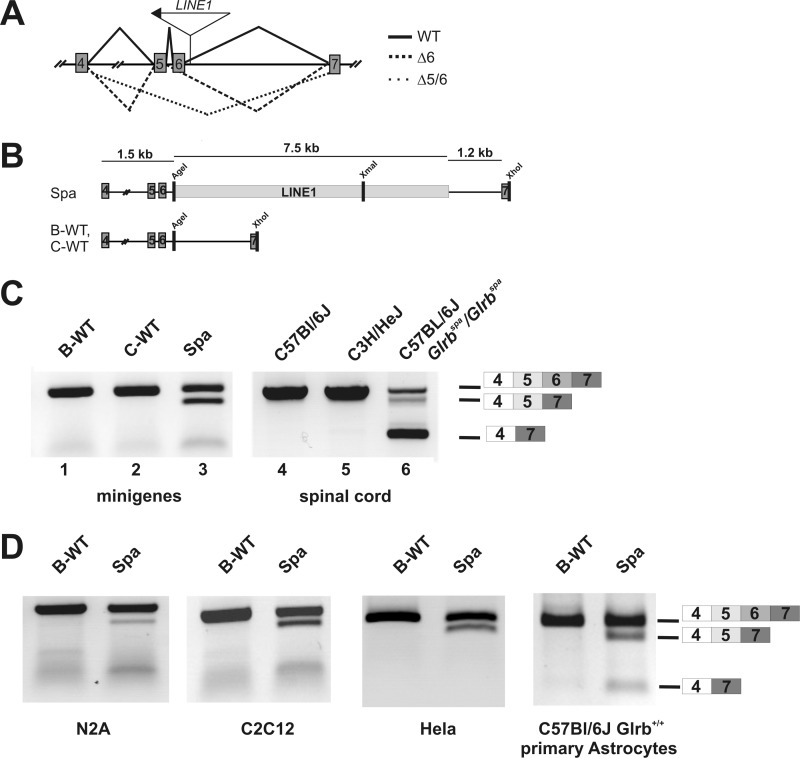
FIGURE 1.
FIGURE 1.
A, structure of the Glrb gene surrounding the LINE1 insertion site. Exons are indicated as gray boxes, position as well as orientation of the LINE1 insertion is indicated by the arrow. Splicing of the pre mRNA derived from the wild-type Glrb allel is indicated as solid line, splicing events observed in Glrbspa mice resulting in skipping of exon 6 (Δ6) as a dashed line or exons 5 and 6 (Δ5/6) as a dotted line, respectively. B, structure of the Glrb minigenes. Exons are depicted as gray boxes, and LINE1 is represented as an open box. The Spa minigene was generated from genomic DNA of a C57BL/6J spastic mouse (Glrbspa/spa). The wild-type minigenes B-WT and C-WT were generated from genomic DNA of C57BL/6J and C3H/HeJ mice, respectively. C, RT-PCR analysis of HEK293 cells transfected with the minigenes indicated in B or spinal cord mRNA preparations from mice with the indicated genomic background and genotype. For amplification, primers specific for a Glrb amplimer containing the exons 4–7 were used. Expected sizes for the full-length amplimer, the Δ6 amplimer and the Δ5–6 amplimer are indicated. Note that skipping of exon 6 or the exons 5 and 6 was only observed in samples from Spa minigene expressing cells or Glrbspa/spa mice. D, RT-PCR analysis from RNA preparations of N2A (mouse neuroblastoma cells, differentiated after 12 h of serum withdrawal), C2C12 (a mouse myoblast cell line, undifferentiated), HeLa cells and primary astrocytes derived from P0 C57BL/6J Glrb+/+ animals after transfection with the indicated minigenes. In all cell lines investigated, skipping of exon 6 could be observed reliably after transfection of the Spa minigene, whereas the combined skipping of exons 5 and 6 was highly variable.
FIGURE 2.
FIGURE 2.
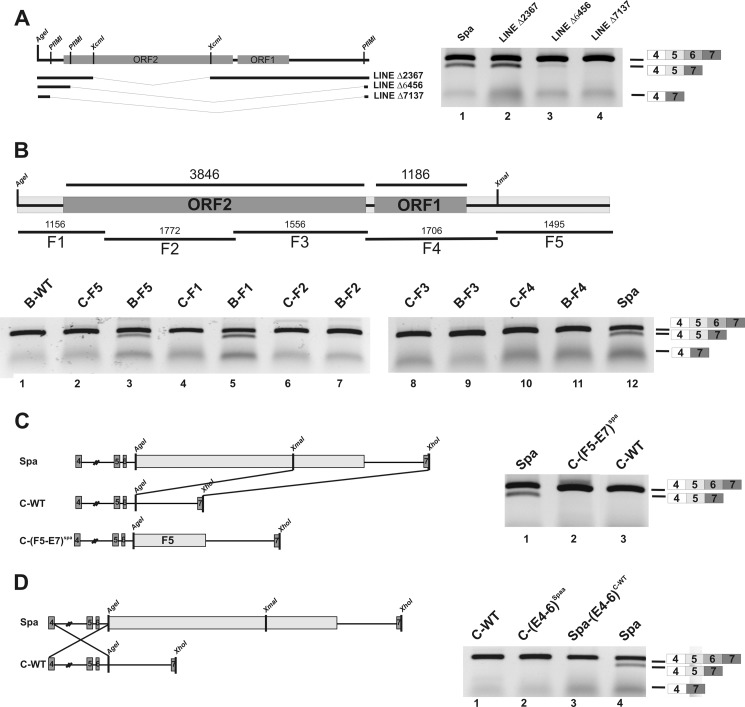
LINE1 associated exon skipping depended on the genetic context. A, deletion constructs containing only fragments of the LINE1 element were generated from the Spa minigene by internal restriction digest. ORFs within the LINE1 are indicated as gray boxes. After transfection in HEK293 cells and RNA extraction from the transfected cells, RT-PCR analysis was performed. Deletion of 2.3 kb from ORF2 did not change splicing, whereas exon skipping was diminished with larger deletions (Δ6456 bp, Δ7137 bp; lanes 3 and 4). B, minigenes containing the indicated LINE1 fragments F1 to F5 at the position of the original LINE1 insertion were generated on the basis of genomic DNA from C57BL/6J and C3H/HeJ mice. The respective minigenes were transfected in HEK293 cells and mRNA extracts analyzed by RT-PCR analysis. Of note, only the 3′ UTR plus 370 bps of ORF2 and 5′ UTR, respectively, promoted exon skipping when inserted into Glrb minigenes derived from C57BL/6J. C, schematic drawing of the construction of a chimeric C3H/HeJ Spa minigene containing exons 4–6 based on the C3HJ/HeJ genomic DNA and the fragment F5–E7 sequence containing the region IVS6 + 194-exon 7 from the Spa construct. After transfection in HEK293 cells and RNA extraction from the transfected cells, RT-PCR analysis was performed. D, schematic drawing of the construction of a Spa C3H/HeJ minigene. A fragment containing E4-IVS5 + 193 from C3H/HeJ genetic background was introduced in the Spa minigene, replacing the homologous region within the Spa minigene suppresses exon skipping despite the presence of a full-length LINE1. For analysis, HEK293 cells were transfected with the indicated minigenes, and exon skipping was determined by RT-PCR.
FIGURE 3.
FIGURE 3.
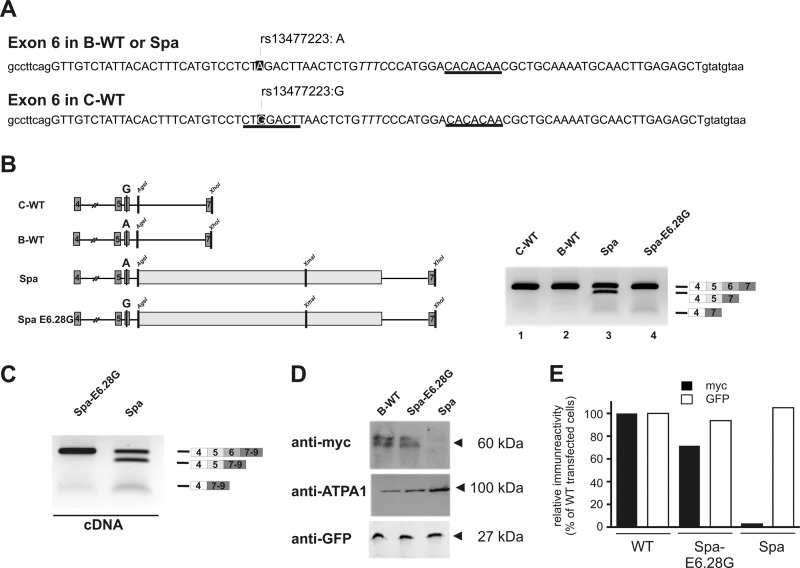
LINE1-associated skipping of exon 6 depended on a polymorphic residue at position E6.28. A, sequence of the Glrb exon 6 from C57BL/6J and C3H/HeJ mice, including the surrounding intronic regions. Exonic sequence is displayed in uppercase letters. Sequence motifs predicted to bind to SRSF1 are indicated. Note that one SRSF1 site predicted E6.23 in the C3H/HeJ exon 6 was not detected in the C57BL/6J due to a SNP at position E6.28 (A, strain C57BL/6J; G, strain C3H/HeJ; dbSNP, rs13477223). B, the effect of the SNP at position E6.28 was analyzed by introducing a G at E6.28 in the Spa minigene. The indicated minigenes were transfected into HEK293 cells and exon skipping was analyzed by RT-PCR. Note that mutation of E6.28 in the Spa minigene to a G (Spa-E6.28G) was sufficient to prevent skipping of exon 6. C, B-WT, Spa, and Spa E6.28G minigenes were complemented to full-length ORFs by adding coding sequences of the Glrb exons 1–3, including an N-terminal Myc tag and at the 5′ end and coding sequences of the exons 8–9 at the 3′ end of the minigene. The constructs were transfected into HEK293 cells and exon skipping was analyzed by RT-PCR using primers positioned in exons 4 and 9. D, membrane preparations form HEK293 cells transfected with the minigenes containing the full-length GlyR β ORF as indicated and for testing transfection efficiencies a plasmid encoding for GFP, were subjected to SDS-PAGE and Western blot analysis. The blots were probed with antibodies against Myc, ATPA1, and GFP. E, expression levels from the experiment shown in D as quantified by scanning of the blots and densitometric analysis using NIH ImageJ software. Note that in contrast to samples from WT and Spa-E6.28G transfected cells, samples from Spa transfected cells, showed almost no Myc immunoreactivity although the cells were transfected efficiently as indicated by GFP immunoreactivity.
FIGURE 4.
FIGURE 4.
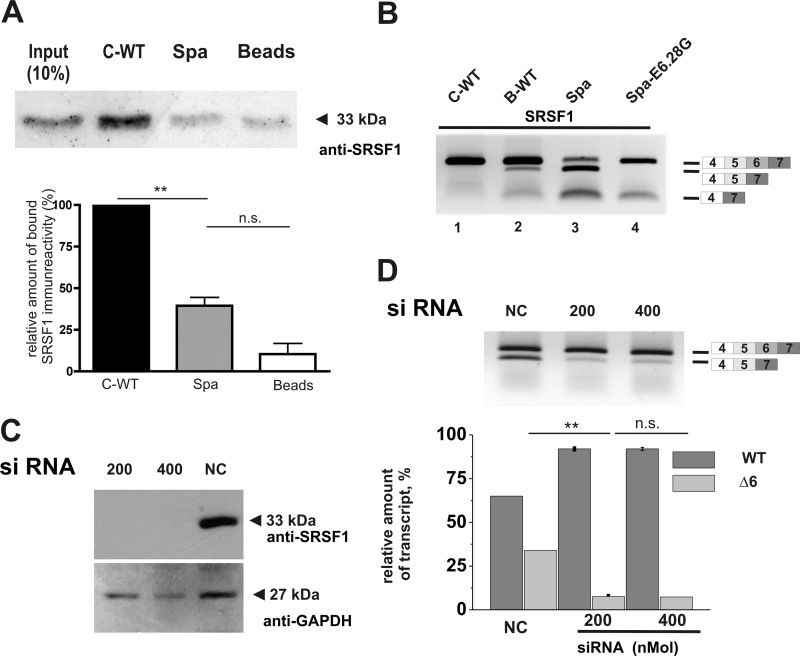
Modulation of exon skipping by splicing factor SRSF1. A, pulldown assays of HeLa nuclear extracts were conducted using in vitro-transcribed Glrb E6.13–E6.61 RNA containing either E6.28G (C-WT) or E6.28A (Spa). After pulldown, proteins were analyzed by Western blotting using a monoclonal antibody against SRSF1. Using a C-WT derived sequence, a strong signal for SRSF1 was detected at 33 kDa, which was diminished when a E6.28G RNA fragment was used as a bait. Lower panel, for quantification band band intensities were analyzed using ImageJ software. All values represent means ± S.E. (n = 3). **, p < 0.01 (one-way ANOVA followed by Bonferroni's multiple comparison test). B, HEK cells were cotransfected with an expression construct for SRSF1 and the minigenes as indicated. In RNA preparations from these cells, exon skipping was analyzed by RT-PCR using primers positioned in exons 4 and 7. C, HEK293 cells were transfected with 200 or 400 ng of an SRSF1 specific siRNA or 400 ng of scrambled siRNA. Efficiency of SRSF1 knockdown was determined in Western blot from protein extracts of transfected cells using an SRSF1-specific antibody. Comparable loading of the gel was assessed by probing the Western blot with antibodies against GAPDH (D); HEK293 cells were transfected with siRNA as described in C. After 24 h, cells were transfected additionally with the Spa minigene. Exon skipping was analyzed in RNA preparations from these cells using primers positioned in exons 4 and 7. For quantification, band intensities were determined on digital images of the gel using ImageJ software. All values represent means ± S.E. (n = 3). **, p < 0.01 (one-way ANOVA followed by Bonferroni's multiple comparison test).
FIGURE 5.
FIGURE 5.
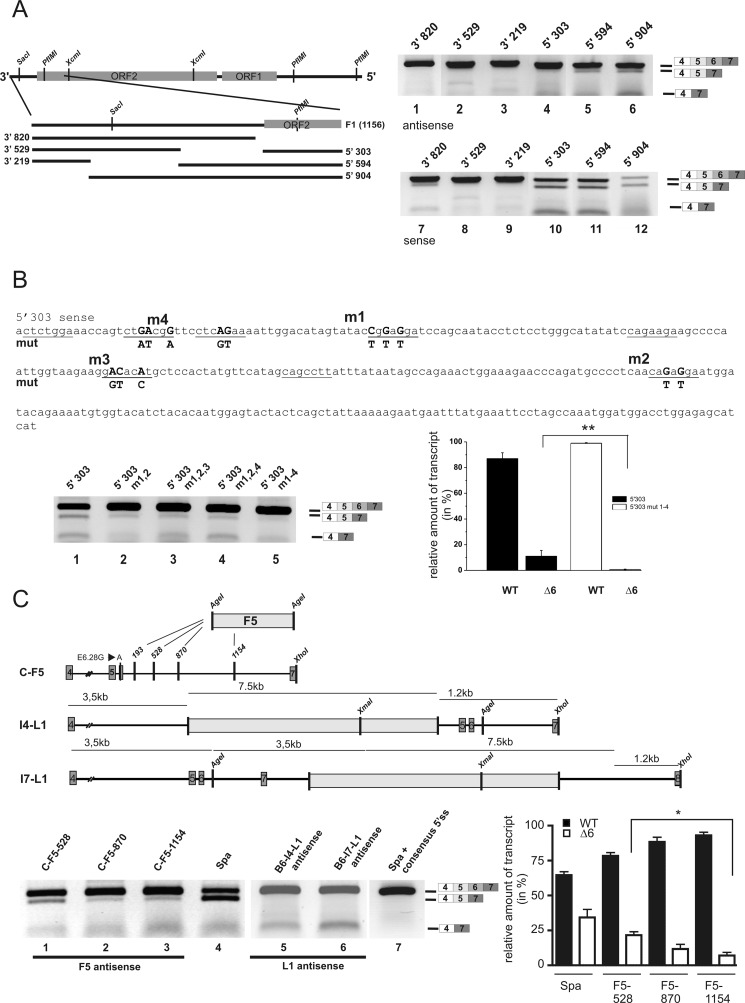
Delineating the LINE1 minimal sequence required to induce exon skipping. A, truncations of F1 (corresponding to the 3′ UTR and adjacent 370 bp of ORF2) from either its 5′ end (constructs F1 3′-820, 3′-529, 3′-219) or its 3′ end (F1 5′-303, 5′-594, 5′-904) were generated by PCR and inserted into C-6.28A via AgeI (schematic in left panel). The respective constructs were transfected in HEK293 cells. RNA extracts from these cells were analyzed by RT-PCR using primers binding in exons 4 and 7, respectively. Skipping was more apparent in minigenes containing LINE1 3′ deletions (right panel, lanes 4–6) and when inserts were oriented in sense with respect to Glrb sequences (right panel, lanes 10–12). B, mutations (m1–m4) in fragment F1–5′-303 of predicted SRSF1 binding sites were introduced to reduce SRSF1 binding to the fragment. Putative SRSF1 binding sites are underscored, mutated residues in boldface type. Left panel, statistical analysis comparing 5′-303 and 5′-303m1–4. All values represent means ± S.E. (n = 3). Note that the combined mutations m1–4 resulted in a significant reduction of exon skipping (lanes 1–5). **, p > 0.001, one-way ANOVA followed by Bonferroni's multiple comparison test. C, skipping of exon 6 depends on the distance of the LINE1 insertion to the skipped exon. Upper panel, plasmid constructs were derived from the C-E6.28A minigene. A fragment of the LINE1 corresponding to its 5′ UTR (F5) was inserted at intronic positions IVS6 + 528, +870, +1154 into the C-E6.28A minigene via an AgeI site. The full-length LINE1 sequence was inserted into “skipping-permissive” B-WT introns 4 (IVS4.15513) and 7 (IVS7.873; this minigene also contains an exon 8 and adjacent intronic sequence IVS7–3720-4223) via a PmlI and SalI site, respectively. Lower panel, exon 6 skipping was significantly reduced with increasing distance from the exon (lanes 1–3, graph); for comparison, see Spa (lane 4). No skipping of exon 6 could be observed with insertions in introns 4 and 7 (lanes 5 and 6). Restoring the weak 5′ splice donor site (5′ ss) of intron 6 to consensus (replacing ..GCTgtatgt.. with ..CAGgtaagt … ) in the Spa construct prevented skipping despite the presence of the full-length LINE1 insertion (lane 7). All values represent means ± S.E. (n = 3). *, p < 0.05 (one-way ANOVA followed by Bonferroni's multiple comparison test).

References

    1. Betz H., Laube B. (2006) Glycine receptors: Recent insights into their structural organization and functional diversity. J. Neurochem. 97, 1600–1610 - PubMed
    1. Grudzinska J., Schemm R., Haeger S., Nicke A., Schmalzing G., Betz H., Laube B. (2005) The β subunit determines the ligand binding properties of synaptic glycine receptors. Neuron 45, 727–739 - PubMed
    1. Oertel J., Villmann C., Kettenmann H., Kirchhoff F., Becker C. M. (2007) A novel glycine receptor β subunit splice variant predicts an unorthodox transmembrane topology. Assembly into heteromeric receptor complexes. J. Biol. Chem. 282, 2798–2807 - PubMed
    1. Harvey R. J., Topf M., Harvey K., Rees M. I. (2008) The genetics of hyperekplexia: More than startle! Trends Genet. 24, 439–447 - PubMed
    1. Kingsmore S. F., Giros B., Suh D., Bieniarz M., Caron M. G., Seldin M. F. (1994) Glycine receptor β-subunit gene mutation in spastic mouse associated with LINE-1 element insertion. Nat. Genet. 7, 136–141 - PubMed

Publication types

LinkOut - more resources