


Modeling huanglongbing transmission within a citrus tree
- PMID: 22783015
- PMCID: PMC3409777
- DOI: 10.1073/pnas.1208326109
Modeling huanglongbing transmission within a citrus tree
Abstract
The citrus disease huanglongbing (HLB), associated with an uncultured bacterial pathogen, is threatening the citrus industry worldwide. A mathematical model of the transmission of HLB between its psyllid vector and citrus host has been developed to characterize the dynamics of the vector and disease development, focusing on the spread of the pathogen from flush to flush (a newly developing cluster of very young leaves on the expanding terminal end of a shoot) within a tree. This approach differs from that of prior models for vector-transmitted plant diseases where the entire plant is the unit of analysis. Dynamics of vector and host populations are simulated realistically as the flush population approaches complete infection. Model analysis indicates that vector activity is essential for initial infection but is not necessary for continued infection because infection can occur from flush to flush through internal movement in the tree. Flush production, within-tree spread, and latent period are the most important parameters influencing HLB development. The model shows that the effect of spraying of psyllids depends on time of initial spraying, frequency, and efficacy of the insecticides. Similarly, effects of removal of symptomatic flush depend on the frequency of removal and the time of initiation of this practice since the start of the epidemic. Within-tree resistance to spread, possibly affected by inherent or induced resistance, is a major factor affecting epidemic development, supporting the notion that alternate routes of transmission besides that by the vector can be important for epidemic development.
Conflict of interest statement
The authors declare no conflict of interest.
Figures
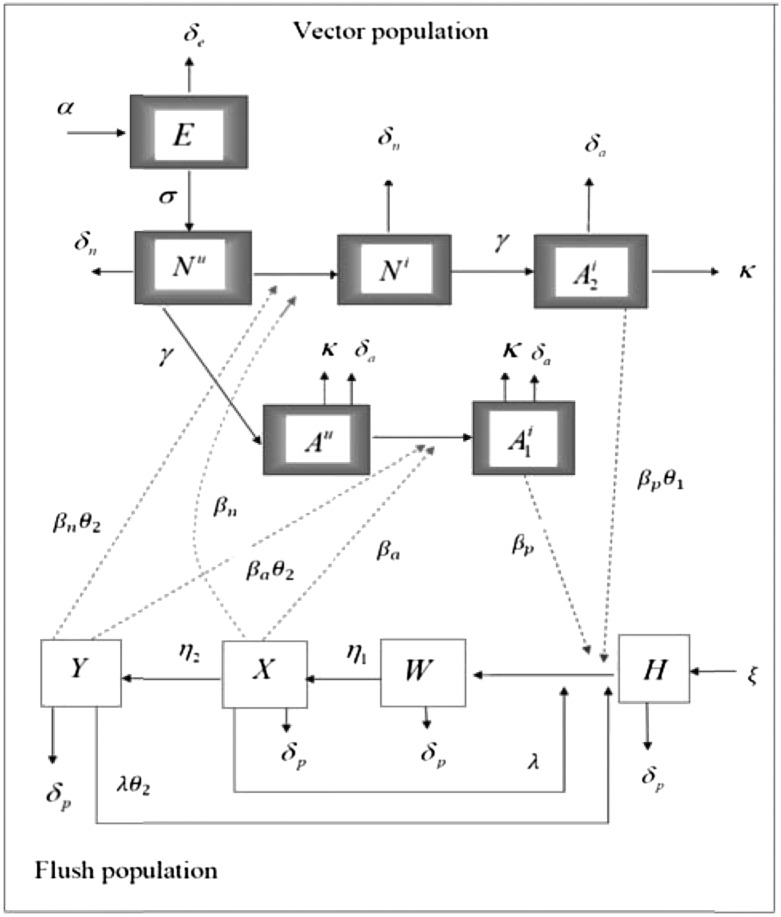
 , infected and asymptomatic but not yet infectious (latent)
  , infectious and asymptomatic
  , and infectious and symptomatic
  . The vector compartments are uninfected nymphs
  , infected nymphs
  , uninfected adult psyllids
  , infected adults that acquired CLas during the adult stage
  , and infected adults that acquired CLas during the nymphal stage
  .
.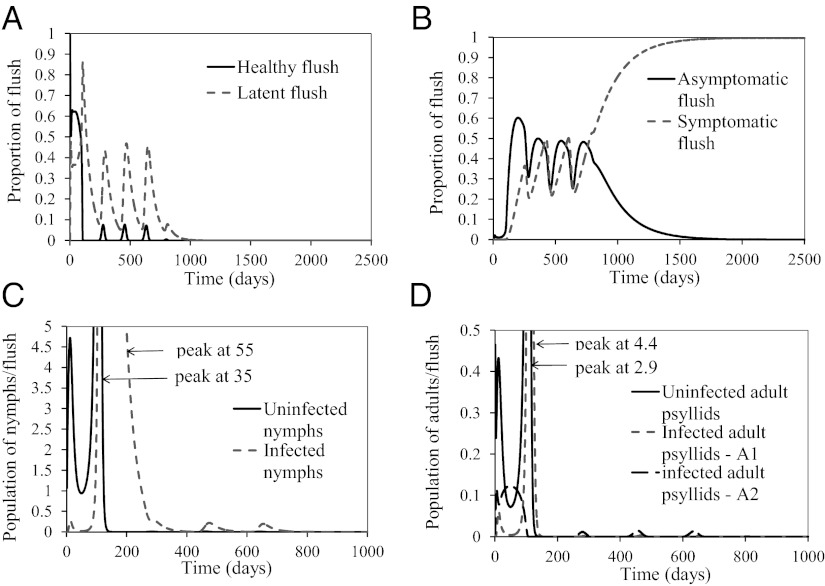
 and A2 =
  . Input rate of healthy flush follows a periodic function with two peaks in 1 y. The parameter for internal movement of the pathogen in the tree,
  .
.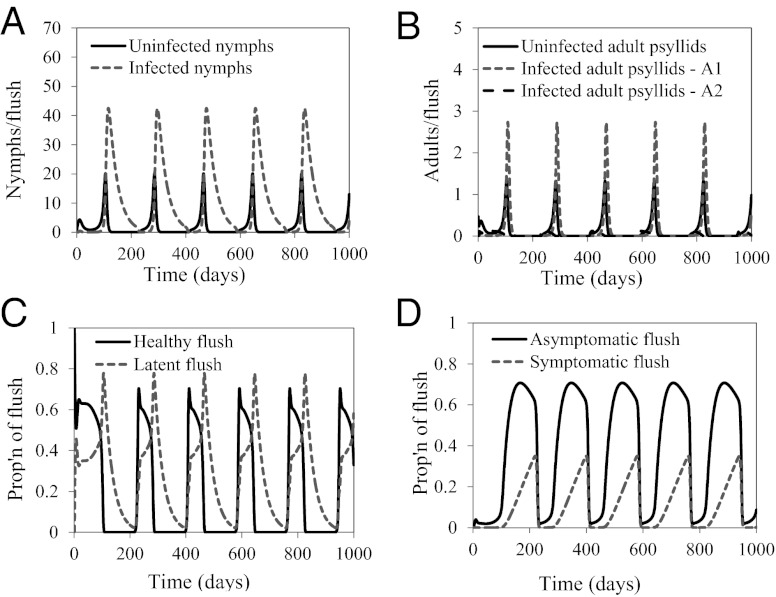
 and A2 =
  . Input rate of healthy flush follows a periodic function with two peaks in 1 y. Internal movement parameter of the pathogen in the tree,
  .
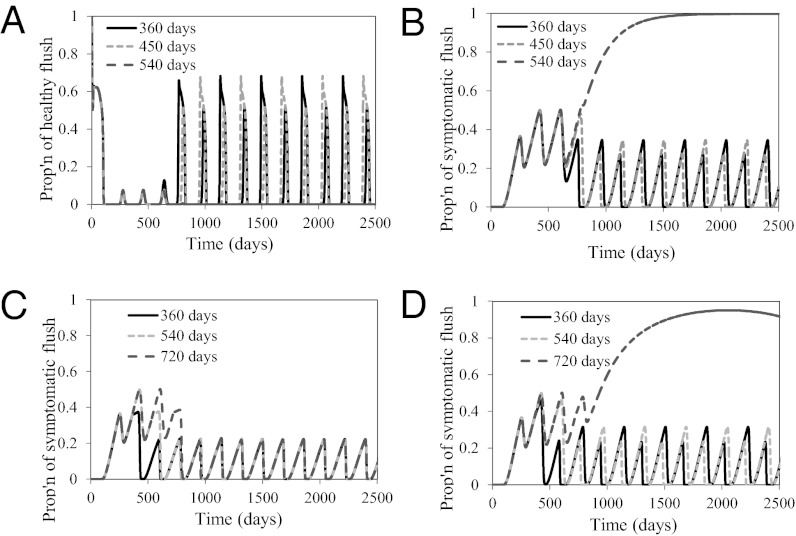
.
References
-
- Bové JM. Huanglongbing: A destructive, newly emerging, century-old disease of citrus. J Plant Pathol. 2006;88:7–37.
-
- Halbert SE, Manjunath KL. Asian citrus psyllids (Sternorrhyncha: Psyllidae) and greening disease of citrus: A literature review and assessment of risk in Florida. Fla Entomol. 2004;87:330–353.
-
- Gottwald TR. Current epidemiological understanding of citrus Huanglongbing. Annu Rev Phytopathol. 2010;48:119–139. - PubMed
-
- Committee on the Strategic Planning for the Florida Citrus Industry: Addressing Citrus Greening Disease (Huanglongbing), National Research Council (2010) Strategic Planning for the Florida Citrus Industry: Addressing Citrus Greening (National Academies Press, Washington, DC)
-
- Bonani JP, et al. Characterization of electrical penetration graphs of the Asian citrus psyllid, Diaphorina citri, in sweet orange seedlings. Entom Experim Applic. 2010;134:35–49.
Publication types
MeSH terms
Grants and funding
LinkOut - more resources
Full Text Sources
