


miR-34 - a microRNA replacement therapy is headed to the clinic
- PMID: 22783274
- PMCID: PMC3387671
- DOI: 10.3389/fgene.2012.00120
miR-34 - a microRNA replacement therapy is headed to the clinic
Abstract
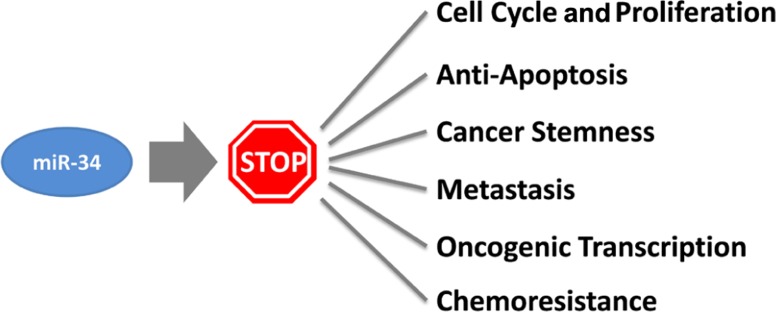
MicroRNA-34 (miR-34) is a master regulator of tumor suppression. It is downregulated in numerous cancers and inhibits malignant growth by repressing genes involved in various oncogenic signaling pathways. Consequently, miR-34 antagonizes processes that are necessary for basic cancer cell viability as well as cancer stemness, metastasis, and chemoresistance. This broad anti-oncogenic activity holds the prospect of creating a new remedy that is effective against tumor heterogeneity. This review focuses on the molecular mechanisms of miR-34-mediated tumor suppression, pharmacologies in animal models of cancer, and a status update of a miR-34 therapy that may be among the first miRNA mimics to reach the clinic.
Keywords: miR-34; miR-34a; miRNA; miRNA replacement; miRNA therapeutics.
Figures
Similar articles
-
Mir-34: a new weapon against cancer?Mol Ther Nucleic Acids. 2014 Sep 23;3(9):e194. doi: 10.1038/mtna.2014.47. Mol Ther Nucleic Acids. 2014. PMID: 25247240 Free PMC article. Review.
-
Identification and validation of microRNAs that synergize with miR-34a - a basis for combinatorial microRNA therapeutics.Cell Cycle. 2019 Aug;18(15):1798-1811. doi: 10.1080/15384101.2019.1634956. Epub 2019 Jul 1. Cell Cycle. 2019. PMID: 31258013 Free PMC article.
-
MicroRNA-34a: Potent Tumor Suppressor, Cancer Stem Cell Inhibitor, and Potential Anticancer Therapeutic.Front Cell Dev Biol. 2021 Mar 8;9:640587. doi: 10.3389/fcell.2021.640587. eCollection 2021. Front Cell Dev Biol. 2021. PMID: 33763422 Free PMC article. Review.
-
Alternative mechanisms of miR-34a regulation in cancer.Cell Death Dis. 2017 Oct 12;8(10):e3100. doi: 10.1038/cddis.2017.495. Cell Death Dis. 2017. PMID: 29022903 Free PMC article. Review.
-
MicroRNA-34a Attenuates Metastasis and Chemoresistance of Bladder Cancer Cells by Targeting the TCF1/LEF1 Axis.Cell Physiol Biochem. 2018;48(1):87-98. doi: 10.1159/000491665. Epub 2018 Jul 12. Cell Physiol Biochem. 2018. PMID: 30001529
Cited by
-
Expression of tumor suppressive microRNA-34a is associated with a reduced risk of bladder cancer recurrence.Int J Cancer. 2015 Sep 1;137(5):1158-66. doi: 10.1002/ijc.29413. Epub 2015 Feb 25. Int J Cancer. 2015. PMID: 25556547 Free PMC article.
-
p53, SKP2, and DKK3 as MYCN Target Genes and Their Potential Therapeutic Significance.Front Oncol. 2012 Nov 28;2:173. doi: 10.3389/fonc.2012.00173. eCollection 2012. Front Oncol. 2012. PMID: 23226679 Free PMC article.
-
Identification of Long Non-Coding RNAs Deregulated in Multiple Myeloma Cells Resistant to Proteasome Inhibitors.Genes (Basel). 2016 Oct 6;7(10):84. doi: 10.3390/genes7100084. Genes (Basel). 2016. PMID: 27782060 Free PMC article.
-
Therapeutic nucleic acids: current clinical status.Br J Clin Pharmacol. 2016 Sep;82(3):659-72. doi: 10.1111/bcp.12987. Epub 2016 Jun 3. Br J Clin Pharmacol. 2016. PMID: 27111518 Free PMC article. Review.
-
MicroRNAs in the prognosis and therapy of colorectal cancer: From bench to bedside.World J Gastroenterol. 2018 Jul 21;24(27):2949-2973. doi: 10.3748/wjg.v24.i27.2949. World J Gastroenterol. 2018. PMID: 30038463 Free PMC article. Review.
References
-
- Akao Y., Noguchi S., Iio A., Kojima K., Takagi T., Naoe T. (2010). Dysregulation of microRNA-34a expression causes drug-resistance to 5-FU in human colon cancer DLD-1 cells. Cancer Lett. 300 197–204 - PubMed
-
- Asslaber D., Pinon J. D., Seyfried I., Desch P., Stocher M., Tinhofer I., Egle A., Merkel O., Greil R. (2010). microRNA-34a expression correlates with MDM2 SNP309 polymorphism and treatment-free survival in chronic lymphocytic leukemia. Blood 115 4191–4197 - PubMed
-
- Bader A. G., Daige C. L., Kelnar K., Priddy L., Dysart S., Wiggins J., Zhao J., Leatherbury N., Omotola M., Stoudemire J., Lammers P., Brown D. (2012). Preclinical data of a microRNA-based therapy for hepatocellular carcinoma. Annual AACR Conference Presentation, March 31–April 4, 2012, Chicago, IL
-
- Bommer G. T., Gerin I., Feng Y., Kaczorowski A. J., Kuick R., Love R. E., Zhai Y., Giordano T. J., Qin Z. S., Moore B. B., MacDougald O. A., Cho K. R., Fearon E. R. (2007). p53-mediated activation of miRNA34 candidate tumor-suppressor genes. Curr. Biol. 17 1298–1307 - PubMed
Grants and funding
LinkOut - more resources
Full Text Sources
Other Literature Sources
