


Variation in OPRM1 moderates the effect of desire to drink on subsequent drinking and its attenuation by naltrexone treatment
- PMID: 22784013
- PMCID: PMC3473112
- DOI: 10.1111/j.1369-1600.2012.00471.x
Variation in OPRM1 moderates the effect of desire to drink on subsequent drinking and its attenuation by naltrexone treatment
Abstract
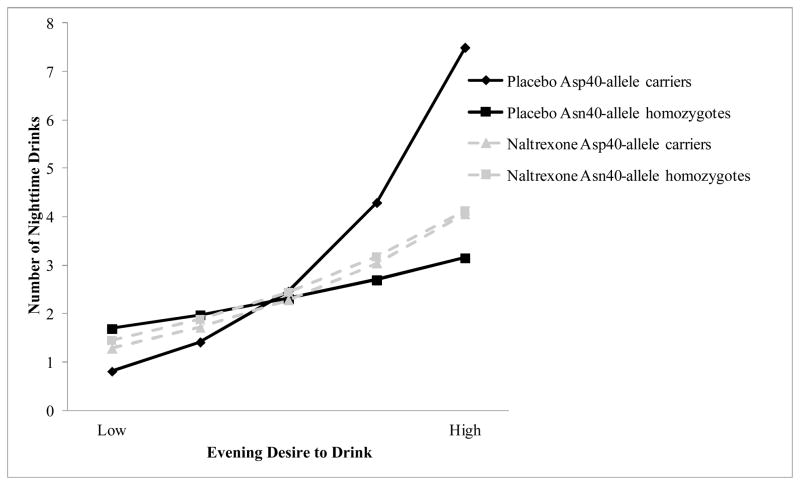
To evaluate the role of the functional Asn40Asp polymorphism in the mu-opioid receptor gene on drinking behavior and naltrexone's ability to attenuate drinking, we used a daily diary method in a 12-week, randomized clinical trial of naltrexone to reduce drinking. Participants (n = 158 problem drinkers) were assigned to receive either daily or targeted naltrexone 50 mg (n = 81) or matching placebo (n = 77). Patients reported by telephone each evening their current desire to drink and their drinking during the previous night and during the reporting day. We examined genotype, medication, desire to drink and their interactions as predictors of nighttime drinks consumed, controlling for drinking earlier in the day. Asp40 carriers showed a stronger positive association between evening desire (deviations from their mean levels) and later night drinking levels than Asn40 homozygotes (P = 0.019). The desire × genotype × medication condition interaction was also significant (P = 0.009), with a significant desire × genotype interaction for the placebo group (P = 0.001) but not for the naltrexone group (P = 0.74). In summary, when the evening level of desire to drink was relatively high, Asp40 allele carriers were at greater risk than Asn40 homozygotes to drink more, which was attenuated by naltrexone. Although average measures across the study were not informative, daily reports helped to demonstrate the moderating effects of genetic variation on the relation between desire to drink and alcohol consumption and the effects of naltrexone on that phenotype.
© 2012 The Authors, Addiction Biology © 2012 Society for the Study of Addiction.
Figures
References
-
- Anton RF, Oroszi G, O’Malley S, Couper D, Swift R, Pettinati H, Goldman D. An evaluation of mu-opioid receptor (OPRM1) as a predictor of naltrexone response in the treatment of alcohol dependence: results from the Combined Pharmacotherapies and Behavioral Interventions for Alcohol Dependence (COMBINE) study. Arch Gen Psychiatry. 2008;65:135–144. - PMC - PubMed
-
- Arias A, Feinn R, Kranzler HR. Association of an Asn40Asp (A118G) polymorphism in the mu-opioid receptor gene with substance dependence: a meta-analysis. Drug Alcohol Depend. 2006;83:262–268. - PubMed
-
- Armeli S, Tennen H, Affleck G, Kranzler HR. Does affect mediate the association between daily events and alcohol use? J Stud Alcohol. 2000;61:862–871. - PubMed
-
- Bergen AW, Kokoszka J, Peterson R, Long JC, Virkkunen M, Linnoila M, Goldman D. Mu-opioid receptor gene variants: lack of association with alcohol dependence. Mol Psychiatry. 1997;2:490–494. - PubMed
-
- Coller JK, Cahill S, Edmonds C, Farquharson AL, Longo M, Minniti R, Sullivan T, Somogyi AA, White JM. OPRM1 A118G genotype fails to predict the effectiveness of naltrexone treatment for alcohol dependence. Pharmacogenet Genomics. 2011;21:902–5. - PubMed
Publication types
MeSH terms
Substances
Grants and funding
LinkOut - more resources
Full Text Sources
Medical
Research Materials
