


Efficient (18)F-labeling of large 37-amino-acid pHLIP peptide analogues and their biological evaluation
- PMID: 22784215
- PMCID: PMC3529145
- DOI: 10.1021/bc3000222
Efficient (18)F-labeling of large 37-amino-acid pHLIP peptide analogues and their biological evaluation
Abstract
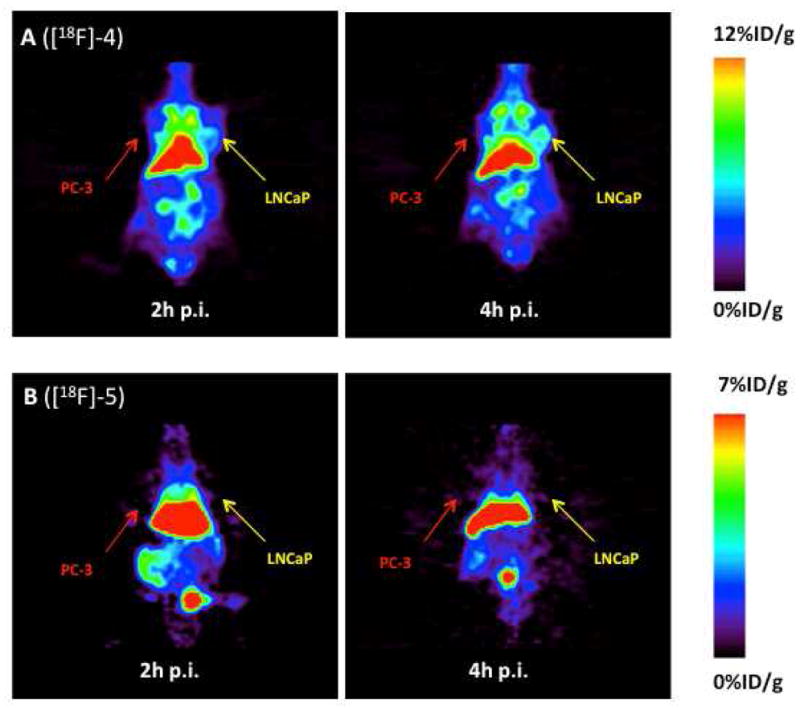
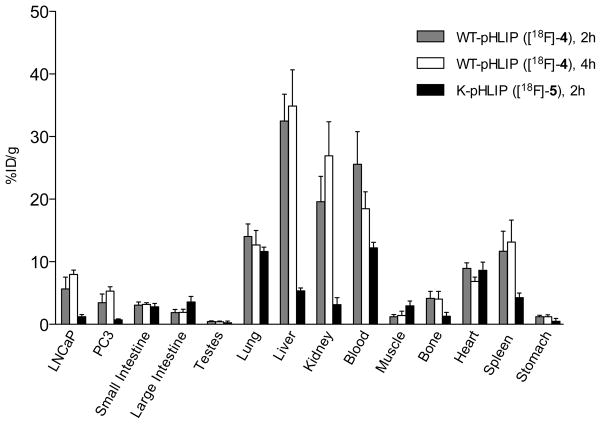
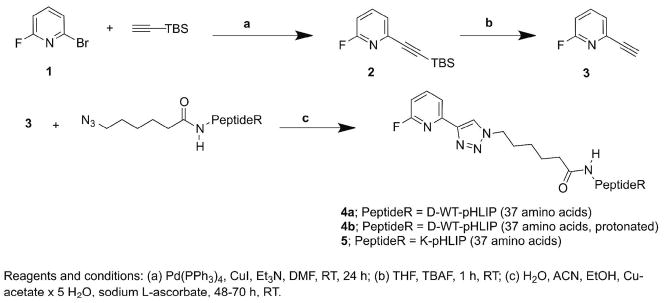
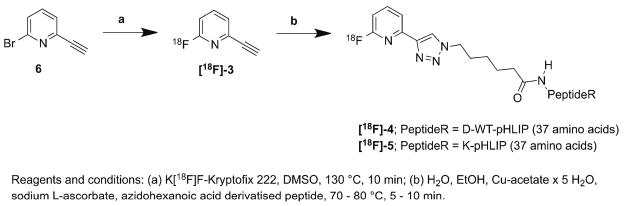
Solid tumors often develop an acidic microenvironment, which plays a critical role in tumor progression and is associated with increased level of invasion and metastasis. The 37-residue pH (low) insertion peptide (pHLIP) is under study as an imaging platform because of its unique ability to insert into cell membranes at a low extracellular pH (pH(e) < 7). Labeling of peptides with [(18)F]-fluorine is usually performed via prosthetic groups using chemoselective coupling reactions. One of the most successful procedures involves the alkyne-azide copper(I) catalyzed cycloaddition (CuAAC). However, none of the known "click" methods have been applied to peptides as large as pHLIP. We designed a novel prosthetic group and extended the use of the CuAAC "click chemistry" for the simple and efficient (18)F-labeling of large peptides. For the evaluation of this labeling approach, a D-amino acid analogue of WT-pHLIP and an L-amino acid control peptide K-pHLIP, both functionalized at the N-terminus with 6-azidohexanoic acid, were used. The novel 6-[(18)F]fluoro-2-ethynylpyridine prosthetic group, was obtained via nucleophilic substitution on the corresponding bromo-precursor after 10 min at 130 °C with a radiochemical yield of 27.5 ± 6.6% (decay corrected) with high radiochemical purity ≥98%. The subsequent Cu(I)-catalyzed "click" reaction with the azido functionalized pHLIP peptides was quantitative within 5 min at 70 °C in a mixture of water and ethanol using Cu-acetate and sodium L-ascorbate. [(18)F]-D-WT-pHLIP and [(18)F]-L-K-pHLIP were obtained with total radiochemical yields of 5-20% after HPLC purification. The total reaction time was 85 min including formulation. In vitro stability tests revealed high stability of the [(18)F]-D-WT-pHLIP in human and mouse plasma after 120 min, with the parent tracer remaining intact at 65% and 85%, respectively. PET imaging and biodistribution studies in LNCaP and PC-3 xenografted mice with the [(18)F]-D-WT-pHLIP and the negative control [(18)F]-L-K-pHLIP revealed pH-dependent tumor retention. This reliable and efficient protocol promises to be useful for the (18)F-labeling of large peptides such as pHLIP and will accelerate the evaluation of numerous [(18)F]-pHLIP analogues as potential PET tracers.
Figures
References
-
- Bild AH, Potti A, Nevins JR. Linking oncogenic pathways with therapeutic opportunities. Nat Rev Cancer. 2006;6(9):735–741. - PubMed
-
- Gillies RJ. Causes and consequences of hypoxia and acidity in tumors. Novartis Foundation symposium. Trends Mol Med. 2001;7(2):47–49. - PubMed
-
- Cairns R, Papandreou I, Denko N. Overcoming physiologic barriers to cancer treatment by molecularly targeting the tumor microenvironment. Molecular cancer research : MCR. 2006;4(2):61–70. - PubMed
-
- Hunt JF, Rath P, Rothschild KJ, Engelman DM. Spontaneous, pH-dependent membrane insertion of a transbilayer alpha-helix. Biochemistry. 1997;36(49):15177–15192. - PubMed
Publication types
MeSH terms
Substances
Grants and funding
LinkOut - more resources
Full Text Sources
Other Literature Sources
