


Effects of ketamine in treatment-refractory obsessive-compulsive disorder
- PMID: 22784486
- PMCID: PMC3667652
- DOI: 10.1016/j.biopsych.2012.05.028
Effects of ketamine in treatment-refractory obsessive-compulsive disorder
Abstract
Background: Treatments for obsessive-compulsive disorder (OCD) usually lead to incomplete symptom relief and take a long-time to reach full effect. Convergent evidence suggests that glutamate abnormalities contribute to the pathogenesis of OCD. Ketamine is a potent noncompetitive antagonist of the N-methyl-D-aspartate glutamate receptor. Trials have reported rapid antidepressant effects after low-dose ketamine infusion.
Methods: We conducted an open-label trial of ketamine (.5 mg/kg IV over 40 min) in 10 subjects with treatment-refractory OCD. Response was defined as >35% improvement in OCD symptoms and >50% improvement in depression symptoms from baseline at any time between 1 and 3 days after infusion.
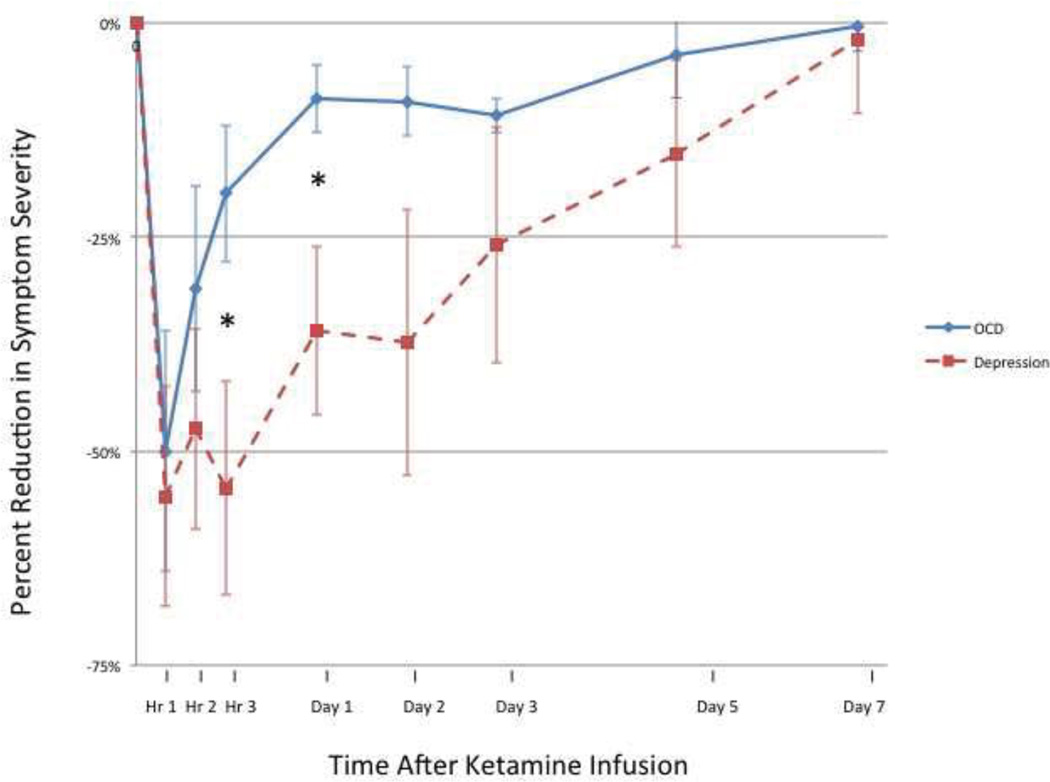
Results: None of 10 subjects experienced a response in OCD symptoms in the first 3 days after ketamine. Four of seven patients with comorbid depression experienced an antidepressant response to ketamine in the first 3 days after infusion. Both OCD and depression symptoms demonstrated a statistically significant improvement in the first 3 days after infusion compared with baseline, but the OCD response was <12%. The percentage reduction in depressive symptoms in the first 3 days after ketamine infusion was significantly greater than the reduction in OCD symptoms.
Conclusions: Ketamine effects on OCD symptoms, in contrast to depressive symptoms, did not seem to persist or progress after the acute effects of ketamine had dissipated.
Copyright © 2012 Society of Biological Psychiatry. Published by Elsevier Inc. All rights reserved.
Conflict of interest statement
All other authors report no biomedical financial interests or potential conflicts of interest.
Figures
References
-
- Foa EB, Liebowitz MR, Kozak MJ, Davies S, Campeas R, Franklin ME, et al. Randomized, placebo-controlled trial of exposure and ritual prevention, clomipramine, and their combination in the treatment of obsessive-compulsive disorder. Am J Psychiatry. 2005;162(1):151–161. - PubMed
-
- Bloch MH, Landeros-Weisenberger A, Kelmendi B, Coric V, Bracken MB, Leckman JF. A systematic review: antipsychotic augmentation with treatment refractory obsessive-compulsive disorder. Mol Psychiatry. 2006;11(7):622–632. - PubMed
-
- Bollini P, Pampallona S, Tibaldi G, Kupelnick B, Munizza C. Effectiveness of antidepressants. Meta-analysis of dose-effect relationships in randomised clinical trials. Br J Psychiatry. 1999;174:297–303. - PubMed
MeSH terms
Substances
Grants and funding
LinkOut - more resources
Full Text Sources
Other Literature Sources
Medical
