. 2012 Oct;108(7):1977-87.
doi: 10.1152/jn.00905.2011. Epub 2012 Jul 11.

Song tutoring in presinging zebra finch juveniles biases a small population of higher-order song-selective neurons toward the tutor song

Affiliations

Song tutoring in presinging zebra finch juveniles biases a small population of higher-order song-selective neurons toward the tutor song

Patrice Adret et al. J Neurophysiol. 2012 Oct.

Abstract

We explored physiological changes correlated with song tutoring by recording the responses of caudal nidopallium neurons of zebra finches aged P21-P24 (days post hatching) to a broad spectrum of natural and synthetic stimuli. Those birds raised with their fathers tended to show behavioral evidence of song memorization but not of singing; thus auditory responses were not confounded by the birds' own vocalizations. In study 1, 37 of 158 neurons (23%) in 17 of 22 tutored and untutored birds were selective for only 1 of 10 stimuli comprising broadband signals, early juvenile songs and calls, female calls, and adult songs. Approximately 30% of the selective neurons (12/37 neurons in 9 birds) were selective for adult conspecific songs. All these were found in the song system nuclei HVC and paraHVC. Of 122 neurons (17 birds) in tutored birds, all of the conspecific song-selective neurons (8 neurons in 6 birds) were selective for the adult tutor song; none was selective for unfamiliar song. In study 2 with a different sampling strategy, we found that 11 of 12 song-selective neurons in 6 of 7 birds preferred the tutor song; none preferred unfamiliar or familiar conspecific songs. Most of these neurons were found in caudal lateral nidopallium (NCL) below HVC. Thus by the time a bird begins to sing, there are small numbers of tutor song-selective neurons distributed in several forebrain regions. We hypothesize that a small population of higher-order auditory neurons is innately selective for complex features of behaviorally relevant stimuli and these responses are modified by specific perceptual/social experience during development.


Figures
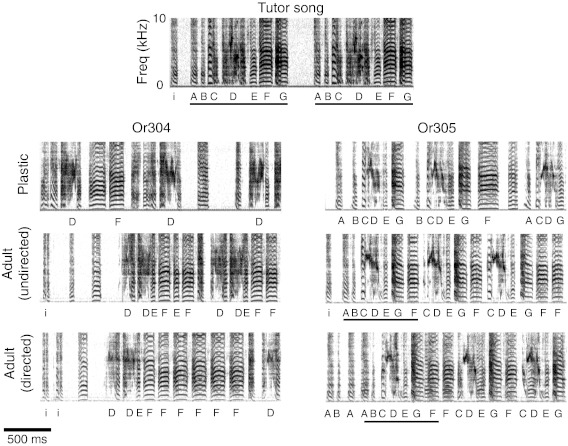
Fig. 1.
Fig. 1.
Song imitation from limited exposure to a live tutor: songs of 2 sibling juveniles that were exposed to their father's singing until P25 and then isolated. Two versions of the final adult songs that the juveniles developed are shown, the song sung in isolation (“undirected”) and the song sung in the presence of a female (“directed”), as well as an exemplar of developmental plastic singing. Each syllable of the tutor song (model) is labeled; there are many corresponding syllables, which are labeled in the offspring's songs. Tutee Or305 copied the entire tutor song; imitation of complex syllable D was imperfect. The song syntax was close to the model, with only a temporal inversion for syllables F and G and omission of syllables A and B from some motifs (song matching index: 86%). Tutee Or304 copied the model's introductory note (i) as well as 3 syllables, all produced with the correct syntax; imitation of complex syllable D was imperfect (song matching index: 34%).
Fig. 2.
Fig. 2.
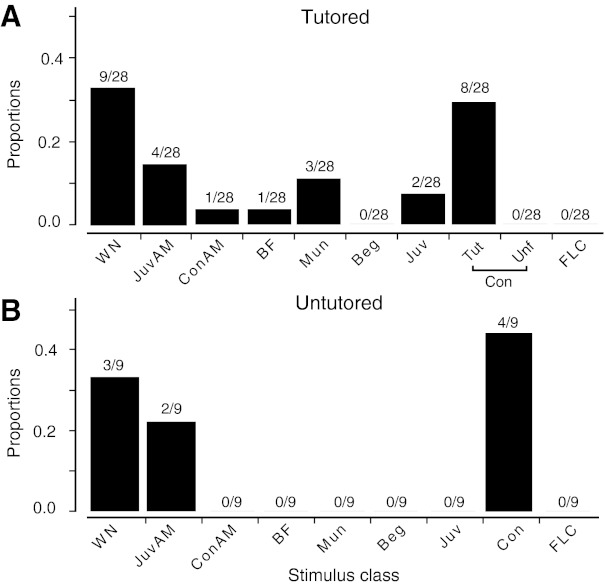
Distribution of stimulus preference among selective neurons in tutored and untutored birds. A: proportion of 28 selective neurons from tutored birds selective for a given stimulus class. All 8 neurons selective for Con were selective for the song of the bird's tutor. B: 9 selective neurons from untutored birds. All 4 Con-selective neurons were selective for 1 of 2 unfamiliar songs.
Fig. 3.
Fig. 3.
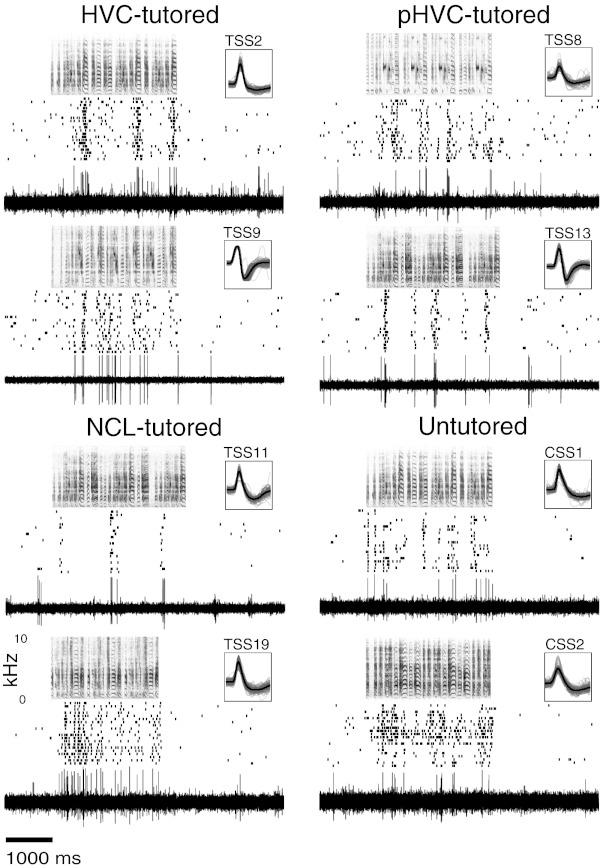
Responses of conspecific song-selective (CSS) neurons in the caudal nidopallium of tutored and untutored young birds from studies 1 and 2: extracellular activity recorded from exemplar neurons drawn from recordings in HVC, paraHVC (pHVC), and caudal lateral nidopallium (NCL) in response to the song of the bird's tutor [for tutor song-selective (TSS) neurons] or to the song of a conspecific male (CSS neurons). All CSS neurons were recorded in birds that were untutored; no units in any tutored bird were selective for conspecific song other than the tutor's. Responses are shown as rasters of spike times and raw electrical activity. Insets (scale 2.4 ms) show 100 random spike waveforms (gray traces) and mean (black trace). One unit (TSS9) had excellent isolation and clipped during recording; inset shows the first 100 spikes, when clipping was minimal. Labels for the TSS units correspond to numbers in Fig. 4 (TSS2 and 8) and Fig. 6 (TSS9, 11, 13, 19). On the basis of stereotaxic coordinates the CSS cells in untutored birds were recorded in the same vicinity as TSS cells in tutored birds, but lesions unambiguously identifying the locations of the CSS cells were not recovered.
Fig. 4.
Fig. 4.
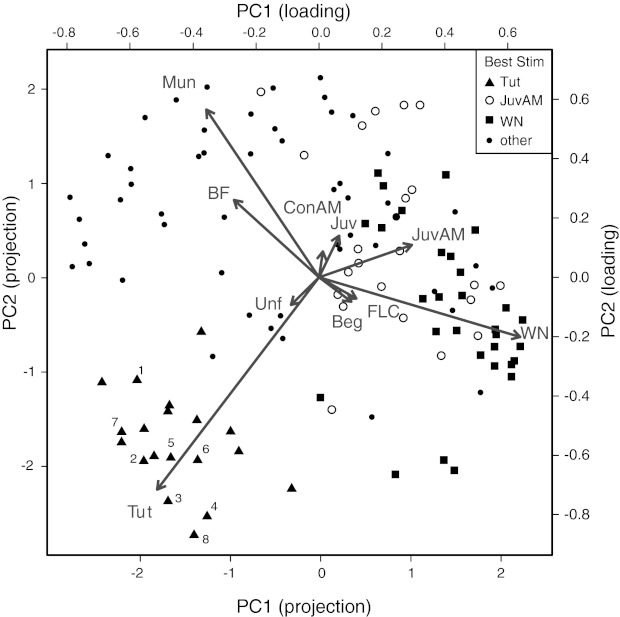
Population selectivity of neurons in tutored birds. Each neuron's response to the test stimuli can be represented by a 10-dimensional vector, which is reduced to 2 dimensions by principal component analysis. Each point represents the projection of a neuron along the first 2 principal components (PCs) (PC1, PC2). The loadings of each class in the first 2 PCs are plotted as arrows labeled with the name of the class. Clustering in the PC space indicates that neurons respond similarly to the same stimuli, and the position of points relative to the loading arrows indicates which stimuli evoked strong responses for those neurons. Arrow length indicates the variance in responses to a given stimulus, and angles between arrows indicate the correlation in responses to the 2 stimuli. For example, neurons tended to respond similarly to WN and JuvAM (low population selectivity) but differently to Tut and WN (high population selectivity). Neurons were categorized by the stimulus that evoked the largest response. Neurons preferring the top 3 classes of stimuli are indicated by different symbols. Values for the projections and loadings are indicated on bottom and left and top and right axes, respectively. Neurons that were significantly selective (d′ > 0.77) for the tutor song over all other stimuli (TSS) are numbered. The proportion of the total variance explained by the first 2 PCs was 44%.
Fig. 5.
Fig. 5.
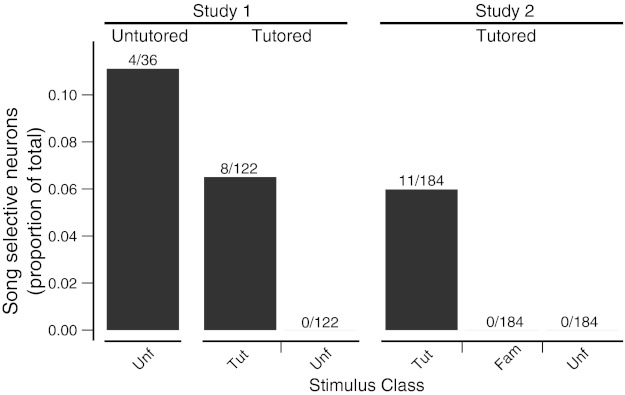
Proportion of neurons selective for conspecific song from the 2 conditions of study 1 and from study 2. Neurons are subdivided according to which class of conspecific song they preferred (unfamiliar, familiar, tutor). Proportions are relative to the total number of auditory units (for study 2, this is based on assuming a similar yield of single units from sites that were not conspecific song selective; see results).
Fig. 6.
Fig. 6.
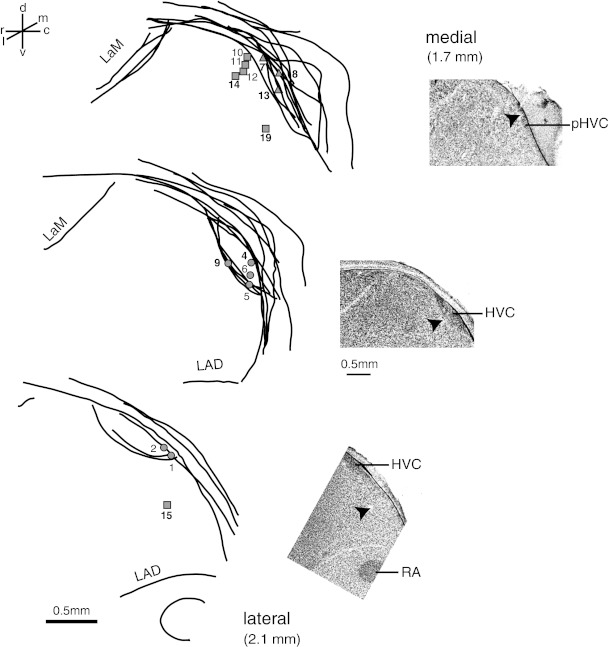
Anatomical reconstruction of recording sites selective for the tutor song in the caudal nidopallium. The composite illustration shows superimposed outlines of structures and landmarks that were drawn from 40-μm-thick sagittal sections. The loci of 15 recovered sites (of 19 total—TSS neurons 3, 16, 17, and 18 were >300 μm from the nearest fiduciary lesion and are not shown) where TSS cells were recorded are shown by different symbols. Sites 1–8 are from study 1; sites 9–19 were from study 2. Sites were located in HVC (6 sites; circles), paraHVC (3 sites; triangles) and deeper nidopallium (6 sites; squares). Numerical labels correspond to cell numbers in Table 1. Sites with bold numerals were localized from electrolytic lesions made at the site. Examples of lesions outside of HVC are shown with arrowheads in the micrographs at right. LaM, lamina mesopallialis; LAD, lamina arcopallialis dorsalis.

References

    1. Adret P. Operant conditioning, song learning and imprinting to taped song in the zebra finch. Anim Behav 45: 149–159, 1993
    1. Adret P. The template concept: crafting a song replica from memory. In: Neuroscience of Birdsong, edited by Zeigler HP, Marler P. Cambridge, UK: Cambridge Univ. Press, 2008, p. 282–299
    1. Aronov D, Andalman AS, Fee MS. A specialized forebrain circuit for vocal babbling in the juvenile songbird. Science 320: 630–634, 2008 - PubMed
    1. Baptista LF, Petrinovich L. Social interaction, sensitive phases and the song template hypothesis in the white-crowned sparrow. Anim Behav 32: 172–181, 1984
    1. Basham ME, Nordeen EJ, Nordeen KW. Blockade of NMDA receptors in the anterior forebrain impairs sensory acquisition in the zebra finch (Poephila guttata). Neurobiol Learn Mem 66: 295–304, 1996 - PubMed

Publication types

LinkOut - more resources