


Inter-language interference in VOT production by L2-dominant bilinguals: Asymmetries in phonetic code-switching
- PMID: 22787285
- PMCID: PMC3391600
- DOI: 10.1016/j.wocn.2011.03.001
Inter-language interference in VOT production by L2-dominant bilinguals: Asymmetries in phonetic code-switching
Abstract
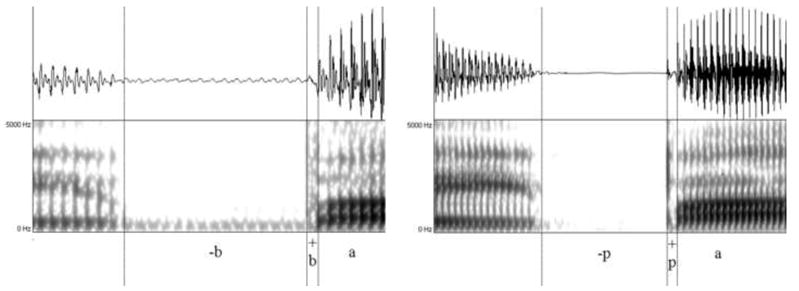
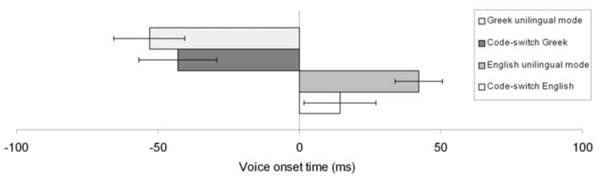
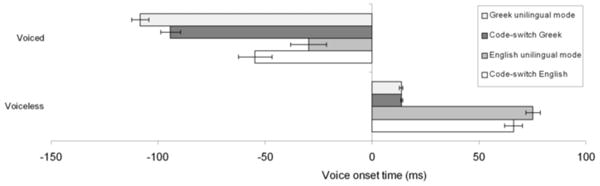
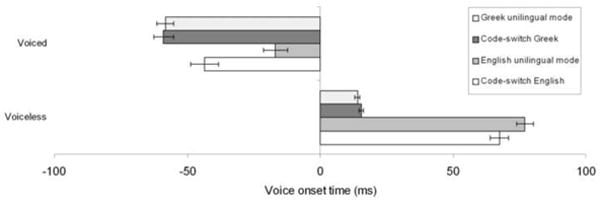
Speech production research has demonstrated that the first language (L1) often interferes with production in bilinguals' second language (L2), but it has been suggested that bilinguals who are L2-dominant are the most likely to suppress this L1-interference. While prolonged contextual changes in bilinguals' language use (e.g., stays overseas) are known to result in L1 and L2 phonetic shifts, code-switching provides the unique opportunity of observing the immediate phonetic effects of L1-L2 interaction. We measured the voice onset times (VOTs) of Greek-English bilinguals' productions of /b, d, p, t/ in initial and medial contexts, first in either a Greek or English unilingual mode, and in a later session when they produced the same target pseudowords as a code-switch from the opposing language. Compared to a unilingual mode, all English stops produced as code-switches from Greek, regardless of context, had more Greek-like VOTs. In contrast, Greek stops showed no shift toward English VOTs, with the exception of medial voiced stops. Under the specifically interlanguage condition of code-switching we have demonstrated a pervasive influence of the L1 even in L2-dominant individuals.
Figures
References
-
- Altarriba J, Kroll JF, Sholl A, Rayner K. The influence of lexical and conceptual constraints on reading mixed-language sentences: Evidence from eye fixations and naming times. Memory & Cognition. 1996;24:477–492. - PubMed
-
- Appel R, Muysken P. Language contact and bilingualism. Baltimore: Edward Arnold; 1987.
-
- Arvaniti A, Joseph BD. Variation in voiced stop prenasalization in Greek. Glossologia. 2000;11-12:131–166.
-
- Baetens Beardsmore H. Bilingualism: Basic principles. Clevedon: Multilingual Matters; 1986.
Grants and funding
LinkOut - more resources
Full Text Sources