


Improving Medication Adherence through Graphically Enhanced Interventions in Coronary Heart Disease (IMAGE-CHD): a randomized controlled trial
- PMID: 22790614
- PMCID: PMC3509298
- DOI: 10.1007/s11606-012-2136-z
Improving Medication Adherence through Graphically Enhanced Interventions in Coronary Heart Disease (IMAGE-CHD): a randomized controlled trial
Abstract
Background: Up to 50 % of patients do not take medications as prescribed. Interventions to improve adherence are needed, with an understanding of which patients benefit most.
Objective: To test the effect of two low-literacy interventions on medication adherence.
Design: Randomized controlled trial, 2 × 2 factorial design.
Participants: Adults with coronary heart disease in an inner-city primary care clinic.
Interventions: For 1 year, patients received usual care, refill reminder postcards, illustrated daily medication schedules, or both interventions.
Main measures: The primary outcome was cardiovascular medication refill adherence, assessed by the cumulative medication gap (CMG). Patients with CMG<0.20 were considered adherent. We assessed the effect of the interventions overall and, post-hoc, in subgroups of interest.
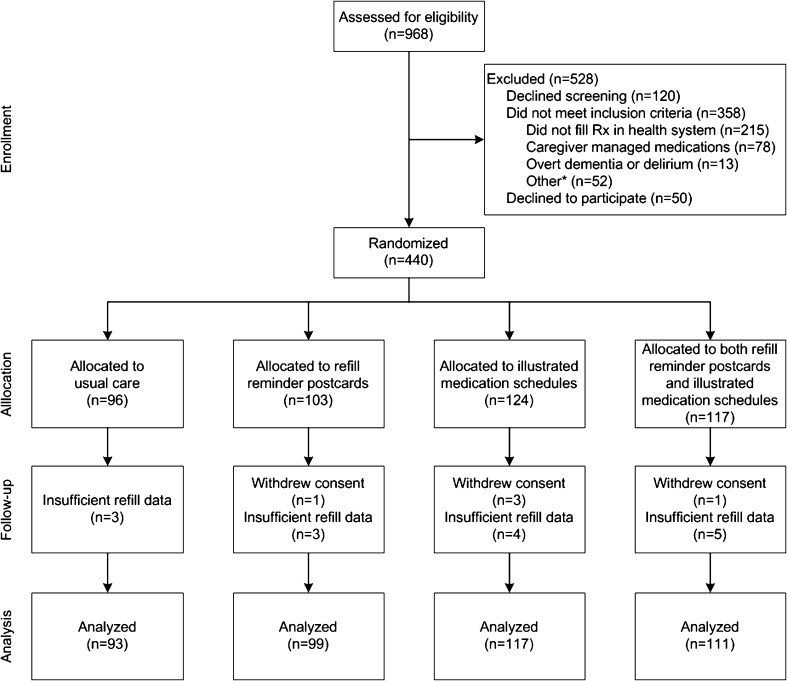
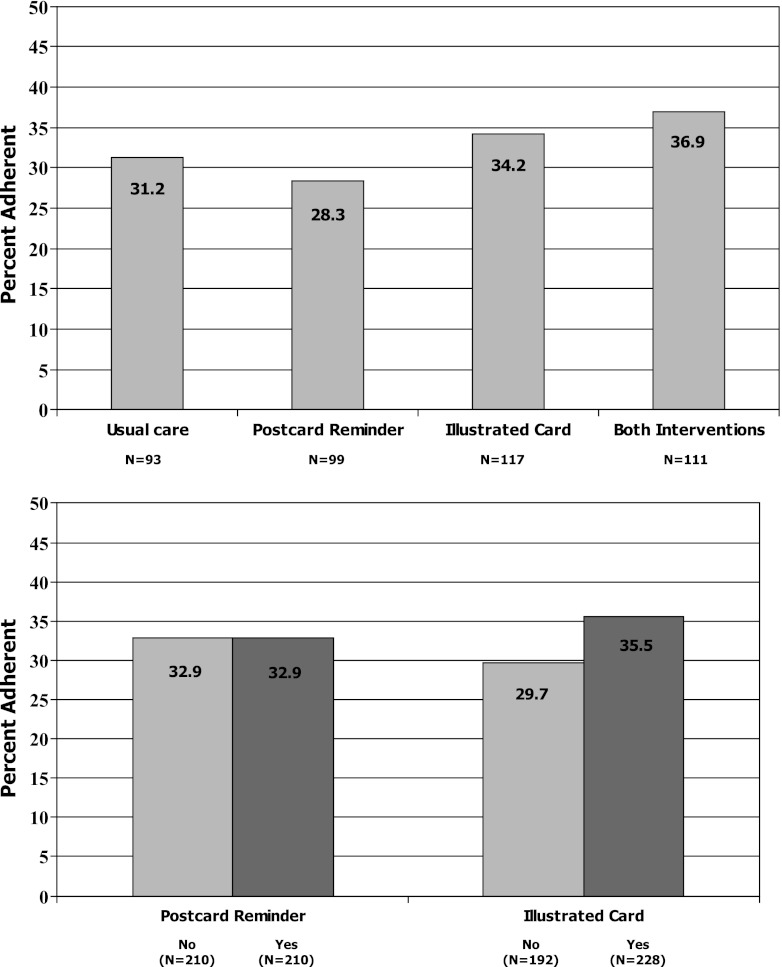
Key results: Most of the 435 participants were elderly (mean age=63.7 years), African-American (91 %), and read below the 9th-grade level (78 %). Among the 420 subjects (97 %) for whom CMG could be calculated, 138 (32.9 %) had CMG<0.20 during follow-up and were considered adherent. Overall, adherence did not differ significantly across treatments: 31.2 % in usual care, 28.3 % with mailed refill reminders, 34.2 % with illustrated medication schedules, and 36.9 % with both interventions. In post-hoc analyses, illustrated medication schedules led to significantly greater odds of adherence among patients who at baseline had more than eight medications (OR=2.2; 95 % CI, 1.21 to 4.04) or low self-efficacy for managing medications (OR=2.15; 95 % CI, 1.11 to 4.16); a trend was present among patients who reported non-adherence at baseline (OR=1.89; 95 % CI, 0.99 to 3.60).
Conclusions: The interventions did not improve adherence overall. Illustrated medication schedules may improve adherence among patients with low self-efficacy, polypharmacy, or baseline non-adherence, though this requires confirmation.
Figures


References
-
- Smith SC, Jr, Allen J, Blair SN, et al. AHA/ACC guidelines for secondary prevention for patients with coronary and other atherosclerotic vascular disease: 2006 update: endorsed by the National Heart, Lung, and Blood Institute. Circulation. 2006;113(19):2363–2372. doi: 10.1161/CIRCULATIONAHA.106.174516. - DOI - PubMed
Publication types
MeSH terms
Substances
LinkOut - more resources
Full Text Sources
Medical
Miscellaneous
