. 2012 Sep;113(1-3):207-19.
doi: 10.1007/s11120-012-9756-3. Epub 2012 Jul 13.

Interaction of temperature and irradiance effects on photosynthetic acclimation in two accessions of Arabidopsis thaliana

Affiliations

Interaction of temperature and irradiance effects on photosynthetic acclimation in two accessions of Arabidopsis thaliana

Thijs L Pons. Photosynth Res. 2012 Sep.

Abstract

The effect of temperature and irradiance during growth on photosynthetic traits of two accessions of Arabidopsis thaliana was investigated. Plants were grown at 10 and 22 °C, and at 50 and 300 μmol photons m(-2) s(-1) in a factorial design. As known from other cold-tolerant herbaceous species, growth of Arabidopsis at low temperature resulted in increases in photosynthetic capacity per unit leaf area and chlorophyll. Growth at high irradiance had a similar effect. However, the growth temperature and irradiance showed interacting effects for several capacity-related variables. Temperature effects on the ratio between electron transport capacity and carboxylation capacity were also different in low compared to high irradiance grown Arabidopsis. The carboxylation capacity per unit Rubisco, a measure for the in vivo Rubisco activity, was low in low irradiance grown plants but there was no clear growth temperature effect. The limitation of photosynthesis by the utilization of triose-phosphate in high temperature grown plants was less when grown at low compared to high irradiance. Several of these traits contribute to reduced efficiency of the utilization of resources for photosynthesis of Arabidopsis at low irradiance. The two accessions from contrasting climates showed remarkably similar capabilities of developmental acclimation to the two environmental factors. Hence, no evidence was found for photosynthetic adaptation of the photosynthetic apparatus to specific climatic conditions.


Figures
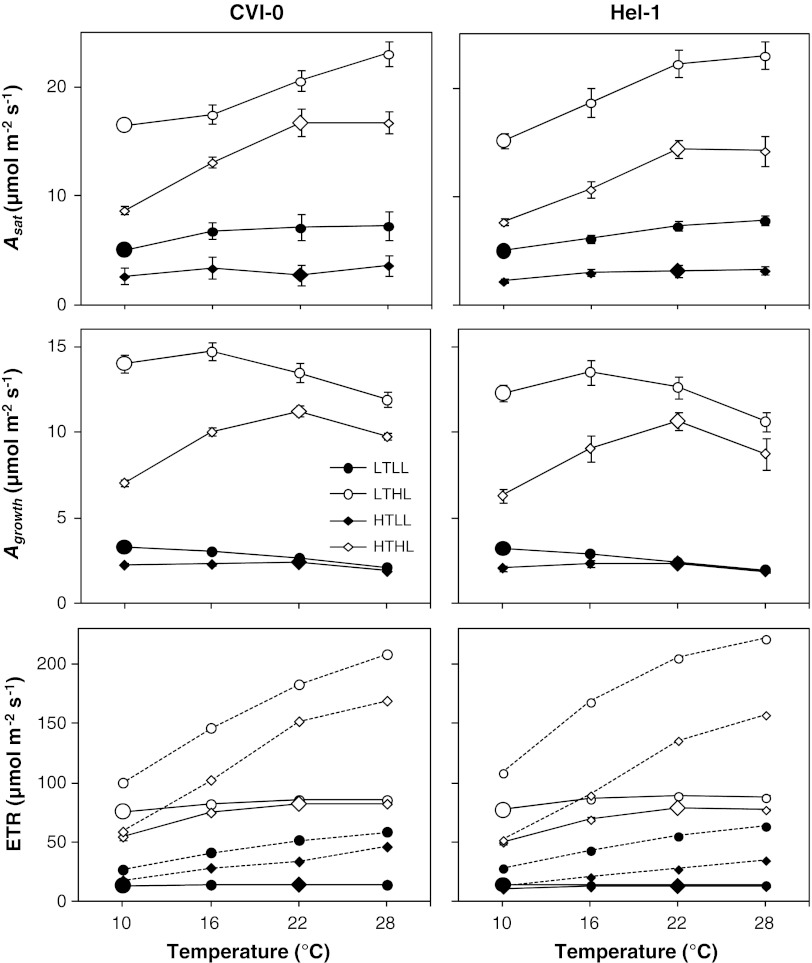
Fig. 1
Fig. 1
Temperature effects on photosynthesis per unit leaf area of leaves of two Arabidopsis accessions (CVI-0 and Hel-1) grown at temperatures of 10 and 22 °C and irradiances of 50 and 300 μmol photons m−2 s−1. The light saturated rate of CO2 assimilation (A sat), the net CO2 assimilation rate at the growth irradiance (A growth), and the electron transport rate (ETR) at the growth irradiance (continuous line) and at saturating irradiance (dashed line) are shown. Means (n = 4) are shown, in the case of A sat and A growth with SE but for ETR without. Abbreviations of the treatments as indicated in the legend are LTLL (low temperature and low irradiance), LTHL (low temperature and high irradiance), HTLL (high temperature and low irradiance), HTHL (high temperature and high irradiance). Large symbols refer to measurements at the growth temperature
Fig. 2
Fig. 2
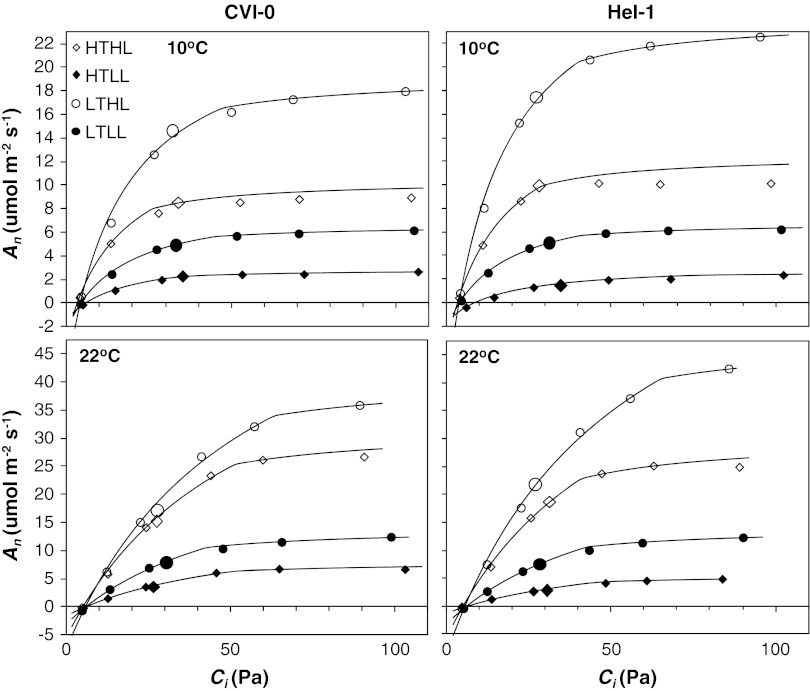
The response of net photosynthesis (A n) to the intercellular CO2 partial pressure (C i) measured at 10 °C (upper panels) and 22 °C (lower panels). A representative example (from n = 3) is shown for all treatment combinations and the two Arabidopsis accessions CVI-0 and Hel-1. Large symbols refer to measurements at ambient CO2 (38 Pa). The data were fitted to the model of Farquhar et al. (1980) to derive values for J max and V Cmax and to draw the lines as shown
Fig. 3
Fig. 3
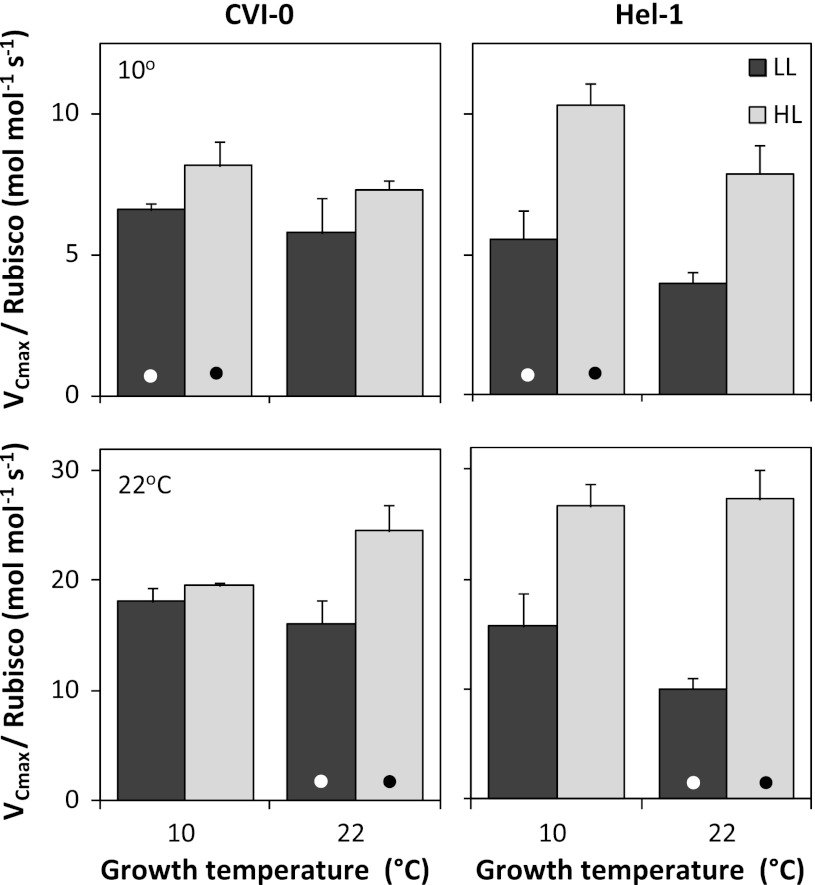
The carboxylation capacity (V Cmax) expressed per unit Rubisco measured at 10 °C (upper panels) and 22 °C (lower panels). The Arabidopsis accession CVI-0 and Hel-1 were grown at temperatures of 10 °C and 22 °C and irradiances of 50 (LL) and 300 (HL) μmol photons m−2 s−1. Means + SE are shown (n = 3). The dots indicate measurements at the growth temperatures
Fig. 4
Fig. 4
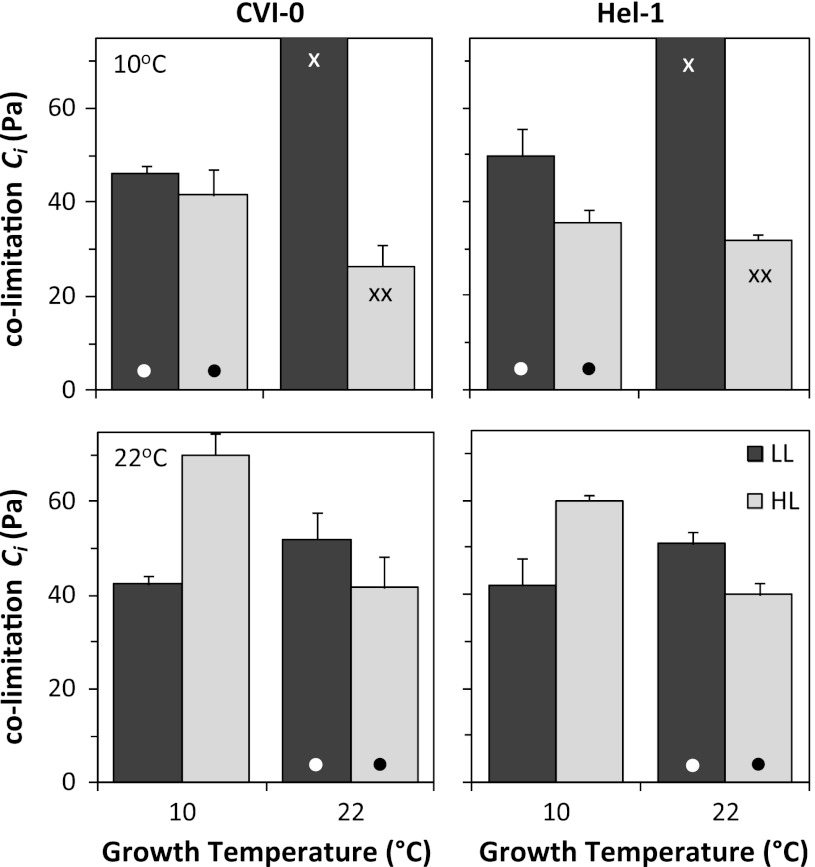
The intercellular CO2 partial pressure (C i) where photosynthesis is co-limited by carboxylation capacity and the regeneration of RuBP (co-limitation C i) measured at 10 °C (upper panels) and 22 °C (lower panels). The Arabidopsis accession CVI-0 and Hel-1 were grown at temperatures of 10 and 22 °C and irradiances of 50 (LL) and 300 (HL) μmol photons m−2 s−1. Means + SE (n = 3) are shown. The dots refer to measurements at the growth temperatures; the single crosses indicate that J max could not be reliably estimated meaning that the co-limitation C i was high; the double crosses indicate where photosynthesis at the co-limitation C i was not limited by V Cmax and J max but by V Cmax and TPU
Fig. 5
Fig. 5
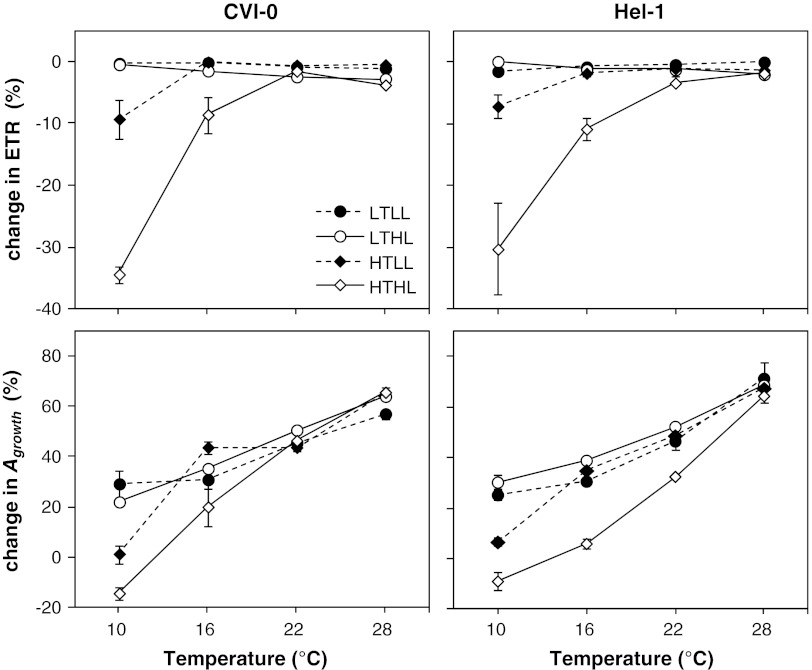
Temperature dependence of the change in photosynthetic rate as a result of a decrease in [O2] from 21 % (atmospheric) to 1 % (mean ± SE; n = 4). The electron transport rate (ETR; upper panels) and the CO2 assimilation rate at the growth irradiance (A growth; lower panels) are shown. When limitation by triose-phosphate utilization (TPU) does not play a role, the A growth and ETR are expected to increase and to remain constant, respectively. Symbols and treatments as in Fig. 1

References

    1. Anderson JM, Chow WS, Park YI. The grand design of photosynthesis: acclimation of the photosynthetic apparatus to environmental cues. Photosynth Res. 1995;46:129–139. doi: 10.1007/BF00020423. - DOI - PubMed
    1. Athanasiou K, Dyson BC, Webster RE, Johnson GN. Dynamic acclimation of photosynthesis increases plant fitness in changing environments. Plant Physiol. 2010;152:366–373. doi: 10.1104/pp.109.149351. - DOI - PMC - PubMed
    1. Atkin OK, Scheurwater I, Pons TL. High thermal acclimation potential of both photosynthesis and respiration in two lowland Plantago species in contrast to an alpine congeneric. Global Change Biol. 2006;12:500–515. doi: 10.1111/j.1365-2486.2006.01114.x. - DOI
    1. Bailey S, Horton P, Walters RG. Acclimation of Arabidopsis thaliana to the light environment: the relationship between photosynthetic function and chloroplast composition. Planta. 2004;218:793–802. doi: 10.1007/s00425-003-1158-5. - DOI - PubMed
    1. Bernacchi CJ, Portis AR, Nakano H, von Caemmerer S, Long SP. Temperature response of mesophyll conductance. Implications for the determination of Rubisco enzyme kinetics and for limitations to photosynthesis in vivo. Plant Physiol. 2002;130:1992–1998. doi: 10.1104/pp.008250. - DOI - PMC - PubMed