


Health behaviors, readiness to change, and interest in health promotion programs among smokers with lung cancer and their family members: a pilot study
- PMID: 22791213
- PMCID: PMC4729371
- DOI: 10.1097/NCC.0b013e31825e4359
Health behaviors, readiness to change, and interest in health promotion programs among smokers with lung cancer and their family members: a pilot study
Abstract
Background: The diagnosis of lung cancer presents an opportunity to motivate individuals to adopt health-promoting behavior. Little attention has been given to using this opportunity to also motivate relatives to change their health behaviors.
Objectives: The objectives of this study were to describe health behaviors and readiness to change lifestyle, identify interest in health promotion programs, and examine concordance of health behaviors among smokers with lung cancer and their family members.
Methods: Cross-sectional data were collected once from 37 lung cancer patient-family member dyads. Standardized questionnaires were used to collect data. Descriptive statistics and percent agreement were used for analyses.
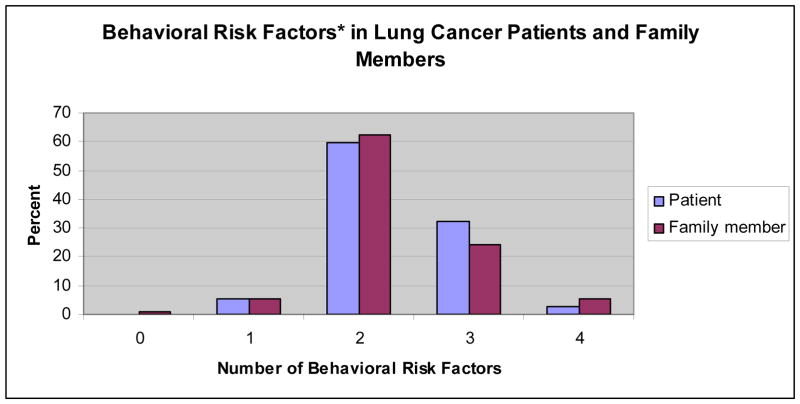
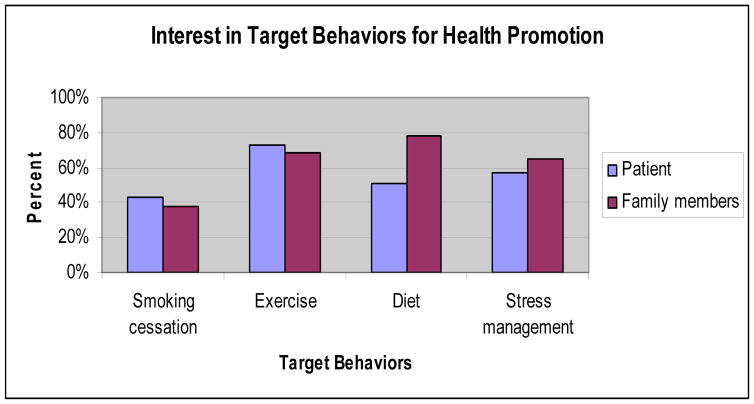
Results: Lung cancer patients and their family members had high rates of continued smoking (43% vs 30%), low intake of fruits and vegetables (92% vs 95%), and high rates of physical inactivity (84% vs 84%). Patients and family members indicated readiness to change behaviors within the next 6 months ranging from 63% for physical activity, 73% for diet, and 88% to quit smoking for patients and 81% for physical activity, 58% for diet, and 91% to quit smoking for family members. Interest in participating in a multiple behavioral risk reduction program was high for patients and family members.
Conclusions: The majority of patients and their family members have multiple behavioral risk factors placing them at risk for poor health outcomes.
Implications for practice: Oncology nurses are in a unique position to provide leadership in assessing health behaviors and implementing evidence-based interventions to enhance outcomes for patient-family member dyads with lung cancer.
Conflict of interest statement
The authors have no conflicts of interest to disclose.
Figures
References
-
- Siegel R, Ward E, Brawley O, Jemal A. Cancer statistics, 2011: the impact of eliminating socioeconomic and racial disparities on premature cancer deaths. CA Cancer J Clin. 2011;61(4):212–236. - PubMed
-
- CDC. Cigarette smoking among adults- United States 2006. Morbidity and Mortality Weekly Report. 2006;56:1157–1161. - PubMed
-
- Fox JL, Rosenzweig KE, Ostroff JS. The effect of smoking status on survival following radiation therapy for non-small cell lung cancer. Lung Cancer. 2004;44(3):287–293. - PubMed
-
- Tucker MA, Murray N, Shaw EG, et al. Second primary cancers related to smoking and treatment of small-cell lung cancer. Lung Cancer Working Cadre. J Natl Cancer Inst. 1997;89(23):1782–1788. - PubMed
Publication types
MeSH terms
Grants and funding
LinkOut - more resources
Full Text Sources
Other Literature Sources
Medical
