Comparative Study
. 2012 Sep 20;120(12):2493-500.
doi: 10.1182/blood-2012-05-430629. Epub 2012 Jul 12.

Munc18b/STXBP2 is required for platelet secretion

Affiliations
Comparative Study

Munc18b/STXBP2 is required for platelet secretion

Rania Al Hawas et al. Blood. .

Abstract

Platelets are vital for hemostasis because they release their granule contents in response to vascular damage. Platelet exocytosis is mediated by soluble N-ethylmaleimide-sensitive factor attachment protein receptors (SNAREs), whose interactions are governed by regulators, eg, Sec/Munc18 proteins. These proteins chaperone syntaxin t-SNAREs and are required for exocytosis. Platelets contain 3 Munc18 isoforms: Munc18a, Munc18b, and Munc18c. We report that Munc18b is the major isoform and is required for platelet secretion. Familial hemophagocytic lymphohistiocytosis type 5 (FHL5) is caused by defects in the Munc18b/STXBP2 gene. We confirm a previous report showing that platelets from FHL5 patients have defective secretion. Serotonin, ADP/ATP, and platelet factor 4 release was profoundly affected in the 2 biallelic patients and partially in a heterozygous patient. Release of lysosomal contents was only affected in the biallelic platelets. Platelets from the FHL5 biallelic patients showed decreased Munc18b and syntaxin-11 levels were significantly reduced; other syntaxins were unaffected. Munc18b formed complexes with syntaxin-11, SNAP-23, and vesicle-associated membrane protein-8 in human platelets. Other potential secretion regulators, Munc13-4 and Rab27, were also found associated. These data demonstrate a key role for Munc18b, perhaps as a limiting factor, in platelet exocytosis and suggest that it regulates syntaxin-11.


Figures
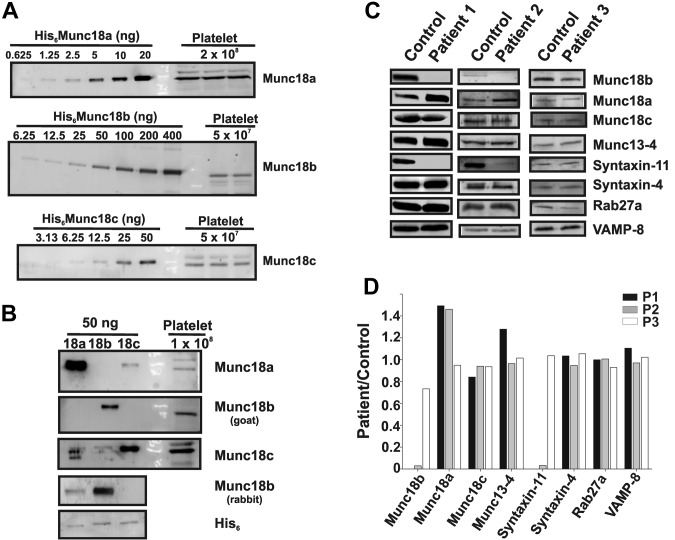
Figure 1
Figure 1
Munc18b is the major Munc18 isoform in platelets and is missing in platelets from FHL5/Munc18b/STXBP2 patients. Recombinant Munc18a, b, and c were used to generate a standard curve for quantification (using ECF Western blotting) of each Munc18 isoforms in the indicated number of human platelets (A). Equal amounts of each Munc18 isoform were subjected to Western blotting with the antibodies used in this study to evaluate their cross-reactivity (B). Platelet extracts (1.0-2.0 × 10⁷ platelets/lane) from control and FHL5 patients were probed by Western blotting with the indicated antibodies (C), and the ratio of patient to control levels of each protein was calculated and graphed (D).
Figure 2
Figure 2
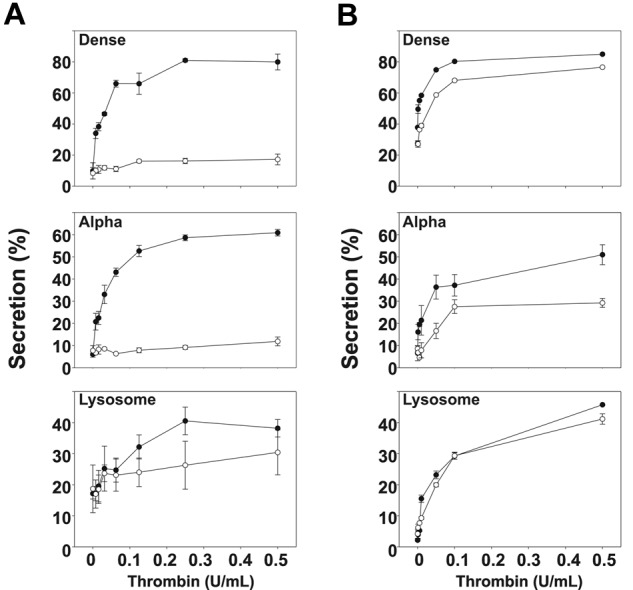
Platelets from FHL5/Munc18b/STXBP2 patients have a secretion defect. Platelet-rich plasma was generated by centrifugation and labeled with [3H]-serotonin. After washing, platelets were stimulated with increasing concentrations of thrombin for 1 minute, and then the release of [3H]-serotonin (Dense), PF4 (Alpha), and β-hexosaminidase (Lysosomes) were measured as described under “Platelet secretion analysis” (A and B). (A) Release profiles for biallelic patient 1 (open symbols) and a normal control (closed symbols). Patient 2 showed a similar profile. (B) Release profiles for heterozygous patient 3 (open symbols) and a normal control (closed symbols). [3H]-serotonin, PF4, and β-hexosaminidase in the releasate and remaining in the platelets were measured, and a percent secretion was calculated for each treatment condition. The data are the averages of triplicate measurements with the SD indicated.
Figure 3
Figure 3
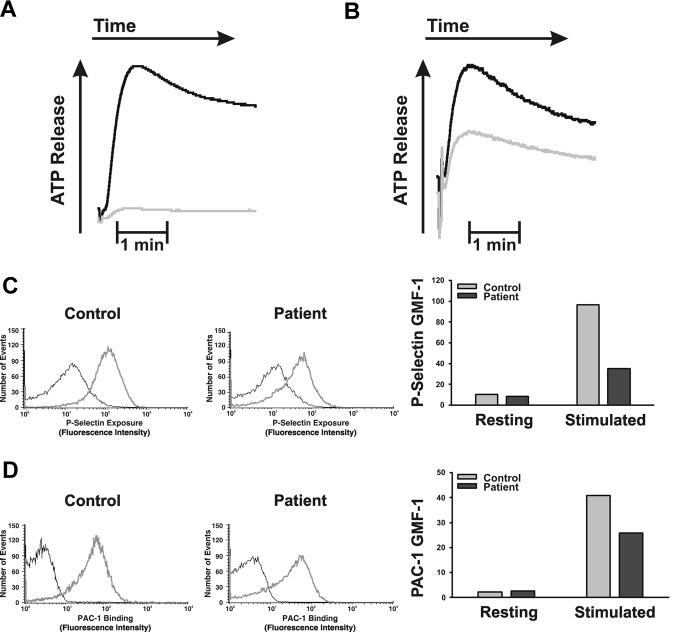
Platelets from FHL5/Munc18b/STXBP2 patients have a defect in ADP/ATP release and P-selectin exposure. Washed platelets were stimulated with thrombin (0.1 U/mL), and the release of ADP/ATP from dense granules was measured in a lumi-aggregometer as described previously. (A) ATP release profile from a normal control (black line) and biallelic patient 1 (gray line). (B) Release profiles for a normal control (black line) and a heterozygous patient 3 (gray line). (C) Resting (black line) thrombin-stimulated (gray line) platelets from control, or biallelic, patient 1 were incubated with FITC-conjugated anti–P-selectin antibodies for 1 minute at room temperature. The reactions were stopped with hirudin, and the stained platelets were analyzed by flow cytometry. A similar experiment was repeated with PAC-1 antibodies (D).
Figure 4
Figure 4
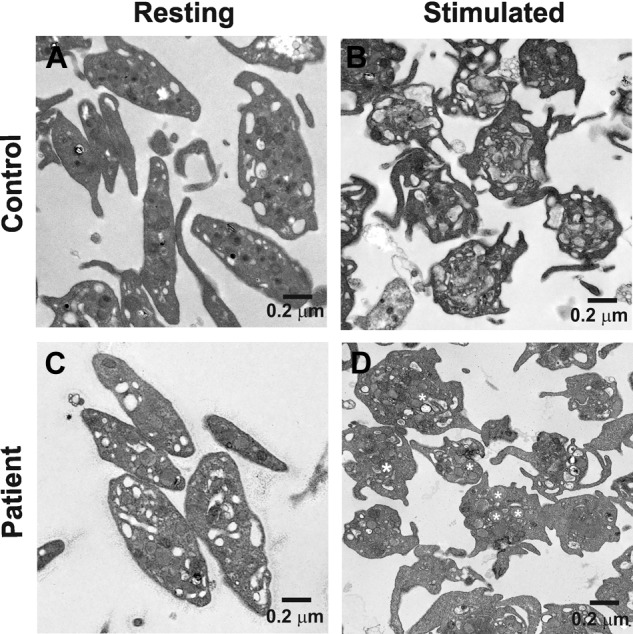
The ultrastructure of resting and stimulated platelets from a FHL5/Munc18b/STXBP2 patient. Platelets from a biallelic patient (P1; A and C) and normal control (B and D) were prepared as described under “Ultrastructure analysis.” (A and B) Platelets under resting conditions. Thrombin (final concentration 0.1 U/mL) was added to samples shown in panels C and D. After 2 minutes at room temperature, samples were fixed and analyzed by transmission electron microscopy. (D) Some α-granules are marked with white asterisks. The scale bar is indicated in all images.
Figure 5
Figure 5
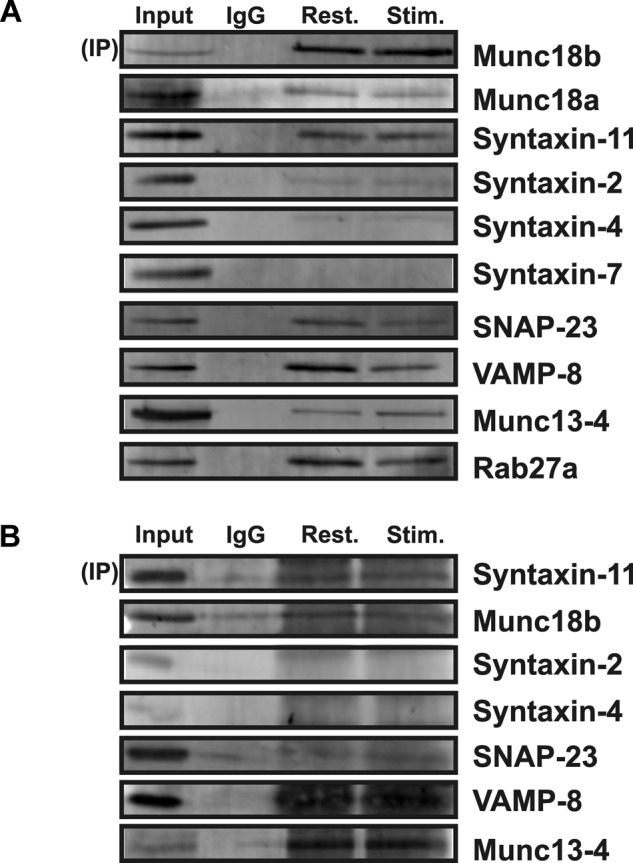
Munc18b associates with syntaxin-11 and with other SNARE proteins. Extracts from resting or stimulated platelets were prepared with 2% n-octyl β-glucopyranoside for immunoprecipitation (IP) with rabbit anti-Munc18b antibodies (A) or 0.5% Triton-X100 for IP with rabbit anti–syntaxin-11 antibodies (B). IgG was used as a specificity control (A and B) and the immune-complexes were recovered with protein A-Sepharose beads. The bound complexes were then analyzed by Western blotting by the use of antibodies to the indicated proteins.

Comment in

References

    1. Maguire PB, Fitzgerald DJ. Platelet proteomics. J Thromb Haemost. 2003;1(7):1593–1601. - PubMed
    1. Coppinger JA, Cagney G, Toomey S, et al. Characterization of the proteins released from activated platelets leads to localization of novel platelet proteins in human atherosclerotic lesions. Blood. 2004;103(6):2096–2104. - PubMed
    1. Smyth SS, McEver RP, Weyrich AS, et al. Platelet functions beyond hemostasis. J Thromb Haemost. 2009;7(11):1759–1766. - PubMed
    1. Ciferri S, Emiliani C, Guglielmini G, Orlacchio A, Nenci GG, Gresele P. Platelets release their lysosomal content in vivo in humans upon activation. Thromb Haemost. 2000;83(1):157–164. - PubMed
    1. Ren Q, Ye S, Whiteheart SW. The platelet release reaction: just when you thought platelet secretion was simple. Curr Opin Hematol. 2008;15(5):537–541. - PMC - PubMed

Publication types

MeSH terms