Meta-analysis of genome-wide scans for total body BMD in children and adults reveals allelic heterogeneity and age-specific effects at the WNT16 locus
- PMID: 22792070
- PMCID: PMC3390371
- DOI: 10.1371/journal.pgen.1002718
Meta-analysis of genome-wide scans for total body BMD in children and adults reveals allelic heterogeneity and age-specific effects at the WNT16 locus
Abstract
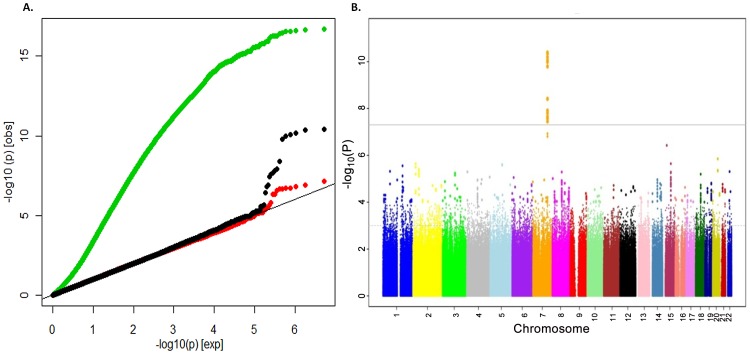
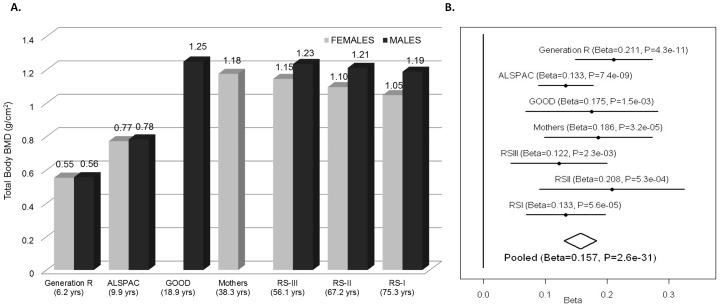
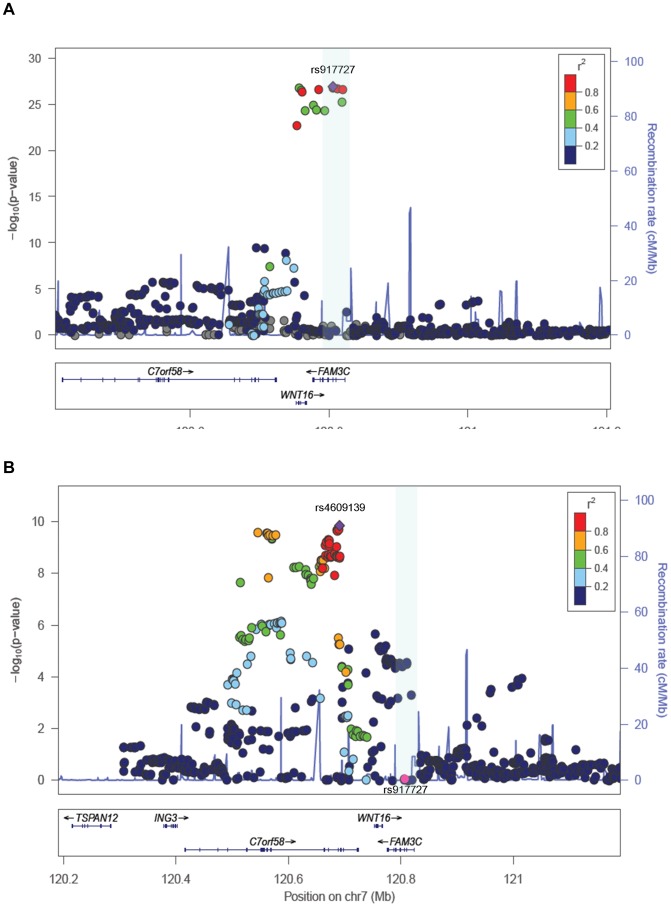
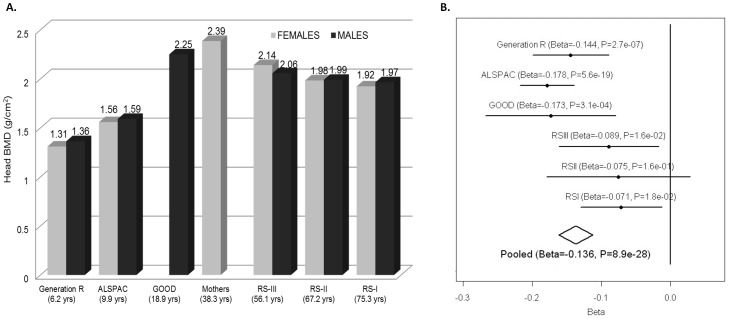
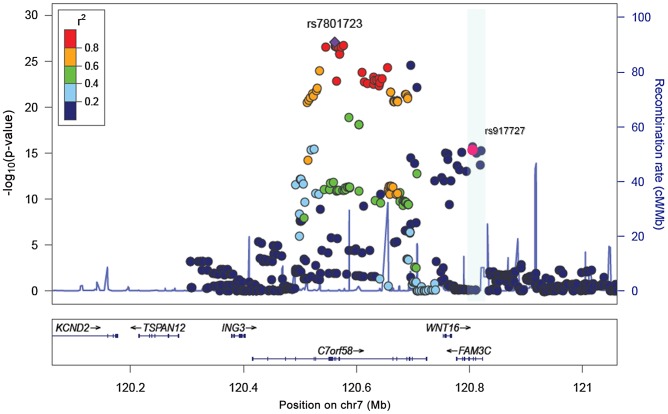
To identify genetic loci influencing bone accrual, we performed a genome-wide association scan for total-body bone mineral density (TB-BMD) variation in 2,660 children of different ethnicities. We discovered variants in 7q31.31 associated with BMD measurements, with the lowest P = 4.1 × 10(-11) observed for rs917727 with minor allele frequency of 0.37. We sought replication for all SNPs located ± 500 kb from rs917727 in 11,052 additional individuals from five independent studies including children and adults, together with de novo genotyping of rs3801387 (in perfect linkage disequilibrium (LD) with rs917727) in 1,014 mothers of children from the discovery cohort. The top signal mapping in the surroundings of WNT16 was replicated across studies with a meta-analysis P = 2.6 × 10(-31) and an effect size explaining between 0.6%-1.8% of TB-BMD variance. Conditional analyses on this signal revealed a secondary signal for total body BMD (P = 1.42 × 10(-10)) for rs4609139 and mapping to C7orf58. We also examined the genomic region for association with skull BMD to test if the associations were independent of skeletal loading. We identified two signals influencing skull BMD variation, including rs917727 (P = 1.9 × 10(-16)) and rs7801723 (P = 8.9 × 10(-28)), also mapping to C7orf58 (r(2) = 0.50 with rs4609139). Wnt16 knockout (KO) mice with reduced total body BMD and gene expression profiles in human bone biopsies support a role of C7orf58 and WNT16 on the BMD phenotypes observed at the human population level. In summary, we detected two independent signals influencing total body and skull BMD variation in children and adults, thus demonstrating the presence of allelic heterogeneity at the WNT16 locus. One of the skull BMD signals mapping to C7orf58 is mostly driven by children, suggesting temporal determination on peak bone mass acquisition. Our life-course approach postulates that these genetic effects influencing peak bone mass accrual may impact the risk of osteoporosis later in life.
Conflict of interest statement
RB and JL are full-time employees of Lexicon Pharmaceuticals. All other authors have declared that no other competing interest exist.
Figures
References
-
- Siris ES, Miller PD, Barrett-Connor E, Faulkner KG, Wehren LE, et al. Identification and fracture outcomes of undiagnosed low bone mineral density in postmenopausal women: results from the National Osteoporosis Risk Assessment. Jama. 2001;286:2815–2822. - PubMed
-
- Lewiecki EM, Gordon CM, Baim S, Binkley N, Bilezikian JP, et al. Special report on the 2007 adult and pediatric Position Development Conferences of the International Society for Clinical Densitometry. Osteoporos Int. 2008;19:1369–1378. - PubMed
-
- Duncan EL, Cardon LR, Sinsheimer JS, Wass JA, Brown MA. Site and gender specificity of inheritance of bone mineral density. J Bone Miner Res. 2003;18:1531–1538. - PubMed
Publication types
MeSH terms
Substances
Grants and funding
LinkOut - more resources
Full Text Sources
Medical
Research Materials