WNT16 influences bone mineral density, cortical bone thickness, bone strength, and osteoporotic fracture risk
- PMID: 22792071
- PMCID: PMC3390364
- DOI: 10.1371/journal.pgen.1002745
WNT16 influences bone mineral density, cortical bone thickness, bone strength, and osteoporotic fracture risk
Abstract
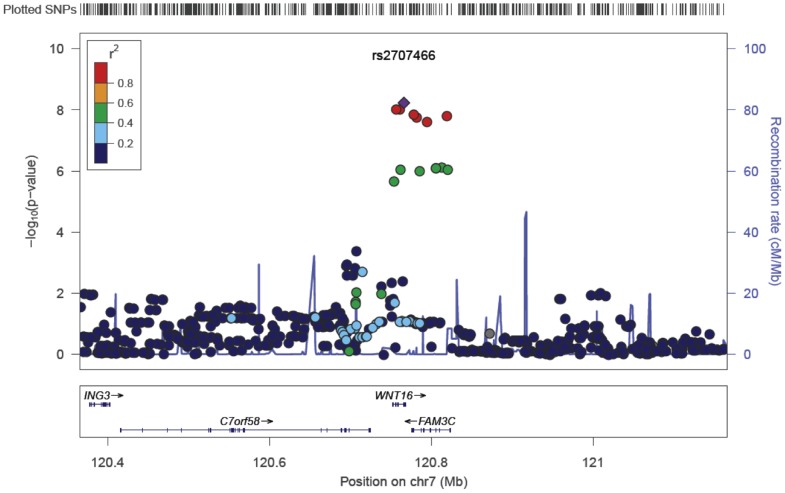
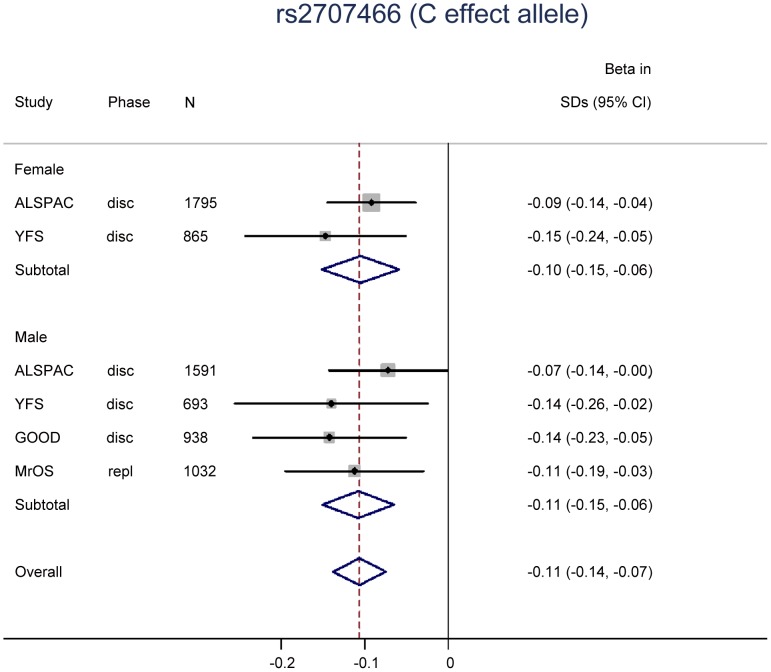
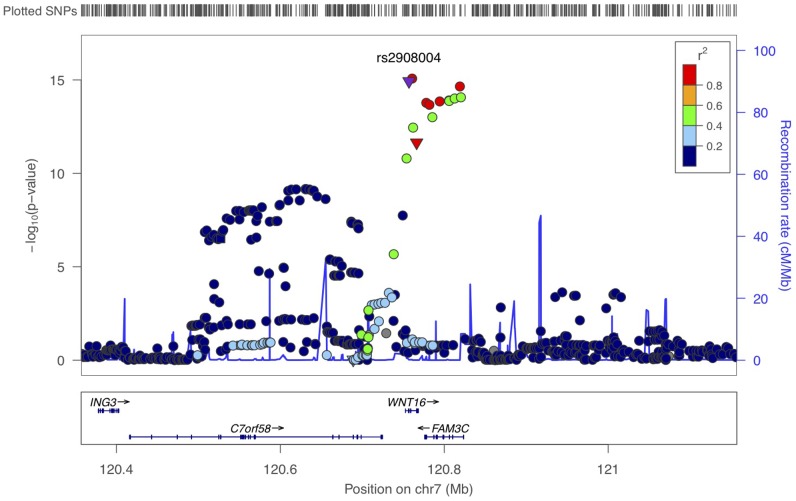
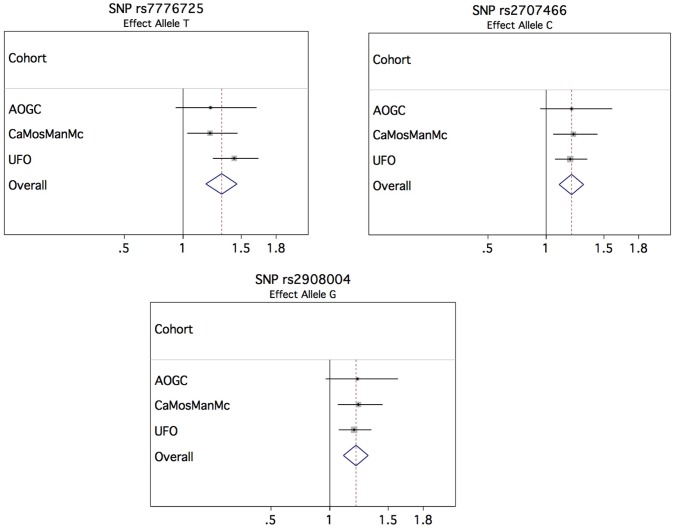
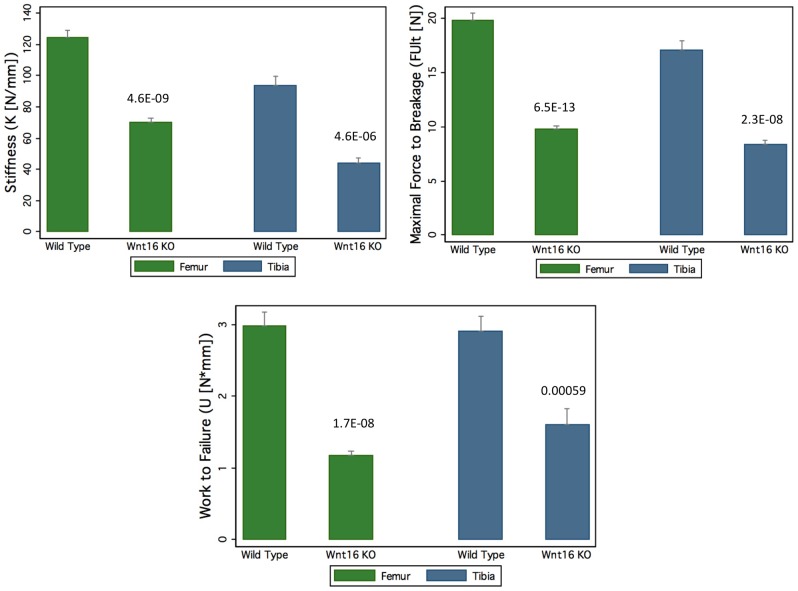
We aimed to identify genetic variants associated with cortical bone thickness (CBT) and bone mineral density (BMD) by performing two separate genome-wide association study (GWAS) meta-analyses for CBT in 3 cohorts comprising 5,878 European subjects and for BMD in 5 cohorts comprising 5,672 individuals. We then assessed selected single-nucleotide polymorphisms (SNPs) for osteoporotic fracture in 2,023 cases and 3,740 controls. Association with CBT and forearm BMD was tested for ∼2.5 million SNPs in each cohort separately, and results were meta-analyzed using fixed effect meta-analysis. We identified a missense SNP (Thr>Ile; rs2707466) located in the WNT16 gene (7q31), associated with CBT (effect size of -0.11 standard deviations [SD] per C allele, P = 6.2 × 10(-9)). This SNP, as well as another nonsynonymous SNP rs2908004 (Gly>Arg), also had genome-wide significant association with forearm BMD (-0.14 SD per C allele, P = 2.3 × 10(-12), and -0.16 SD per G allele, P = 1.2 × 10(-15), respectively). Four genome-wide significant SNPs arising from BMD meta-analysis were tested for association with forearm fracture. SNP rs7776725 in FAM3C, a gene adjacent to WNT16, was associated with a genome-wide significant increased risk of forearm fracture (OR = 1.33, P = 7.3 × 10(-9)), with genome-wide suggestive signals from the two missense variants in WNT16 (rs2908004: OR = 1.22, P = 4.9 × 10(-6) and rs2707466: OR = 1.22, P = 7.2 × 10(-6)). We next generated a homozygous mouse with targeted disruption of Wnt16. Female Wnt16(-/-) mice had 27% (P<0.001) thinner cortical bones at the femur midshaft, and bone strength measures were reduced between 43%-61% (6.5 × 10(-13)<P<5.9 × 10(-4)) at both femur and tibia, compared with their wild-type littermates. Natural variation in humans and targeted disruption in mice demonstrate that WNT16 is an important determinant of CBT, BMD, bone strength, and risk of fracture.
Conflict of interest statement
R Brommage and J Liu are full-time employees of Lexicon Pharmaceuticals. All other authors have declared that no competing interests exist.
Figures
References
-
- Consensus development conference: diagnosis, prophylaxis, and treatment of osteoporosis. The American journal of medicine. 1993;94:646–650. - PubMed
-
- Kanis JA, Johnell O, Oden A, Sembo I, Redlund-Johnell I, et al. Long-term risk of osteoporotic fracture in Malmo. Osteoporos Int. 2000;11:669–674. - PubMed
-
- Organization WH. WHO scientific group on the assessment of osteoporosis at primary health care level; 2007 May 5; Brussels, Belgium.
-
- Burge R, Dawson-Hughes B, Solomon DH, Wong JB, King A, et al. Incidence and economic burden of osteoporosis-related fractures in the United States, 2005–2025. Journal of bone and mineral research. 2007;22:465–475. - PubMed
-
- Gueguen R, Jouanny P, Guillemin F, Kuntz C, Pourel J, et al. Segregation analysis and variance components analysis of bone mineral density in healthy families. J Bone Miner Res. 1995;10:2017–2022. - PubMed
Publication types
MeSH terms
Substances
Grants and funding
- G0600705/MRC_/Medical Research Council/United Kingdom
- G0800582/MRC_/Medical Research Council/United Kingdom
- 092731/WT_/Wellcome Trust/United Kingdom
- CAPMC/ CIHR/Canada
- R01 AG18728/AG/NIA NIH HHS/United States
- ref: 74882/MRC_/Medical Research Council/United Kingdom
- U01 HL084756/HL/NHLBI NIH HHS/United States
- P30 DK072488/DK/NIDDK NIH HHS/United States
- R01AR046838/AR/NIAMS NIH HHS/United States
- ref: 076467/WT_/Wellcome Trust/United Kingdom
- R01HL088119/HL/NHLBI NIH HHS/United States
- WT083431MA/WT_/Wellcome Trust/United Kingdom
- R01 HL088119/HL/NHLBI NIH HHS/United States
- F32AR059469/AR/NIAMS NIH HHS/United States
- R01 AR046838/AR/NIAMS NIH HHS/United States
- F32 AR059469/AR/NIAMS NIH HHS/United States
- MRC G0800582/MRC_/Medical Research Council/United Kingdom
- R01 AG018728/AG/NIA NIH HHS/United States
- P30DK072488/DK/NIDDK NIH HHS/United States
LinkOut - more resources
Full Text Sources
Other Literature Sources
Medical
Molecular Biology Databases
Miscellaneous