


Accelerometry: a feasible method to quantify physical activity in ambulatory and nonambulatory adolescents with cerebral palsy
- PMID: 22792119
- PMCID: PMC3390038
- DOI: 10.1155/2012/329284
Accelerometry: a feasible method to quantify physical activity in ambulatory and nonambulatory adolescents with cerebral palsy
Abstract
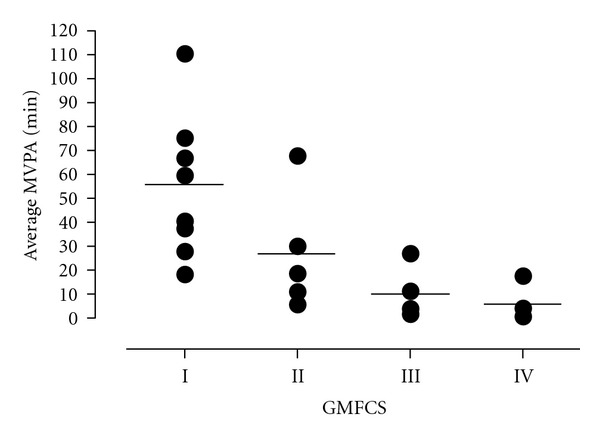
Objective. To determine the feasibility of physical activity monitoring in adolescents with cerebral palsy (CP). Methods. A convenience sample of ambulatory and non-ambulatory adolescents (N = 23; 17 males, 6 females; mean age 13.5 y, SD 2.6 y; Gross Motor Function Classification System (GMFCS) distribution: n = 9 Level I, n = 5 Level II, n = 5 Level III, n = 4 Level IV) was recruited. Physical activity (PA) was objectively assessed using the ActiGraph GT1M activity monitor. Discomfort or adverse effects of wearing the accelerometers were recorded by participants. Levels of physical activity were determined as total PA, light PA (LPA), moderate PA (MPA), moderate-to-vigorous (MVPA), and vigorous PA (VPA) using cut-points recently validated for CP. Results. Most participants showed little reluctance. Mean daily MVPA for all participants was 30.7 minutes (SD 30.3), which corresponded to 2.7 (SD 2.4) minutes of MVPA per hour or 4.5% (SD 3.9) of the total monitoring time. Total PA and MVPA were greatest in ambulatory youth (GMFCS levels I and II) compared with youth who use a walking aid or wheelchair (GMFCS levels III and IV) (P < 0.05). Conclusion(s). The results support the use of the accelerometer as a feasible and useful measure of activity in ambulatory and nonambulatory adolescents with CP.
Figures
References
-
- Maher CA, Williams MT, Olds T, Lane AE. Physical and sedentary activity in adolescents with cerebral palsy. Developmental Medicine and Child Neurology. 2007;49(6):450–457. - PubMed
-
- Fowler EG, Kolobe THA, Damiano DL, et al. Promotion of physical fitness and prevention of secondary conditions for children with cerebral palsy: section on pediatrics research summit proceedings. Physical Therapy. 2007;87(11):1495–1510. - PubMed
-
- Verschuren O, Ketelaar M, Takken T, Helders PJM, Gorter JW. Exercise programs for children with cerebral palsy: a systematic review of the literature. American Journal of Physical Medicine and Rehabilitation. 2008;87(5):404–417. - PubMed
LinkOut - more resources
Full Text Sources
Miscellaneous
