. 2012;7(7):e40138.
doi: 10.1371/journal.pone.0040138. Epub 2012 Jul 6.

Milk matters: soluble Toll-like receptor 2 (sTLR2) in breast milk significantly inhibits HIV-1 infection and inflammation

Affiliations

Milk matters: soluble Toll-like receptor 2 (sTLR2) in breast milk significantly inhibits HIV-1 infection and inflammation

Bethany M Henrick et al. PLoS One. 2012.

Abstract

The majority of infants who breastfeed from their HIV-positive mothers remain uninfected despite constant and repeated exposure to virus over weeks to years. This phenomenon is not fully understood but has been closely linked to innate factors in breast milk (BM). Most recently we have focused on one such innate factor, soluble Toll-like receptor 2 (sTLR2) for its significant contribution as an inhibitor of inflammation triggered by bacterial and viral antigens. We hypothesized that sTLR2 in BM inhibits immune activation/inflammation and HIV-1 infection. sTLR2 protein profiles were analyzed in HIV-uninfected BM and showed dramatic variability in expression concentration and predominant sTLR2 forms between women. sTLR2 immunodepleted BM, versus mock-depleted BM, incubated with Pam(3)CSK(4) lead to significant increases in IL-8 production in a TLR2-dependant fashion in U937, HEK293-TLR2, and Caco-2. Importantly, TLR2-specific polyclonal and monoclonal antibody addition to BM prior to cell-free R5 HIV-1 addition led to significantly (P<0.01, P<0.001, respectively) increased HIV-1 infection in TZM-bl reporter cells. To confirm these findings, sTLR2-depletion in BM led to significantly (P<0.001) increased HIV-1 infection in TZM-bl cells. Notably, immunodepletion does not allow for the complete removal of sTLR2 from BM, thus functional testing shown here may underestimate the total effect elicited by sTLR2 against HIV-1 and synthetic bacterial ligand. This study provides evidence for the first time that sTLR2 in BM may provide a dual protective role for infants breastfeeding from their HIV-infected mothers by; (1) immunomodulating pro-inflammatory responses to bacterial ligands, and (2) directly inhibiting cell-free HIV-1 infection. Thus, sTLR2 in BM may be critical to infant health and prove beneficial in decreasing vertical HIV-1 transmission to infants.


Conflict of interest statement

Competing Interests: The authors have declared that no competing interests exist.

Figures

Figure 1
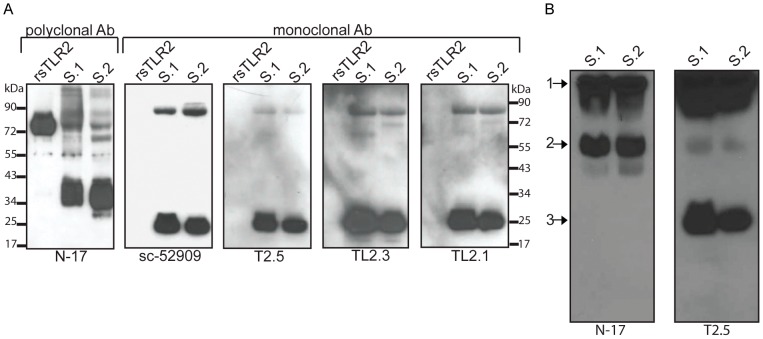
Figure 1. Predominant sTLR2 polypeptides profiles in breast milk.
Predominant sTLR2 polypeptide profiles found in multiple breast milk (BM) samples using Western and Native blot analysis. (A) BM samples (10 µg total milk protein) with commercial rsTLR2 were evaluated by Western blot analysis with N-17 pAb and 4 mAb (sc-52909, T2.5, TL2.3, TL2.1). pAb N-17 detected commercial rsTLR2 as well as multiple bands in BM; the predominant BM forms were ∼83 kDa and ∼38 kDa sTLR2 forms. In contrast, mAbs did not detect the commercial rsTLR2. In BM mAbs detected the ∼83 kD band, as well as a unique ∼26 kDa sTLR2 form, which was not detected with the N-17 pAb. (B) N-17 pAb and T2.5 mAb were used in Native blot analysis of two BM samples. N-17 pAb detected two large proteins (arrow 1 & 2), while T2.5 mAb detected 3 proteins (arrow 1, 2 & 3). A representative data set from three experiments is shown.
Figure 2
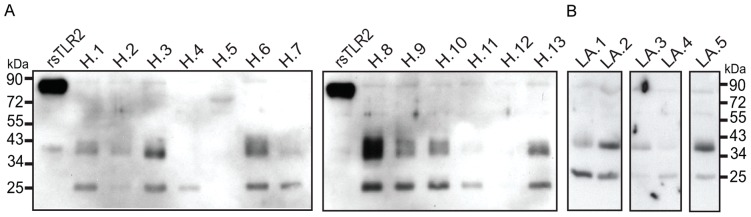
Figure 2. Variation in sTLR2 polypeptides between different women.
Breast milk samples (10 µg total protein) from HIV-uninfected women were evaluated using a cocktail of anti-sTLR2 antibodies (N-17 pAb and T2.5 mAb) using Western blot analysis. Results show dramatic variation in predominant sTLR2 polypeptide (∼38 kDa and ∼26 kDa) expression in milk from different women. (A) Samples taken within one week postpartum. (B) Samples taken within one month postpartum.
Figure 3
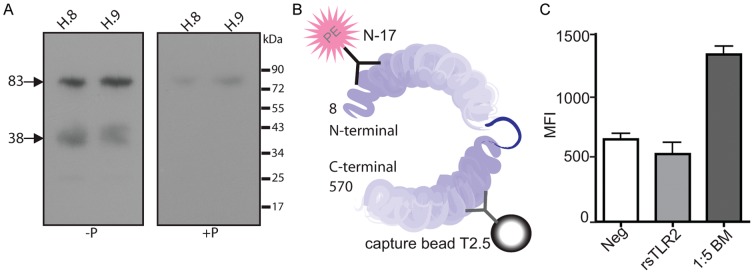
Figure 3. Specificity of anti-sTLR2 antibodies.
The specificity of anti-sTLR2 antibodies was confirmed using a peptide competition assay and CBA. (A) N-17 was preincubated without (-P) or with (+P) 5× molar excess of peptide (N-17P) prior to immunoblotting. Pre-incubation with excess peptide markedly reduced both the ∼83 kDa and ∼38 kDa isoforms of sTLR2. Results representative of breast milk (BM) samples from different donors tested. (B) Schematic of cytometric bead array shows that beads coated with T2.5 mAb pulled natural sTLR2 out of milk and were detected with phycoerythrin (PE) labeled N-17 detection antibody. (C) CBA analysis of commercial rsTLR2 and BM dilution clearly shows system can detect natural sTLR2 but cannot detect commercial rsTLR2. A representative data set from triplicate experiments is shown.
Figure 4
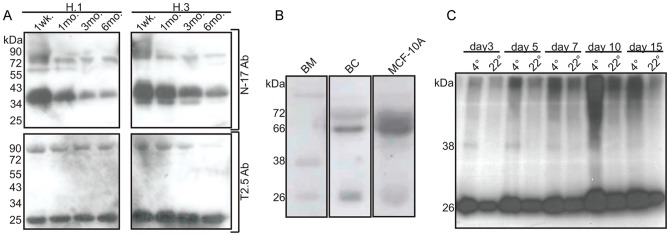
Figure 4. Expression kinetics, source, and bioavailability of sTLR2.
sTLR2 expression kinetics, source and bioavailability in breast milk (BM) (10 µg total milk protein) were evaluated using Western blot analysis. (A) BM evaluated at one week to six months using N-17 pAb (top panel) and T2.5 mAb (bottom panel) indicated a reduction of the ∼38 kDa and consistent expression of the ∼26 kDa sTLR2 polypeptide postpartum. A representative data set from four different donors is shown. (B) BM, BM cells (BC), and MCF-10A supernatant were tested. ∼38 kDa sTLR2 was observed in BM, but absent from BC and MCF-10A. ∼26 kDa sTLR2 form was observed in BM, BC, and MCF-10A. (C) BM stored at 4°C or 24°C revealed ∼38 kDa sTLR2 polypeptide was quickly degraded compared to the slight degredation of the ∼26 kDa form. Western blot analyses were developed with a cocktail of N-17 pAb and T2.5 mAb. A representative data set from triplicate experiments is shown.
Figure 5
Figure 5. sTLR2-mediated augmentation of pro-inflammatory cytokines during bacterial lipoprotein exposure.
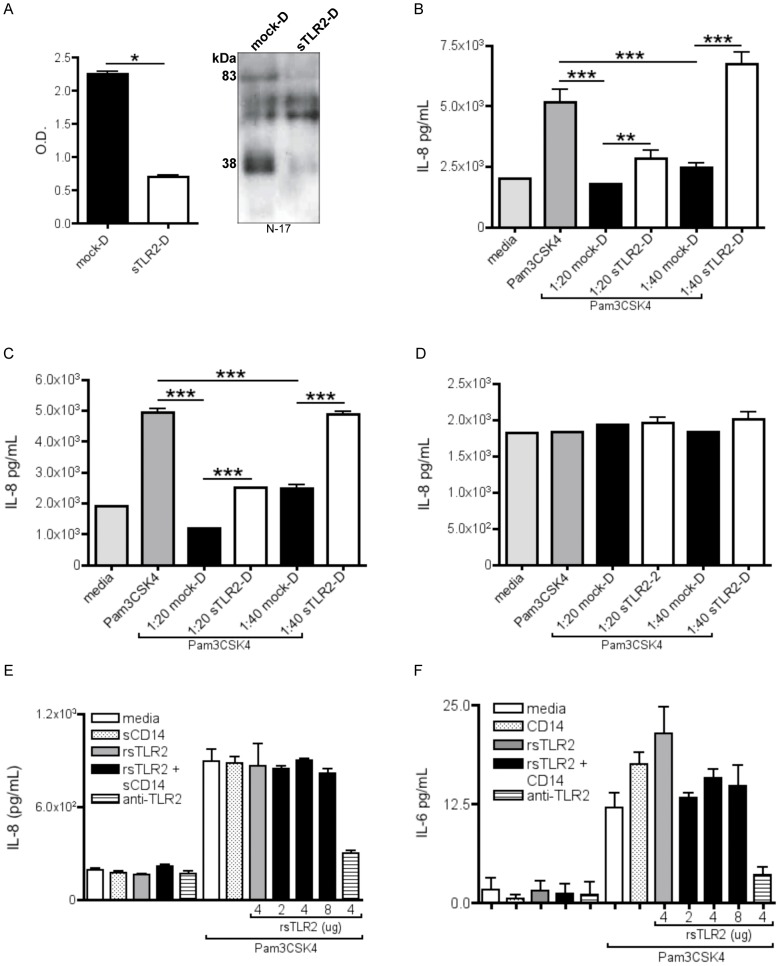
(A) Immunodepletion of ∼38 kDa sTLR2 in breast milk (BM) described in materials and methods. Quantitative analysis using TLR2 ELISA indicated a significant (P<0.05) decrease in sTLR2-depleted (sTLR2-D) compared to mock-D breast milk (BM). Western blot analysis revealed that ∼38 kDa and ∼83 kDa sTLR2 were markedly reduced compared to mock-D BM. (B-D) 500 ng/mL Pam3CSK4 was incubated with media or BM that was either mock-D or sTLR2-D for 1 hr at 37°C before being placed on cells. Supernatants were collected for IL-8 ELISA after 18 hours. Results represent (B) U937, (C) HEK293-TLR2 and (D) HEK293. (E) Commercial rsTLR2 was used at varying concentration with or without sCD14 and showed no inhibition of IL-8 or (F) IL-6 production in HEK293-TLR2 cells. Significant increases in pro-inflammatory cytokine, IL-8, was observed in sTLR2-D compared to mock-D BM. *P<0.05, **P<0.01, ***P<0.001. Errors bars, SEM. A representative data set from triplicate experiments is shown.
Figure 6
Figure 6. sTLR2 forms function similarly in human intestinal epithelial cells.
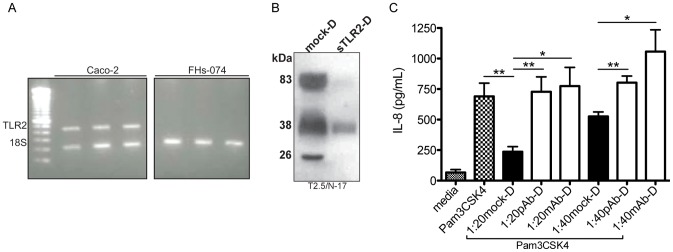
(A) PCR analysis indicated that Caco-2, intestinal epithelial cells (IEC), expressed TLR2 mRNA while FHs-074 IEC did not. (B) Western blot analysis indicated that the majority of ∼83 kDa and ∼26 kDa sTLR2 forms were removed from sTLR2-depleted (sTLR2-D) compared to mock-D breast milk (BM). (C) In vitro testing of Caco-2 cells pre-incubated with mock-D BM for 1 hour at 37°C significantly inhibited IL-8 production (1∶20 P<0.001; 1∶40 P<0.001) following exposure to Pam3CSK4 (5 ng/mL). A significant IL-8 increase was observed in pAb-D (N-17 pAb) BM (P<0.01) and mAb-D (T2.5) BM (P<0.05) following Pam3CSK4 exposure. **P<0.01, ***P<0.001. Errors bars, SEM. A representative figure of the experiment completed in triplicate is shown.
Figure 7
Figure 7. sTLR2 significantly inhibits HIV-1 infection in reporter assay.
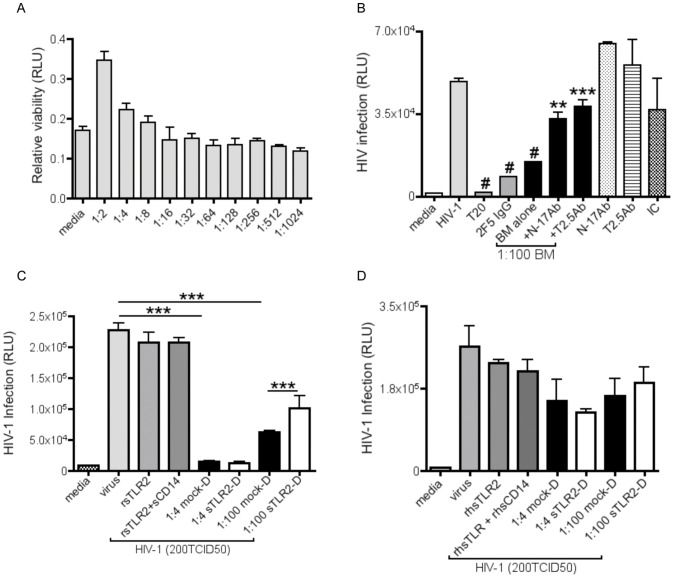
(A) MTT assay indicates that HIV-uninfected breast milk (BM) was not toxic to TZM-bl cells. (B) HIV-uninfected BM was incubated with either N-17 pAb or T2.5 mAb (200 before R5 HIV-1 (200 TCID50) and then placed on TZM-bl cells. T20, 2F5IgG, and 1∶100 BM significantly inhibited infection (P<0.001). A significant increase (P<0.001, 0.01, respectively) in HIV-1 infection was shown when sTLR2-specific N-17 or T2.5 Ab were pre-incubated with BM. N-17 pAb and T2.5 mAb alone and isotype control (200 ng/mL) did not inhibit HIV-1 infection. (C) rsTLR2+/− sCD14 or pooled HIV-uninfected mock-D or sTLR2-D BM (described in materials and methods) were incubated with R5 HIV-1 (200 TCID50) before addition to TZM-bl cells for 48 hours. A significant decrease (P<0.001) in HIV infection was observed in cells exposed to mock-D BM. However, a significant increase (P<0.001) in HIV infection was detected with sTLR2-depleted BM. (D) rsTLR2+/− sCD14, mock-D, or sTLR2-D was incubated with cells for 1 hour at 37°C, washed with PBS, and then exposed to R5 HIV-1 (200 TCID50) did not alter HIV-1 infection. ** P<0.01, ***P<0.001. Errors bars, SEM. A representative data set from four experiments is shown.

References

    1. Grulee CG, Sanford HN, Schwartz H. Breast and Artificially Fed Infants. Jour AMA. 1935. pp. 1–3.
    1. Beaudry M, Dufour R, Marcoux S. Relation between infant feeding and infections during the first six months of life. J Pediatr. 1995;126:191–197. - PubMed
    1. Kramer MS. “Breast is best”: The evidence. Early Hum Dev. 2010;86:729–732. doi: 10.1016/j.earlhumdev.2010.08.005. - DOI - PubMed
    1. Arifeen S, Black RE, Antelman G, Baqui A, Caulfield L, et al. Exclusive breastfeeding reduces acute respiratory. 2001. pp. 1–10. doi: 10.1542/peds.108.4.e67. - DOI - PubMed
    1. Coovadia HM, Rollins NC, Bland RM, Little K, Coutsoudis A, et al. Mother-to-child transmission of HIV-1 infection during exclusive breastfeeding in the first 6 months of life: an intervention cohort study. Lancet. 2007;369:1107–1116. doi: 10.1016/S0140-6736(07)60283-9. - DOI - PubMed

Publication types

MeSH terms