


Evaluation of tyrosine receptor kinases in the interactions of head and neck squamous cell carcinoma cells and fibroblasts
- PMID: 22795534
- PMCID: PMC3496822
- DOI: 10.1016/j.oraloncology.2012.06.011
Evaluation of tyrosine receptor kinases in the interactions of head and neck squamous cell carcinoma cells and fibroblasts
Abstract
Objective: Despite treatment advancements, disease-free survival of head and neck squamous cell carcinoma (HNSCC) has not significantly improved. This may be a result of tumor-fibroblasts interactions providing protective pathways for oncogenic cells to resist therapy. Further understanding of these relationships in HNSCC may improve effectiveness of targeted therapies. In this article, we investigated the role of several receptor tyrosine kinases (RTKs) in the interactions between HNSCC cells and supporting cells (fibroblasts).
Materials and methods: HNSCC cell lines and human tumor samples were evaluated for FGFR1/2/3, and PDGF-beta expression levels. Cell lines (FADU, SCC1, OSC19, Cal27, SCC22A) were treated with a range of physiological concentrations of dovitinib and assessed for proliferation, cytotoxicity, and apoptosis. Mice bearing HNSCC xenografts were treated with dovitinib (20 mg/kg).
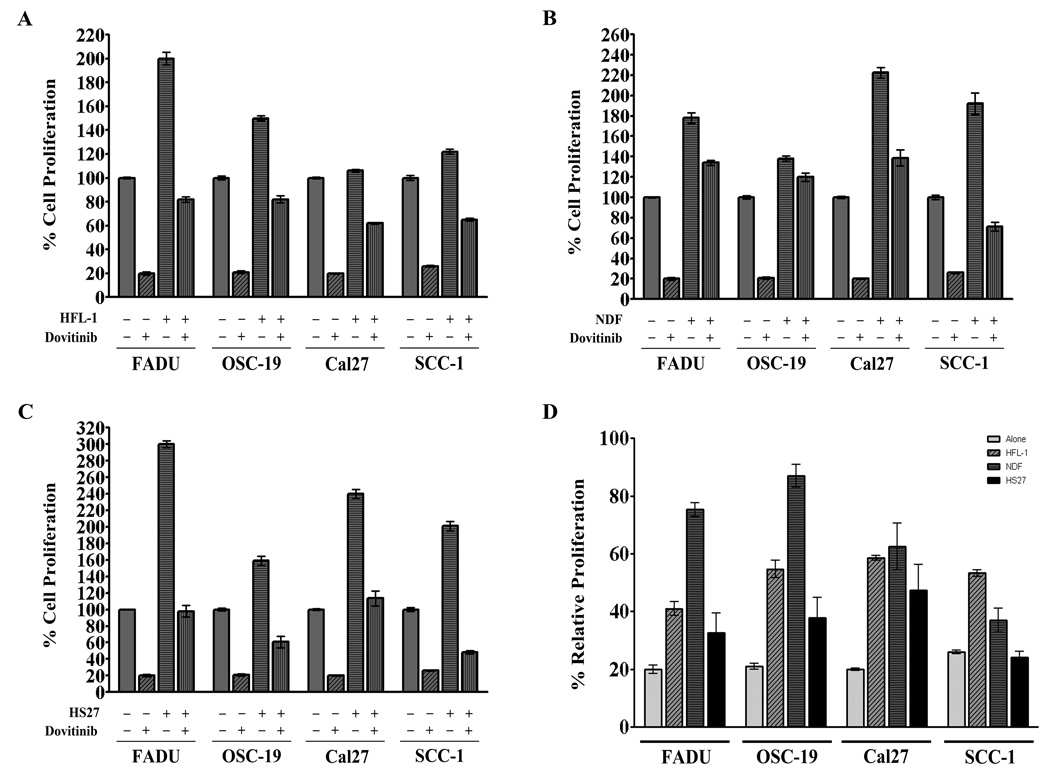
Results: Evaluation of HNSCC tumor specimens, cell lines and fibroblasts found variable expression of multiple RTKs (fibroblasts growth factor receptor, platelet derived growth factor receptor and vascular endothelial growth factor receptor) and their ligands, supporting previous theories of paracrine and autocrine signaling within the microenvironment. In a dose-dependent fashion, RTK inhibition reduced proliferation of HNSCC cell lines and fibroblast in vitro. When HNSCC cells were cocultured with fibroblasts, RTK inhibition resulted in a smaller reduction in the proliferation relative to untreated conditions. In vivo, RTK inhibition resulted in significant tumor regression and growth inhibition (p<0.05) and reduced the incidence of regional lymph node metastasis.
Conclusion: Effective treatment of HNSCC, therefore, may require inhibition of multiple RTKs in order to adequately inhibit the microenvironment's various signaling pathways.
Copyright © 2012 Elsevier Ltd. All rights reserved.
Conflict of interest statement
No potential conflicts of interest were disclosed.
Figures


References
-
- Blume-Jensen P, Hunter T. Oncogenic kinase signalling. Nature. 2001;411(6835):355–365. - PubMed
-
- Lee SH, Lopes de Menezes D, Vora J, Harris A, Ye H, Nordahl L, et al. In vivo target modulation and biological activity of CHIR-258, a multitargeted growth factor receptor kinase inhibitor, in colon cancer models. Clin Cancer Res. 2005;11(10):3633–3641. - PubMed
-
- Freier K, Schwaenen C, Sticht C, Flechtenmacher C, Muhling J, Hofele C, et al. Recurrent FGFR1 amplification and high FGFR1 protein expression in oral squamous cell carcinoma (OSCC) Oral Oncol. 2007;43(1):60–66. - PubMed
Publication types
MeSH terms
Substances
Grants and funding
LinkOut - more resources
Full Text Sources
Medical
Miscellaneous
