


Top-down versus bottom-up attentional control: a failed theoretical dichotomy
- PMID: 22795563
- PMCID: PMC3426354
- DOI: 10.1016/j.tics.2012.06.010
Top-down versus bottom-up attentional control: a failed theoretical dichotomy
Abstract
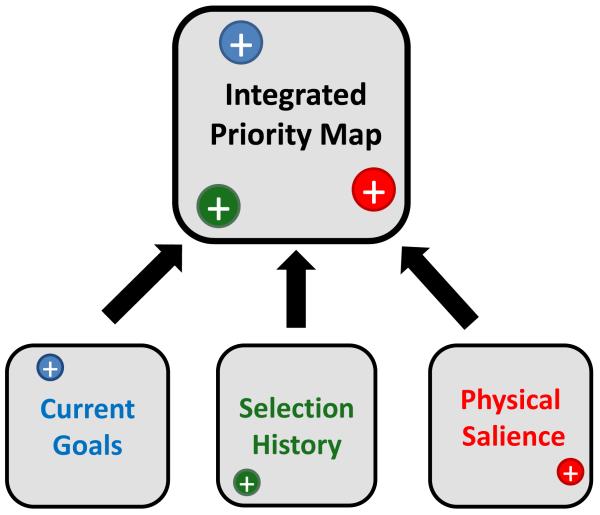
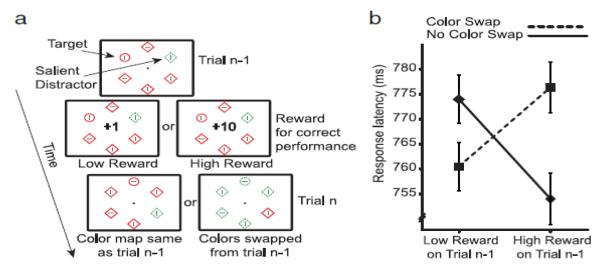
Prominent models of attentional control assert a dichotomy between top-down and bottom-up control, with the former determined by current selection goals and the latter determined by physical salience. This theoretical dichotomy, however, fails to explain a growing number of cases in which neither current goals nor physical salience can account for strong selection biases. For example, equally salient stimuli associated with reward can capture attention, even when this contradicts current selection goals. Thus, although 'top-down' sources of bias are sometimes defined as those that are not due to physical salience, this conception conflates distinct--and sometimes contradictory--sources of selection bias. We describe an alternative framework, in which past selection history is integrated with current goals and physical salience to shape an integrated priority map.
Copyright © 2012 Elsevier Ltd. All rights reserved.
Figures
References
-
- Posner MI. Orienting of attention. Q. J. Exp. Psychol. 1980;32:3–25. - PubMed
-
- Jonides J. Voluntary versus automatic control over the mind’s eye’s movement. In: Long JB, Baddeley AD, editors. Attention and Performance IX. Lawrence Erlbaum Associates; 1981. pp. 187–203.
-
- Posner MI, Petersen SE. The attention system of the human brain. Annu Rev Neurosci. 1990;13:25–42. - PubMed
-
- Folk CL, et al. Involuntary covert orienting is contingent on attentional control settings. J Exp Psychol Hum Percept Perform. 1992;18:1030–1044. - PubMed
-
- Wolfe JM, et al. Guided search: an alternative to the feature integration model for visual search. J Exp Psychol Hum Percept Perform. 1989;15:419–433. - PubMed
Publication types
MeSH terms
Grants and funding
LinkOut - more resources
Full Text Sources
Miscellaneous
