


Case-control association analysis of polymorphisms in the δ-opioid receptor, OPRD1, with cocaine and opioid addicted populations
- PMID: 22795689
- PMCID: PMC3509227
- DOI: 10.1016/j.drugalcdep.2012.06.023
Case-control association analysis of polymorphisms in the δ-opioid receptor, OPRD1, with cocaine and opioid addicted populations
Abstract
Background: Addiction susceptibility and treatment responsiveness are greatly influenced by genetic factors. Sequence variation in genes involved in the mechanisms of drug action have the potential to influence addiction risk and treatment outcome. The opioid receptor system is involved in mediating the rewarding effects of cocaine and opioids. The μ-opioid receptor (MOR) has traditionally been considered the primary target for opioid addiction. The MOR, however, interacts with and is regulated by many known MOR interacting proteins (MORIPs), including the δ-opioid receptor (DOR).
Methods: The present study evaluated the contribution of OPRD1, the gene encoding the DOR, to the risk of addiction to opioids and cocaine. The association of OPRD1 polymorphisms with both opioid addiction (OA) and cocaine addiction (CA) was analyzed in African American (OA n=336, CA n=503) and European American (OA n=1007, CA n=336) populations.
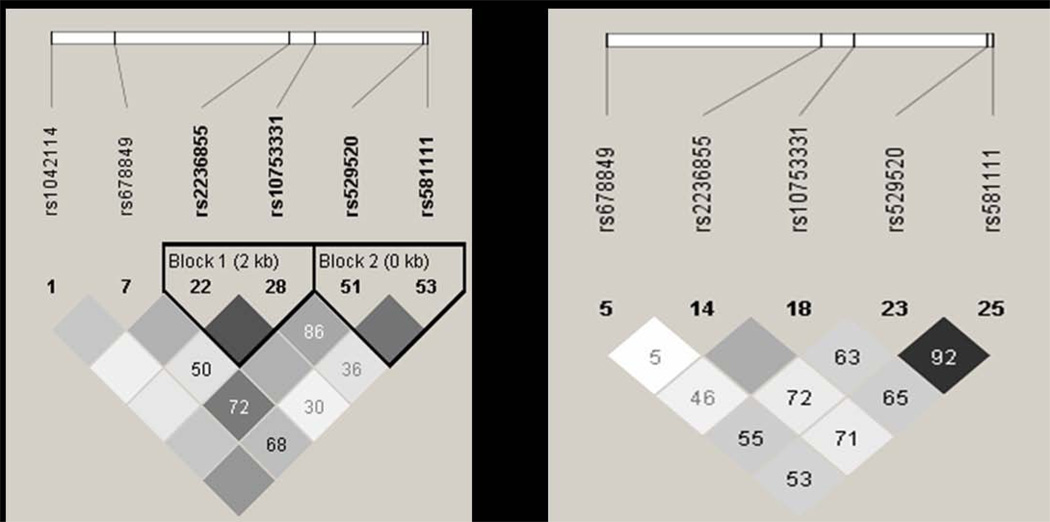
Results: The primary finding of this study is an association of rs678849 with cocaine addiction in African Americans (allelic p=0.0086). For replication purposes, this SNP was analyzed in a larger independent population of cocaine addicted African Americans and controls and the association was confirmed (allelic p=4.53 × 10(-5); n=993). By performing a meta-analysis on the expanded populations, the statistical evidence for an association was substantially increased (allelic p=8.5 × 10(-7)) (p-values non-FDR corrected).
Conclusion: The present study suggests that polymorphisms in OPRD1 are relevant for cocaine addiction in the African American population and provides additional support for a broad role for OPRD1 variants in drug dependence.
Copyright © 2012 Elsevier Ireland Ltd. All rights reserved.
Conflict of interest statement
The authors report no biomedical financial interests or potential conflicts of interest.
Figures
References
-
- Barrett JC, Fry B, Maller J, Daly MJ. Haploview: analysis and visualization of LD and haplotype maps. Bioinformatics. 2005;21:263–265. - PubMed
-
- Becker A, Grecksch G, Kraus J, Loh HH, Schroeder H, Hollt V. Rewarding effects of ethanol and cocaine in mu opioid receptor-deficient mice. Naunyn Schmiedebergs Arch. Pharmacol. 2002;365:296–302. - PubMed
Publication types
MeSH terms
Substances
Grants and funding
- R01 MH061675/MH/NIMH NIH HHS/United States
- P20 DA025995/DA/NIDA NIH HHS/United States
- R01 MH067257/MH/NIMH NIH HHS/United States
- R01 MH060870/MH/NIMH NIH HHS/United States
- T32 MH014654/MH/NIMH NIH HHS/United States
- R01 MH059587/MH/NIMH NIH HHS/United States
- R01 MH059571/MH/NIMH NIH HHS/United States
- P60 DA005186/DA/NIDA NIH HHS/United States
- P50 DA012756/DA/NIDA NIH HHS/United States
- R01 MH059565/MH/NIMH NIH HHS/United States
- P50DA012756/DA/NIDA NIH HHS/United States
- U10 DA013043/DA/NIDA NIH HHS/United States
- R01 MH059586/MH/NIMH NIH HHS/United States
- R01 MH059566/MH/NIMH NIH HHS/United States
- T32MH014654/MH/NIMH NIH HHS/United States
- P60DA05186/DA/NIDA NIH HHS/United States
- R01 MH059588/MH/NIMH NIH HHS/United States
- P20DA025995/DA/NIDA NIH HHS/United States
- R01 MH060879/MH/NIMH NIH HHS/United States
LinkOut - more resources
Full Text Sources
Other Literature Sources
Medical
Molecular Biology Databases
Research Materials
