


Atomistic modeling of protein-DNA interaction specificity: progress and applications
- PMID: 22796087
- PMCID: PMC3425445
- DOI: 10.1016/j.sbi.2012.06.002
Atomistic modeling of protein-DNA interaction specificity: progress and applications
Abstract
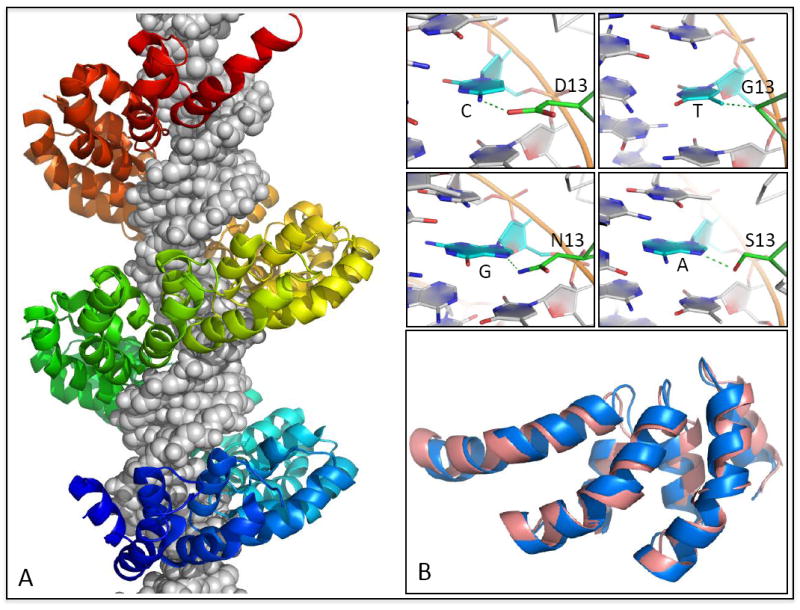
An accurate, predictive understanding of protein-DNA binding specificity is crucial for the successful design and engineering of novel protein-DNA binding complexes. In this review, we summarize recent studies that use atomistic representations of interfaces to predict protein-DNA binding specificity computationally. Although methods with limited structural flexibility have proven successful at recapitulating consensus binding sequences from wild-type complex structures, conformational flexibility is likely important for design and template-based modeling, where non-native conformations need to be sampled and accurately scored. A successful application of such computational modeling techniques in the construction of the TAL-DNA complex structure is discussed. With continued improvements in energy functions, solvation models, and conformational sampling, we are optimistic that reliable and large-scale protein-DNA binding prediction and engineering is a goal within reach.
Copyright © 2012 Elsevier Ltd. All rights reserved.
Figures


References
-
- Stormo GD, Zhao Y. Determining the specificity of protein-DNA interactions. Nature Reviews Genetics. 2010;11:751–760. A comprehensive review of state-of-the-art experimental techniques for determining protein-DNA binding specificity; both in vivo and in vitro methods are discussed. - PubMed
-
- Guerois R, Nielsen JE, Serrano L. Predicting changes in the stability of proteins and protein complexes: a study of more than 1000 mutations. J Mol Biol. 2002;320:369–387. - PubMed
Publication types
MeSH terms
Substances
Grants and funding
LinkOut - more resources
Full Text Sources
Miscellaneous
