


Food chain mycotoxin exposure, gut health, and impaired growth: a conceptual framework
- PMID: 22797988
- PMCID: PMC3649721
- DOI: 10.3945/an.112.002188
Food chain mycotoxin exposure, gut health, and impaired growth: a conceptual framework
Abstract
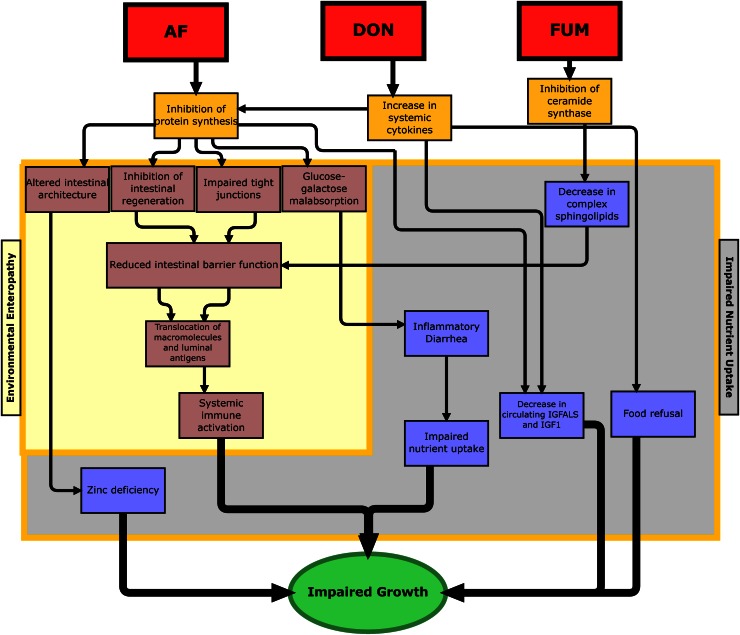
Childhood stunting is an important and intractable public health problem that underlies ~20% of deaths among children aged <5 y in developing countries. Environmental enteropathy (EE), a subclinical condition of the small intestine characterized by reduced absorptive capacity and increased intestinal permeability, is almost universal among children in developing countries and may mediate stunting. However, the etiology of EE is poorly understood. Mycotoxins are metabolites of fungi that frequently contaminate the staple foods of children living in developing countries. We review evidence from human and animal studies that exposure to mycotoxins, particularly aflatoxin (AF), fumonisin (FUM), and deoxynivaenol (DON), may impair child growth. Although these toxins have distinct actions, they all mediate intestinal damage through: 1) inhibition of protein synthesis (AF, DON); 2) an increase in systemic proinflammatory cytokines (DON); and 3) inhibition of ceramide synthase (FUM). The intestinal pathology that arises from mycotoxin exposure is very similar to that of EE. We propose that future studies should address the role of mycotoxins in the pathogenesis of EE and evaluate interventions to limit mycotoxin exposure and reduce childhood stunting.
Conflict of interest statement
Author disclosures: L. E. Smith, R. J. Stoltzfus, and A. Prendergast, no conflicts of interest.
Figures
References
-
- Black RE, Allen LH, Bhutta ZA, Caulfield LE, de Onis M, Ezzati M, Mathers C, Rivera J. Maternal. Maternal and child undernutrition 1: maternal and child undernutrition. Global and regional exposures and health consequences. Lancet. 2008;371:243–60 - PubMed
-
- McKay S, Gaudier E, Campbell DI, Prentice AM, Albers R. Environmental enteropathy: new targets for nutritional interventions. Int Health. 2010;2:172–80 - PubMed
-
- Lunn PG, Northropclewes CA, Downes RM. Intestinal permeability, mucosal injury, and growth faltering in Gambian infants. Lancet. 1991;338:907–10 - PubMed
-
- Campbell DI, Elia M, Lunn PG. Growth faltering in rural Gambian infants is associated with impaired small intestinal barrier function, leading to endotoxemia and systemic inflammation. J Nutr. 2003;133:1332–8 - PubMed
Publication types
MeSH terms
Substances
LinkOut - more resources
Full Text Sources
Medical
