


Environmental epigenetics: a role in endocrine disease?
- PMID: 22798698
- PMCID: PMC3752847
- DOI: 10.1530/JME-12-0066
Environmental epigenetics: a role in endocrine disease?
Abstract
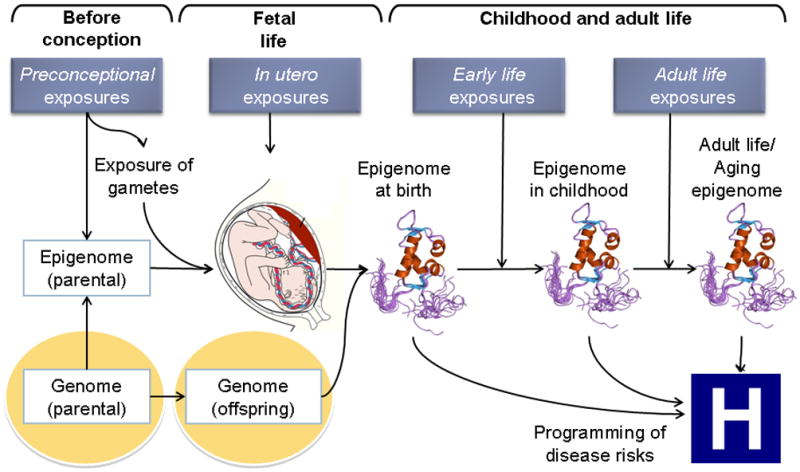
Endocrine disrupting chemicals that are structurally similar to steroid or amine hormones have the potential to mimic endocrine endpoints at the receptor level. However, more recently, epigenetic-induced alteration in gene expression has emerged as an alternative way in which environmental compounds may exert endocrine effects. We review concepts related to environmental epigenetics and relevance for endocrinology through three broad examples: 1) effect of early-life nutritional exposures on future obesity and insulin resistance, 2) effect of lifetime environmental exposures such as ionizing radiation on endocrine cancer risk, and 3) potential for compounds previously classified as endocrine disrupting to additionally or alternatively exert effects through epigenetic mechanisms. The field of environmental epigenetics is still nascent, and additional studies are needed to confirm and reinforce data derived from animal models and preliminary human studies. Current evidence suggests that environmental exposures may significantly impact expression of endocrine-related genes and thereby affect clinical endocrine outcomes.
Conflict of interest statement
The authors declare that there is no conflict of interest that could be perceived as prejudicing the impartiality of the research reported.
Figures


References
-
- Chem Biol Interact; Proceedings of the International Symposium on Recent Advances in Benzene Toxicity; Munich, Germany. 9–12 October 2004; 2005. pp. 1–270. - PubMed
-
- Bennett KL, Lee W, Lamarre E, Zhang X, Seth R, Scharpf J, Hunt J, Eng C. HPV status-independent association of alcohol and tobacco exposure or prior radiation therapy with promoter methylation of FUSSEL18, EBF3, IRX1, and SEPT9, but not SLC5A8, in head and neck squamous cell carcinomas. Genes Chromosomes Cancer. 2010;49:319–326. - PubMed
-
- Bird AP, Wolffe AP. Methylation-induced repression--belts, braces, and chromatin. Cell. 1999;99:451–454. - PubMed
Publication types
MeSH terms
Substances
Grants and funding
- R35 CA197449/CA/NCI NIH HHS/United States
- T32 HS00063/HS/AHRQ HHS/United States
- R21 ES019773/ES/NIEHS NIH HHS/United States
- P30 ES000002/ES/NIEHS NIH HHS/United States
- P42ES016454/ES/NIEHS NIH HHS/United States
- R01 ES013744/ES/NIEHS NIH HHS/United States
- P30ES000002/ES/NIEHS NIH HHS/United States
- R01ES020268/ES/NIEHS NIH HHS/United States
- T32 HS000063/HS/AHRQ HHS/United States
- P42 ES016454/ES/NIEHS NIH HHS/United States
- R01 ES020268/ES/NIEHS NIH HHS/United States
- R21ES019773/ES/NIEHS NIH HHS/United States
- R01ES013744/ES/NIEHS NIH HHS/United States
- R21ES020010/ES/NIEHS NIH HHS/United States
- R21 ES020010/ES/NIEHS NIH HHS/United States
LinkOut - more resources
Full Text Sources
Medical
