. 2012 Jul 17:12:526.
doi: 10.1186/1471-2458-12-526.

A comparison of cancer burden and research spending reveals discrepancies in the distribution of research funding

Affiliations

A comparison of cancer burden and research spending reveals discrepancies in the distribution of research funding

Ashley J R Carter et al. BMC Public Health. .

Abstract

Background: Ideally, the distribution of research funding for different types of cancer should be equitable with respect to the societal burden each type of cancer imposes. These burdens can be estimated in a variety of ways; "Years of Life Lost" (YLL) measures the severity of death in regard to the age it occurs, "Disability-Adjusted Life-Years" (DALY) estimates the effects of non-lethal disabilities incurred by disease and economic metrics focus on the losses to tax revenue, productivity or direct medical expenses. We compared research funding from the National Cancer Institute (NCI) to a variety of burden metrics for the most common types of cancer to identify mismatches between spending and societal burden.

Methods: Research funding levels were obtained from the NCI website and information for societal health and economic burdens were collected from government databases and published reports. We calculated the funding levels per unit burden for a wide range of different cancers and burden metrics and compared these values to identify discrepancies.

Results: Our analysis reveals a considerable mismatch between funding levels and burden. Some cancers are funded at levels far higher than their relative burden suggests (breast cancer, prostate cancer, and leukemia) while other cancers appear underfunded (bladder, esophageal, liver, oral, pancreatic, stomach, and uterine cancers).

Conclusions: These discrepancies indicate that an improved method of health care research funding allocation should be investigated to better match funding levels to societal burden.


Figures
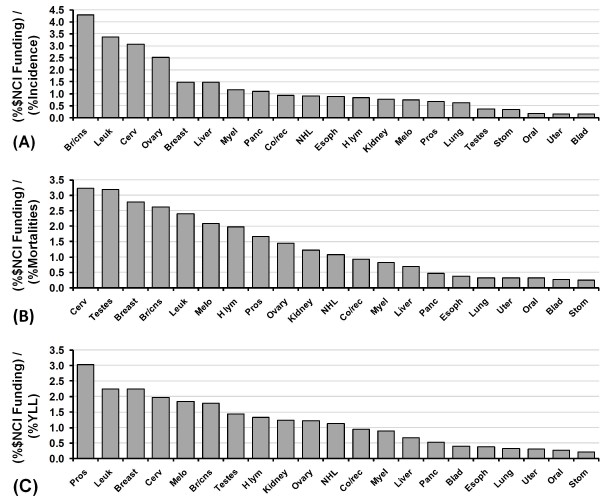
Figure 1
Figure 1
NCI research funding relative to societal health cost. NCI research funding relative to societal health cost. Values are the amount of NCI funding for each cancer expressed as a percentage of overall funding divided by the (a) percentage of incidences, (b) percentage of mortalities or (c) value of YLL as a percentage of the overall value for all 21 cancers.
Figure 2
Figure 2
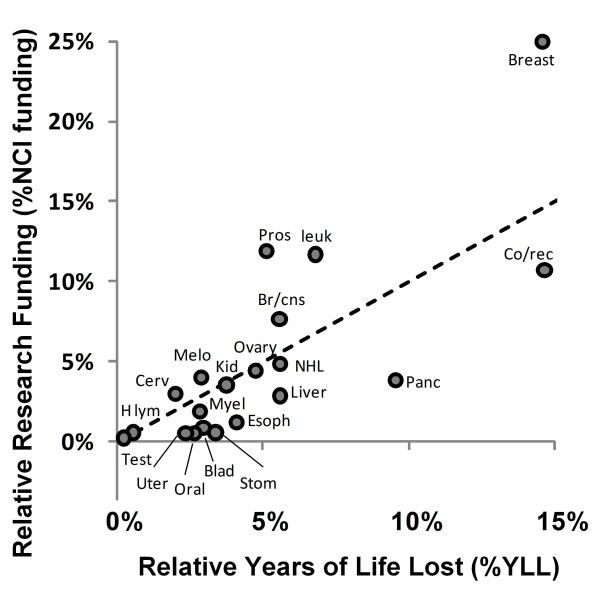
NCI research funding relative to societal health cost as measured by YLL. Dashed line indicates funding if resources are equitably shared according to burden imposed by YLL, cancers above the line receive more funding relative to YLL than expected whereas cancers below the line receive less. Due to its extremely large %YLL (approx. 30%) and relatively low funding (approx. 10%), lung cancer is excluded from this plot and was not used in these calculations.
Figure 3
Figure 3
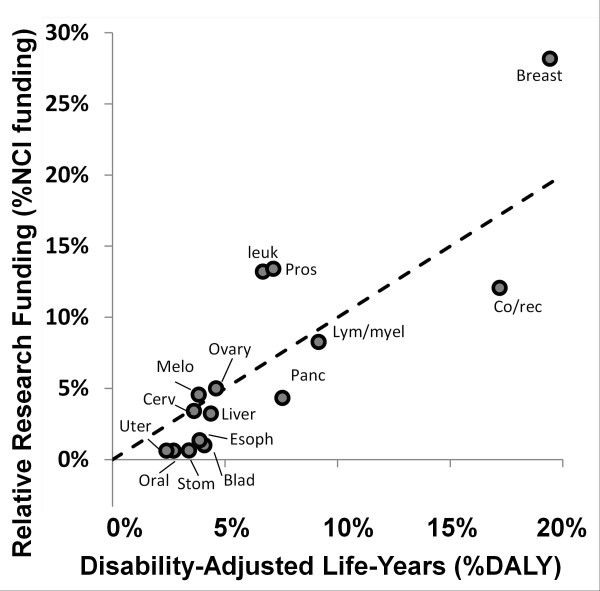
NCI research funding relative to societal health cost as measured by DALYs. Dashed line indicates funding if resources are equitably shared according to burden imposed by DALY, cancers above the line receive more funding relative to DALY than expected whereas cancers below the line receive less. Due to its extremely large %DALY (approx. 30%) and relatively low funding (approx. 10%), lung cancer is excluded from this plot and was not used in these calculations.
Figure 4
Figure 4
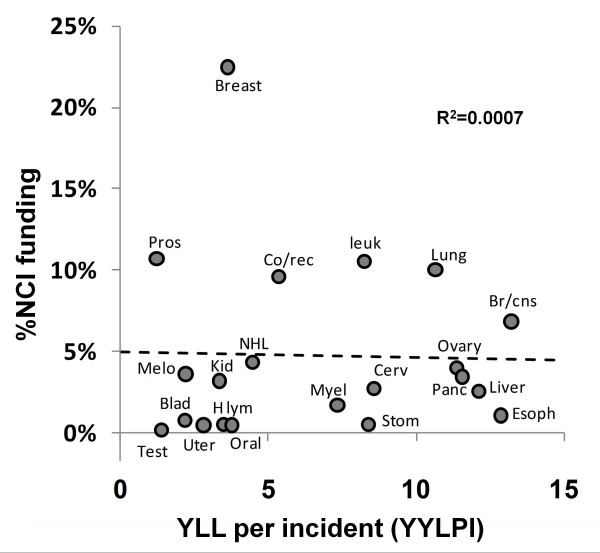
NCI research funding relative to YLLPI. Dashed line indicates linear regression and the R2 of 0.0007 indicates that NCI research funding is not associated with YYLPI. Removal of the extreme value for breast cancer from this plot does result in a slight non-significant positive relationship (R2 = 0.0223).
Figure 5
Figure 5
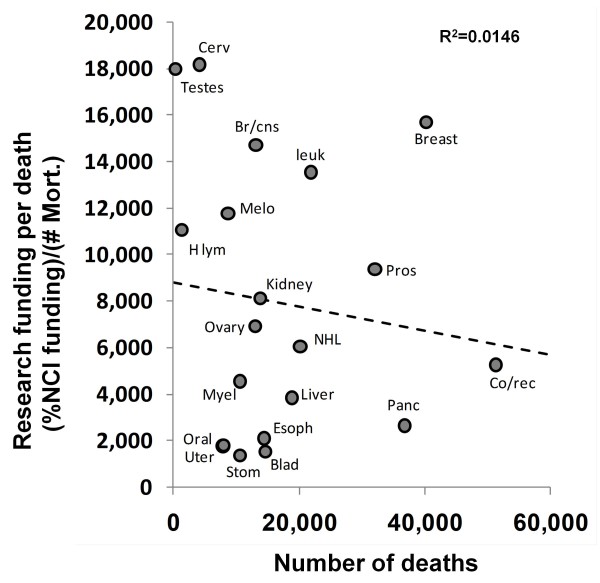
NCI research funding relative to total number of deaths. Dashed line indicates linear regression and the R2 of 0.0146 indicates virtually no relationship between the number of deaths due to each cancer and the funding per death. Due to its extremely large number of deaths (approx. 160,000) and relatively low funding (approx. $1800 per death), lung cancer is excluded from this plot. Removal of the extreme value for testes cancer from this plot reverses the relationship (positive slope, R2 = 0.008), but it remains non-significant.
Figure 6
Figure 6
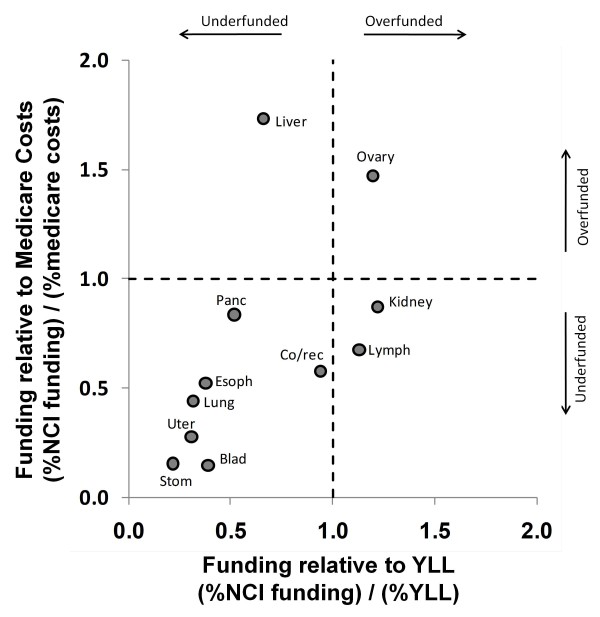
NCI research funding relative to Medicare payment costs[[20]]and YLL. Dashed lines indicate borders between regions that are underfunded (%funding < % cost or %YLL) and overfunded (%funding > % cost or %YLL). Several cancers have funding ratios exceeding 2.0 for one axis or the other and are therefore considerably overfunded according to the criteria corresponding to that axis. To focus on underfunded cancers, those cancers (breast, leukemia, melanoma, prostate, and brain/cns) are not depicted. Note also that economic data for myeloma, oral cancer and testes cancer was not available and the lymphoma data represents both Hodgkin's and non-Hodgkin's lymphomas combined.
Figure 7
Figure 7
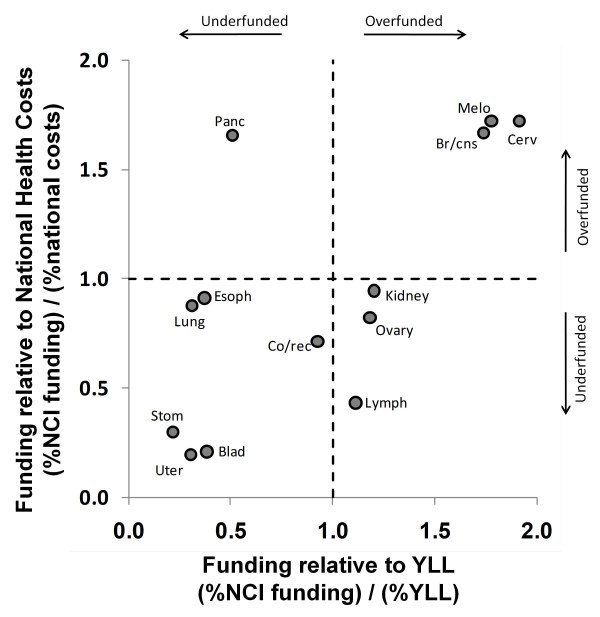
NCI research funding relative to estimated Total National medical costs[[21]]and YLL. Dashed lines indicate borders between regions that are underfunded (%funding < % cost or %YLL) and overfunded (%funding > % cost or %YLL). Several cancers have funding ratios exceeding 2.0 for one axis or the other and are therefore considerably overfunded according to the criteria corresponding to that axis. To focus on underfunded cancers, those cancers (breast, leukemia and prostate) are not depicted. Note also that economic data for liver cancer, myeloma, oral cancer and testes cancer was not available and the lymphoma data represents both Hodgkin's and non-Hodgkin's lymphomas combined.
Figure 8
Figure 8
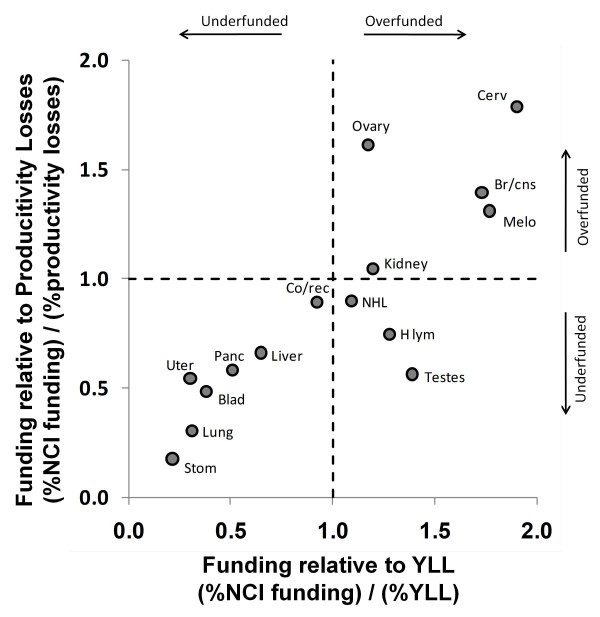
NCI research funding relative to economic costs arising from lost productivity and earnings[[22]]and YLL. Dashed lines indicate borders between regions that are underfunded (%funding < % cost or %YLL) and overfunded (%funding > % cost or %YLL). Several cancers have funding ratios exceeding 2.0 for one axis or the other and are therefore considerably overfunded according to the criteria corresponding to that axis. To focus on underfunded cancers, those cancers (breast, leukemia and prostate) are not depicted. Note also that economic data for esophageal cancer, myeloma and oral cancer was not available.
Figure 9
Figure 9
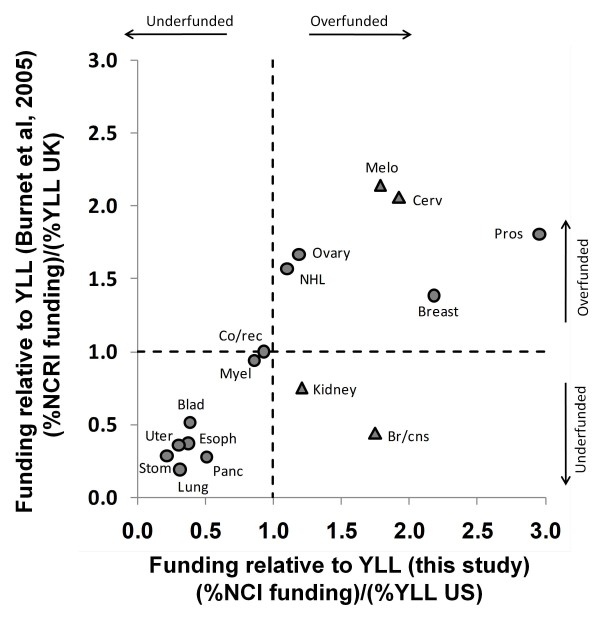
Comparison of research funding relative to YLL as reported for the UK[[8]]and in this study for the US. Dashed lines indicate borders between regions that are underfunded (%funding < % cost or %YLL) and overfunded (%funding > % cost or %YLL). Cancers identified with triangles are those named in the text (and abstract) of Burnet et al. [8] as lying in a "Cinderella" region indicative of underfunding. Several cancers are identified as underfunded in both studies, but only two of the "Cinderella" region cancers appear underfunded according to the UK data and none are underfunded according to our US data. Data for for Hodgkin's lymphoma, liver cancer, oral cancer and testes cancer are not plotted as they were not included in the UK data [8]. Due to its extremely large ratio in the UK study (approx. 5.83) leukemia is excluded from this plot although the values were used in the calculation of the relative funding and YLL values for the remaining cancer types.
Figure 10
Figure 10
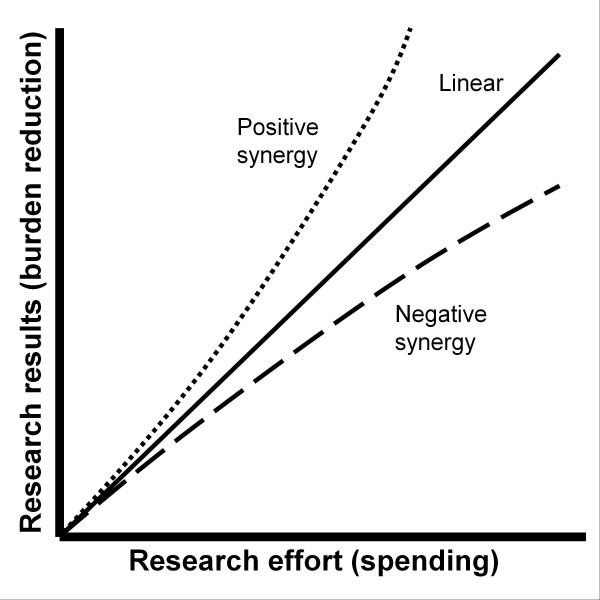
Hypothetical relationships between research effort (I.E., dollars) and results (metric unspecified). If each dollar spent generates results that lead to the same decrease in burden then the relationship between effort and results would be a linear one (solid line). Positive synergistic effects would cause results, per dollar, to increase with the total funding amount (dotted line). Negative synergistic effects would cause results, per dollar, to decrease with the total funding amount (dashed line). Which of these relationships is likely to be true is unclear, but each leads to different optimal approaches for the distribution of research effort.

References

    1. Jemal A, Siegel R, Jiaquan X, Ward E. Cancer Statistics, 2010. CA: A Cancer Journal for Clinicians. 2010;60:277–300. doi: 10.3322/caac.20073. - DOI - PubMed
    1. Gross CP, Anderson GF, Powe NR. The relation between funding by the National Institutes of Health and the burden of disease. N Engl J Med. 1999;340(24):1881–1887. doi: 10.1056/NEJM199906173402406. - DOI - PubMed
    1. Gardner JW, Sanborn JS. Years of potential life lost (YPLL)–what does it measure? Epidemiology. 1990;1(4):322–329. doi: 10.1097/00001648-199007000-00012. - DOI - PubMed
    1. Murphy SL, Xu J, Kochanek KD. Deaths: Preliminary Data for. Natl Vital Stat Rep. 2010;60(4):51. - PubMed
    1. Nahin RL. Identifying and pursuing research priorities at the National Center for Complementary and Alternative Medicine. FASEB J. 2005;19:1209–1215. doi: 10.1096/fj.05-3727LFE. - DOI - PubMed

Publication types

MeSH terms