


Investigation into longitudinal dietary behaviours and household socio-economic indicators and their association with BMI Z-score and fat mass in South African adolescents: the Birth to Twenty (Bt20) cohort
- PMID: 22801035
- PMCID: PMC10271871
- DOI: 10.1017/S1368980012003308
Investigation into longitudinal dietary behaviours and household socio-economic indicators and their association with BMI Z-score and fat mass in South African adolescents: the Birth to Twenty (Bt20) cohort
Abstract
Objective: The present study aimed to assess the relationship between dietary habits, change in socio-economic status and BMI Z-score and fat mass in a cohort of South African adolescents.
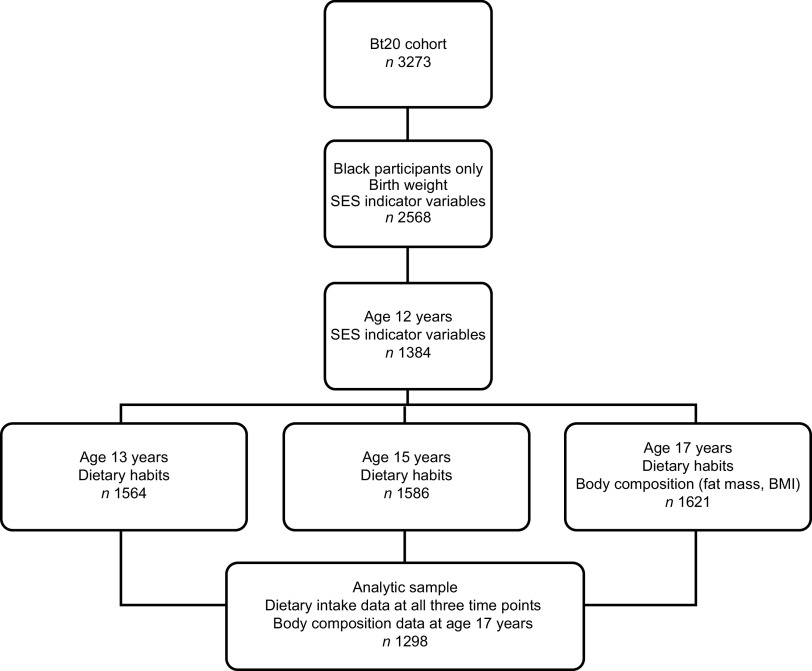
Design: In the longitudinal study, data were collected at ages 13, 15 and 17 years on a birth cohort who have been followed since 1990. Black participants with complete dietary habits data (breakfast consumption during the week and at weekends, snacking while watching television, eating main meal with family, lunchbox use, number of tuck shop purchases, fast-food consumption, confectionery consumption and sweetened beverage consumption) at all three ages and body composition data at age 17 years were included in the analyses. Generalized estimating equations were used to test the associations between individual longitudinal dietary habits and obesity (denoted by BMI Z-score and fat mass) with adjustments for change in socio-economic status between birth and age 12 years.
Setting: Birth to Twenty (Bt20) study, Soweto-Johannesburg, South Africa.
Subjects: Adolescents (n 1298; 49·7 % male).
Results: In males, the multivariable analyses showed that soft drink consumption was positively associated with both BMI Z-score and fat mass (P < 0·05). Furthermore, these relationships remained the same after adjustment for socio-economic indicators (P < 0·05). No associations were found in females.
Conclusions: Longitudinal soft drink consumption was associated with increased BMI Z-score and fat mass in males only. Fridge ownership at birth (a proxy for greater household disposable income in this cohort) was shown to be associated with both BMI Z-score and fat mass.
Figures
References
-
- Steyn K, Fourie J & Temple N (2006) Chronic Diseases of Lifestyle in South Africa: 1995–2005. Technical Report. Cape Town: Medical Research Council.
-
- Mayosi BM, Flisher AJ, Lalloo UG et al. (2009) The burden of non-communicable diseases in South Africa. Lancet 374, 934–947. - PubMed
-
- Bourne LT, Lambert EV & Steyn K (2002) Where does the black population of South Africa stand on the nutrition transition? Public Health Nutr 5, 157–162. - PubMed
-
- International Association for the Study of Obesity (2010) About Obesity. London: IASO.
-
- Department of Health, Medical Research Council & OrcMacro (2007) The South African Demographic and Health Survey (SADHS) 2003. Pretoria: Department of Health.
Publication types
MeSH terms
Grants and funding
LinkOut - more resources
Full Text Sources
Medical
