. 2012 Sep;32(18):3732-42.
doi: 10.1128/MCB.00615-12. Epub 2012 Jul 16.

The KRAB zinc finger protein RSL1 regulates sex- and tissue-specific promoter methylation and dynamic hormone-responsive chromatin configuration

Affiliations

The KRAB zinc finger protein RSL1 regulates sex- and tissue-specific promoter methylation and dynamic hormone-responsive chromatin configuration

Christopher J Krebs et al. Mol Cell Biol. 2012 Sep.

Abstract

Over 400 Krüppel-associated box zinc finger proteins (KRAB-ZFPs) are encoded in mammalian genomes. While KRAB-ZFPs strongly repress transcription in vitro, little is known about their biological function or gene targets in vivo. Regulator of sex limitation 1 (Rsl1), one of the first KRAB-Zfp genes assigned a physiological role, accentuates sex-biased liver gene expression, most dramatically for mouse sex-limited protein (Slp), which provides an in vivo reporter of KRAB-ZFP function. Slp is induced in males in the liver and kidney by growth hormone (GH) and androgen, respectively. In the liver but not kidney, the Rsl1 genotype correlates with methylation of a CpG dinucleotide in the Slp promoter that is demethylated at puberty. RSL1 binds 2 kb upstream of the Slp promoter, both in vitro and in vivo, within an enhancer containing response elements for STAT5b. Chromatin immunoprecipitation (ChIP) assays demonstrate that RSL1 recruits KAP1/TRIM28, the corepressor for KRAB action in vitro, to this enhancer. Slp induction requires rapid cycling of STAT5b in chromatin. Remarkably, RSL1 simultaneously binds adjacent to STAT5b with a reciprocal binding pattern that limits hormonal response. These experiments demonstrate a surprisingly dynamic interplay between a hormonal activator, STAT5b, and a KRAB-ZFP repressor and provide unique insights into KRAB-ZFP epigenetic mechanisms.


Figures
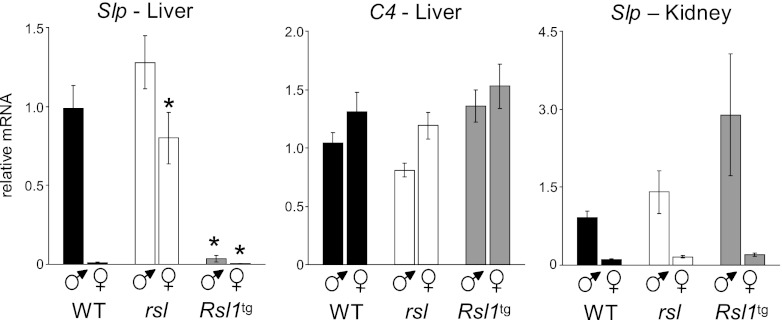
Fig 1
Fig 1
Rsl1 affects sex- and tissue-specific expression of Slp. Slp and C4 RNAs in liver and kidney of WT, rsl, and Rsl1tg mice were measured by qRT-PCR. To compare relative expression across sex and genotype, data were normalized to those for WT males. Bars indicate means ± SEMs; n ≥ 3 mice per group. *, significant differences (P < 0.001) from WT mice of the same sex. ♂, male; ♀, female.
Fig 2
Fig 2
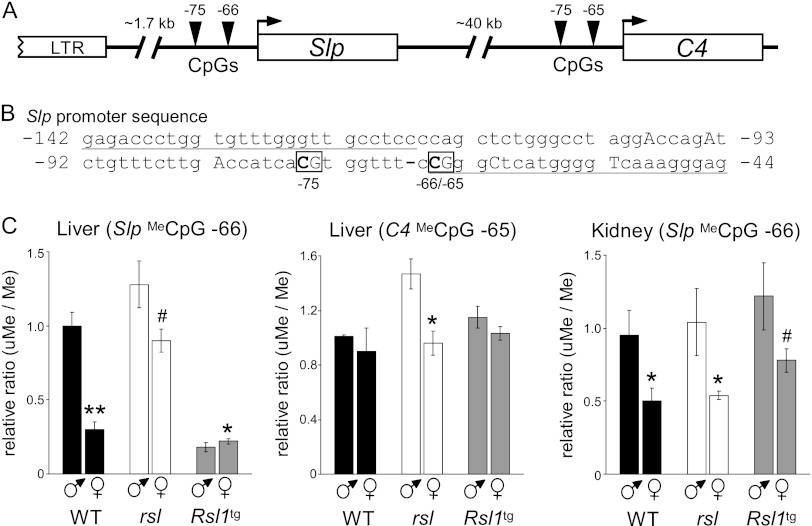
Analysis of Slp and C4 promoters by quantitative methylation-specific PCR. (A) Slp/C4 locus. Triangles indicate CpG dinucleotides near the transcription start of each gene (bp −75 and −66/65). The ancient retrovirus upstream of Slp (LTR) is not present upstream of C4. (B) Slp promoter sequence amplified by methylation-specific primers. The −66 and −75 CpGs are boxed; bases in capital letters differ between Slp and C4; hyphen, a 1-bp deletion in C4 relative to the Slp sequence. (C) Relative ratio of unmethylated (uMe) to methylated (Me) PCR product for Slp and C4 in WT, rsl, and Rsl1tg mouse liver and kidney. Data were normalized to one WT male in each assay. Bars indicate the mean ± SEM; n = 3 mice per group. Sex differences within genotypes are indicated: **, P = 0.002; #, P < 0.1; *, P < 0.05.
Fig 3
Fig 3
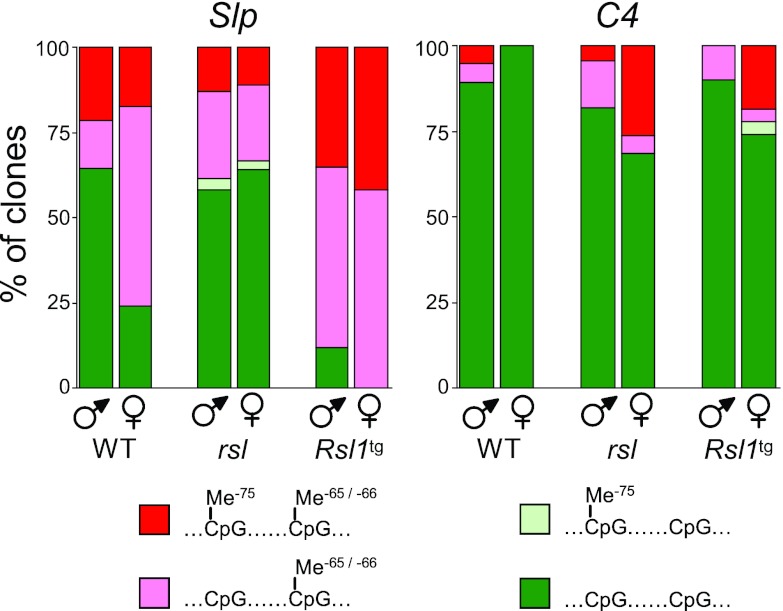
Analysis of Slp and C4 promoter methylation by bisulfite sequencing. Liver DNA from each sex of WT, rsl, and Rsl1tg mice was treated with sodium bisulfite. A 100-bp region encompassing CpG −65/−66 and CpG −75 was PCR amplified and cloned into pCR2.1Topo. At least 20 clones per sex and genotype were sequenced, and the percentage of clones methylated or not at one or both CpGs was charted.
Fig 4
Fig 4
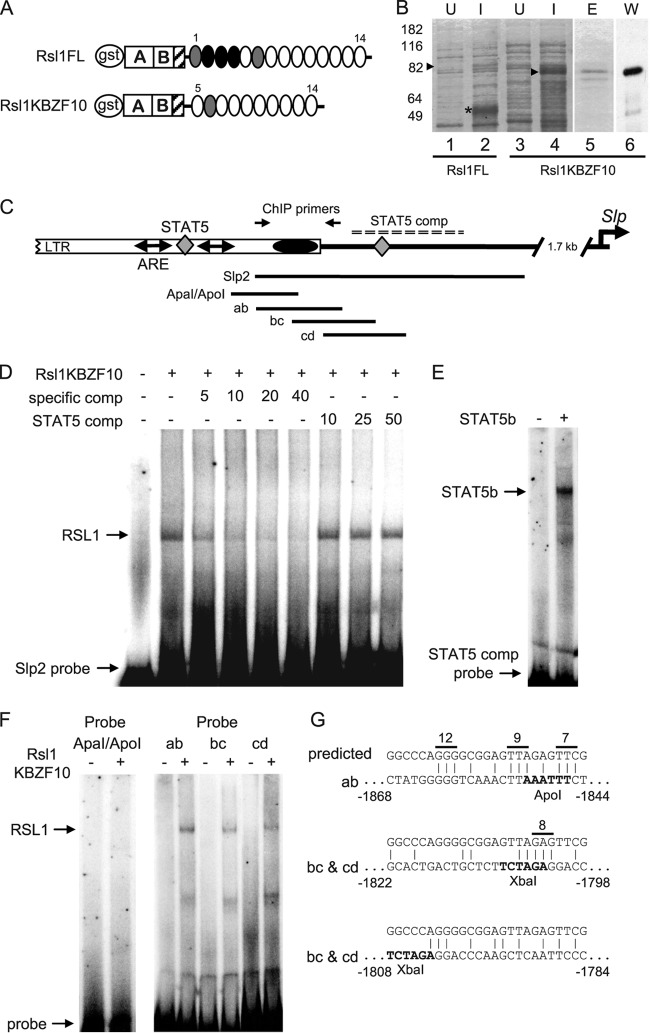
In vitro identification of an RSL1 binding site upstream of Slp. (A) Gst-Rsl1 fusion proteins expressed in E. coli. FL, full-length protein. ZNFs 1 to 4 are deleted in Rsl1KBZF10. GST and KRAB A and B domains are indicated; striped box, peptide antigen for RSL1 antisera; ovals, ZNFs; gray ovals, degenerate ZNFs lacking C or H residue for zinc coordination (18); black ovals, ZNFs inhibiting RSL1 expression in E. coli. (B) SDS-PAGE analysis of lysates from bacteria transformed with Gst-Rsl1 FL (lanes 1 and 2) or Gst-Rsl1KBZF10 (lanes 3 to 6). U and I, uninduced and induced with IPTG, respectively; E, eluted protein; W, Western blot of eluted Rsl1KBZF10 probed with RSL1 antibody; arrowheads, expected protein positions; asterisk, truncated or degraded fusion protein upon induction of Gst-Rsl1FL. (C) Sequence elements 1.7 to 2.0 kb 5′ to Slp. Open rectangle, proviral 5′ LTR; double-headed arrows and diamonds, AREs and STAT5 sites, respectively; black oval at the LTR end, the RSL1 binding site; arrows, primers used for ChIP; dashed line, STAT5 competitor. The locations of other EMSA probes are shown below the diagram. (D) EMSA with Rsl1KBZF10 and Slp2 probes. A molar excess of nonradioactive competitors (comp) is indicated. The specific competitor was Slp2 (bp −1696 to −1874 from Slp position bp +1) or an 80-bp sequence from bp −1728 to −1807 that contains the proximal STAT5 consensus (dashed line in panel C). (E) To verify STAT5b binding, labeled 80-bp competitor was incubated with in vitro-transcribed/translated STAT5b for EMSA. (F) To delimit RSL1 binding, EMSA was performed with the ApaI/ApoI probe and overlapping 75-bp probes ab, bc, and cd. A shift occurs with each 75-bp probe but is most evident with probe ab. (G) The predicted RSL1 binding site based on the ZNF code (16) (top sequence) is aligned to regions with the best identity within Slp2 (bottom sequence). Lines above the predicted sequence indicate putative contacts for ZNFs 7, 8, 9, and 12. The 75-bp EMSA probe that contains the site is indicated. The location of each site relative to Slp position bp +1 is indicated.
Fig 5
Fig 5
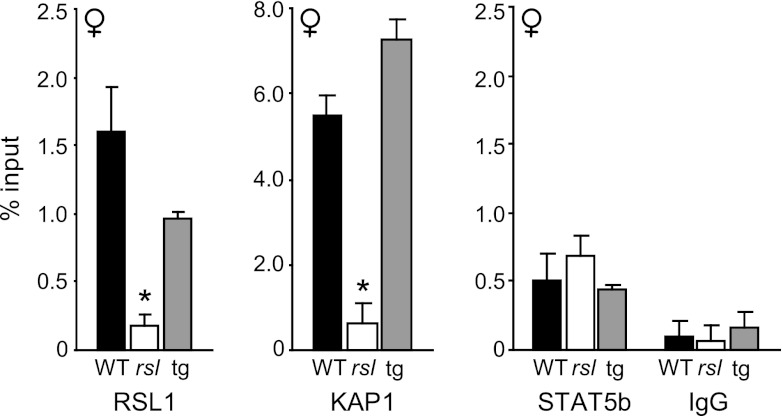
RSL1, KAP1, and STAT5b bind upstream of Slp in female liver. ChIP assays were performed for RSL1, KAP1, and STAT5b on liver from pairs of adult female WT, rsl, and Rsl1tg mice using primers flanking the RSL1 binding site, as shown in Fig. 4. IgG served as a negative control. Bars are the mean of the percent input ± SEM. RSL1, STAT5b, and IgG were plotted on the same scale to demonstrate low and similar binding of STAT5b in all genotypes. *, significant difference (P < 0.05) from WT.
Fig 6
Fig 6
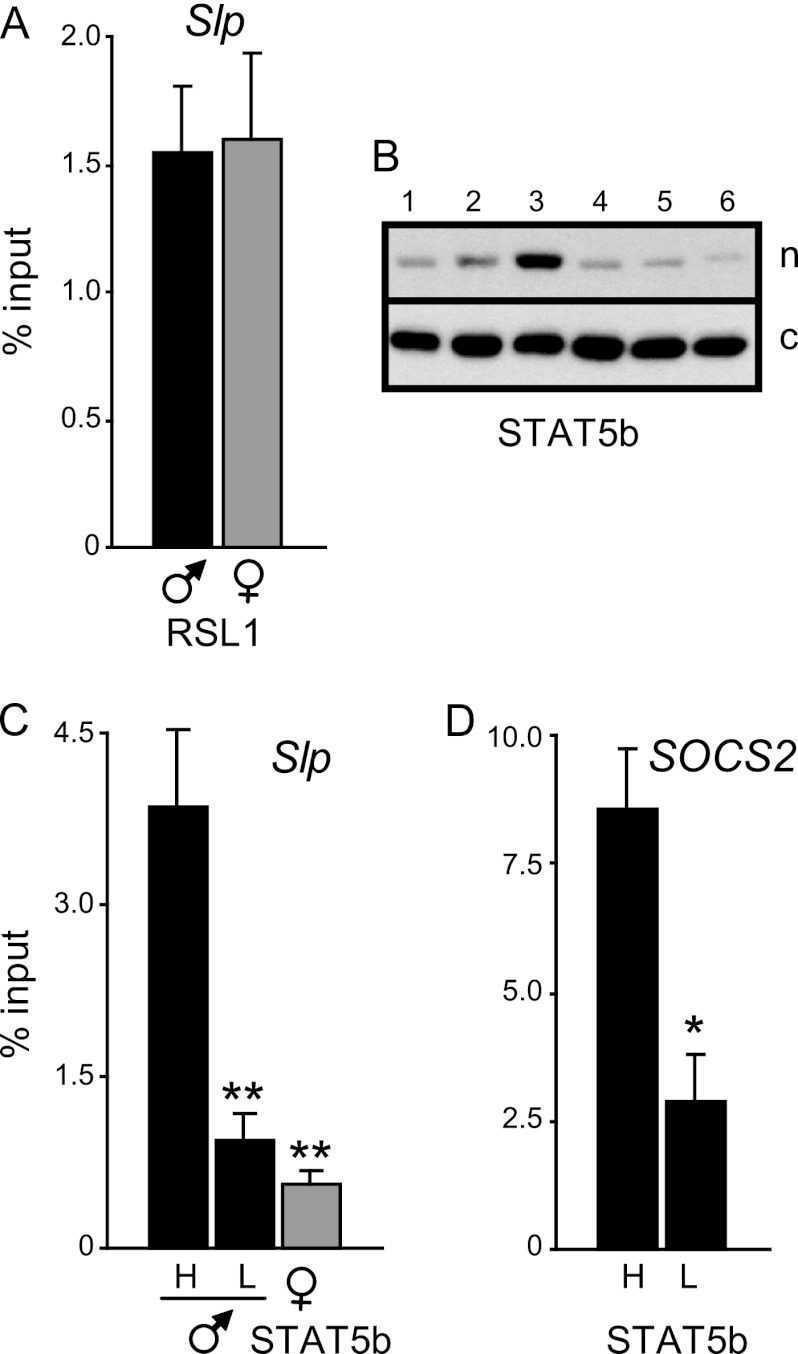
Sex- and hormone-dependent binding of RSL1 and STAT5b to the Slp enhancer in WT mouse liver. (A) ChIP assays were performed for RSL1 on liver from WT males (n = 5; inputs ranged from 1.26% to 2.98%) and females (n = 3; inputs ranged from 1.01% to 2.14%). Bars are the mean of the percent input ± SEM. (B) Western blots of male liver nuclear (n) and cytoplasmic (c) extracts probed for STAT5b to assess the range in STAT5b levels due to nuclear cycling. (C) ChIP result for STAT5b binding to Slp. H, high nuclear STAT5b (e.g., lane 3 in panel B; n = 3); L, low nuclear STAT5b (e.g., lanes 5 and 6 in panel B; n = 5). Bars are the mean of the percent input ± SEM. ChIP results for STAT5b in WT female liver highlight sex-specific binding. (D) STAT5b ChIP for SOCS2 in WT males. H, GH-injected males (n = 4). Significant differences from WT males are indicated: *, P < 0.05; **, P < 0.005.
Fig 7
Fig 7
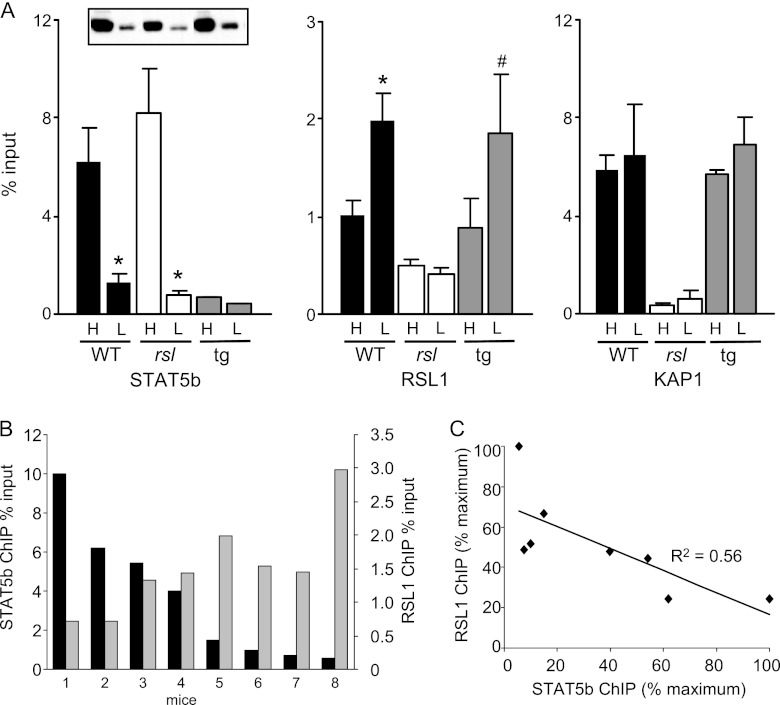
Dynamic interaction of RSL1, KAP1, and STAT5b on the Slp enhancer in male liver. To assess factor binding relative to STAT5b levels, male mice were injected with GH 30 min prior to isolation of livers (peak) or not (trough); STAT5b levels were confirmed by Western blotting of nuclear lysates. (A) ChIP data graphed as mean of the percent input ± SEM (n = 2 to 4 mice per group). (Inset) Western blot showing relative levels of nuclear STAT5b in representative individuals in the same lane order as the ChIP data. H, high nuclear STAT5b; L, low nuclear STAT5b. Immunoprecipitation with RSL1 antibody in WT and Rsl1tg males was approximately 25% of that obtained with antibodies to STAT5b or KAP1 but was significantly above the IgG negative-control level (mean = 0.3 ± 0.04% input; P < 0.001). Significant differences between high and low nuclear STAT5b are indicated: *, P < 0.05; #, P = 0.11. (B) RSL1 and STAT5b bind reciprocally in WT males. STAT5b ChIP results from 8 WT males (dark bars) were arranged from highest to lowest and graphed next to the corresponding RSL1 ChIP data (light bars). (C) ChIP results were plotted as percent maximum, defined as the individual with the greatest percent input value. R2, correlation coefficient.
Fig 8
Fig 8
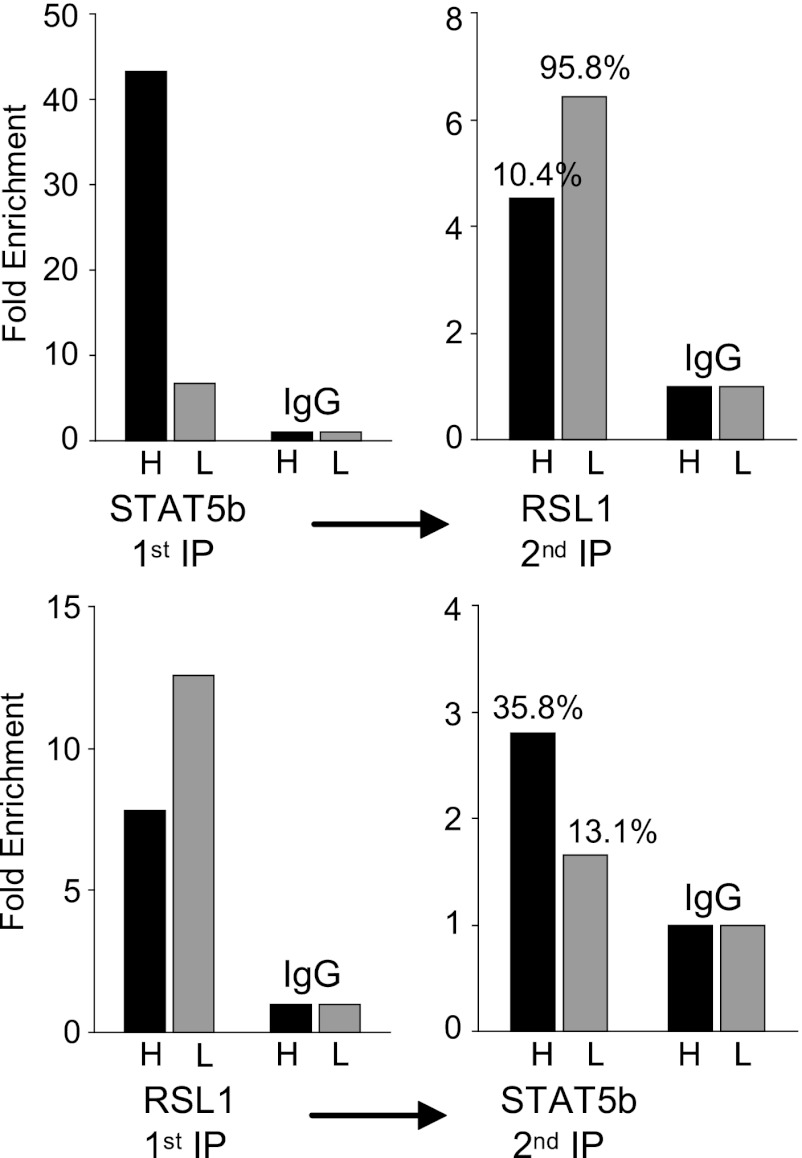
STAT5b and RSL1 cooccupancy at the Slp enhancer varies in accord with GH. Re-ChIP was performed on WT males that were treated with GH (high [H]) or not (low [L]), as described in the legend to Fig. 7. Results are fold enrichment relative to the IgG negative control. (Top) Re-ChIP results with the STAT5b antibody used first and the RSL1 antibody used second; (bottom) reciprocal experiment. Numbers denote the percentage of the first IP with cooccupied complexes.
Fig 9
Fig 9
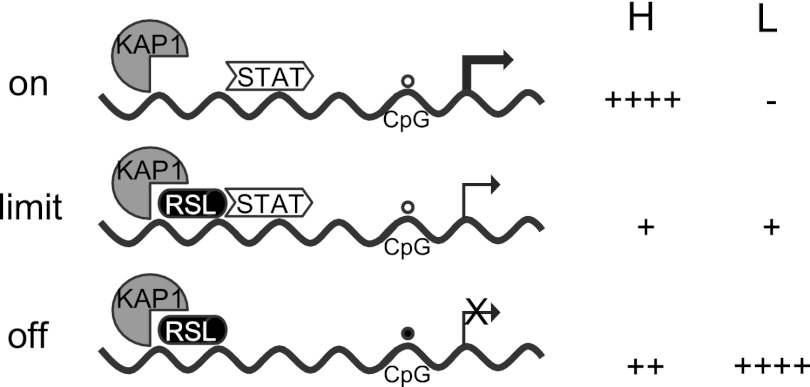
Interplay of opposing forces on the Slp enhancer. In males, STAT5b transitions from high to low chromatin binding at the peak (high [H]) and trough (low [L]) of the GH pulse. RSL1 binding is qualitatively reciprocal to that of STAT5b; KAP1 presence is more invariant. Although the STAT5b transition is complete, some RSL1 is always bound. Circles, methylation status (open, unmethylated; closed, methylated) of the −66 Slp CpG. The size of the arrow indicates transcription expected on the basis of the bound protein complex. +, relative proportion of the corresponding complexes on the basis of the re-ChIP data. Females bear similarity to males during the GH trough.

References

    1. Ayyanathan K, et al. 2003. Regulated recruitment of HP1 to a euchromatic gene induces mitotically heritable, epigenetic gene silencing: a mammalian cell culture model of gene variegation. Genes Dev. 17: 1855–1869 - PMC - PubMed
    1. Boyd KE, Farnham PJ. 1999. Coexamination of site-specific transcription factor binding and promoter activity in living cells. Mol. Cell. Biol. 19: 8393–8399 - PMC - PubMed
    1. Chia DJ, Rotwein P. 2010. Defining the epigenetic actions of growth hormone: acute chromatin changes accompany GH-activated gene transcription. Mol. Endocrinol. 24: 2038–2049 - PMC - PubMed
    1. Choi HK, Waxman DJ. 2000. Pulsatility of growth hormone (GH) signalling in liver cells: role of the JAK-STAT5b pathway in GH action. Growth Horm. IGF Res. 10(Suppl B): S1–S8 - PubMed
    1. Chomczynski P, Sacchi N. 1987. Single-step method of RNA isolation by acid guanidinium thiocyanate-phenol-chloroform extraction. Anal. Biochem. 162: 156–159 - PubMed

Publication types