


Differences in risk factors for coronary heart disease among diabetic and nondiabetic individuals from a population with high rates of diabetes: the Strong Heart Study
- PMID: 22802089
- PMCID: PMC3674295
- DOI: 10.1210/jc.2012-2110
Differences in risk factors for coronary heart disease among diabetic and nondiabetic individuals from a population with high rates of diabetes: the Strong Heart Study
Abstract
Context: Coronary heart disease (CHD) is the leading cause of death in the United States.
Objective: This study compares differences in risk factors for CHD in diabetic vs. nondiabetic Strong Heart Study participants.
Design: This was an observational study.
Setting: The study was conducted at three centers in Arizona, Oklahoma, and North and South Dakota.
Participants: Data were obtained from 3563 of 4549 American Indians free of cardiovascular disease at baseline.
Intervention(s): CHD events were ascertained during follow-up.
Main outcome measure: CHD events were classified using standardized criteria.
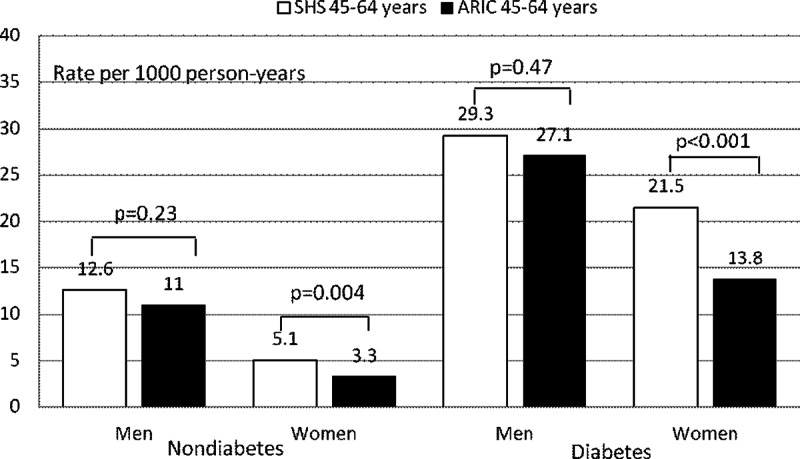
Results: In diabetic and nondiabetic participants, 545 and 216 CHD events, respectively, were ascertained during follow-up (21,194 and 22,990 person-years); age- and sex-adjusted incidence rates of CHD were higher for the diabetic group (27.5 vs. 12.1 per 1,000 person-years). Risk factors for incident CHD common to both groups included older age, male sex, prehypertension or hypertension, and elevated low-density lipoprotein cholesterol. Risk factors specific to the diabetic group were lower high-density lipoprotein cholesterol, current smoking, macroalbuminuria, lower estimated glomerular filtration rate, use of diabetes medication, and longer duration of diabetes. Higher body mass index was a risk factor only for the nondiabetic group. The association of male sex and CHD was greater in those without diabetes than in those with diabetes.
Conclusions: In addition to higher incidence rates of CHD events in persons with diabetes compared with those without, the two groups differed in CHD risk factors. These differences must be recognized in estimating CHD risk and managing risk factors.
Figures
References
-
- Roger VL, Go AS, Lloyd-Jones DM, Benjamin EJ, Berry JD, Borden WB, Bravata DM, Dai S, Ford ES, Fox CS, Fullerton HJ, Gillespie C, Hailpern SM, Heit JA, Howard VJ, Kissela BM, Kittner SJ, Lackland DT, Lichtman JH, Lisabeth LD, Makuc DM, Marcus GM, Marelli A, Matchar DB, Moy CS, Mozaffarian D, Mussolino ME, Nichol G, Paynter NP, Soliman EZ, Sorlie PD, Sotoodehnia N, Turan TN, Virani SS, Wong ND, Woo D, Turner MB. 2012. Heart disease and stroke statistics—2012 update: a report from the American Heart Association. Circulation 125:e2–e220 - PMC - PubMed
-
- Nelson RG, Sievers ML, Knowler WC, Swinburn BA, Pettitt DJ, Saad MF, Liebow IM, Howard BV, Bennett PH. 1990. Low incidence of fatal coronary heart disease in Pima Indians despite high prevalence of non-insulin-dependent diabetes. Circulation 81:987–995 - PubMed
-
- Sievers ML, Fisher KR. 1979. Increasing rates of acute myocardial infarction in southwestern American Indians. Ariz Med 39:739–742 - PubMed
-
- Howard BV, Lee ET, Cowan LD, Devereux RB, Galloway JM, Go OT, Howard WJ, Rhoades ER, Robbins DC, Sievers ML, Welty TK. 1999. Rising tide of cardiovascular disease in American Indians. The Strong Heart Study. Circulation 99:2389–2395 - PubMed
Publication types
MeSH terms
Grants and funding
LinkOut - more resources
Full Text Sources
Medical
