. 2012 Sep;56(9):4937-44.
doi: 10.1128/AAC.00124-12. Epub 2012 Jul 16.

Consequences of noncompliance for therapy efficacy and emergence of resistance in murine tuberculosis caused by the Beijing genotype of Mycobacterium tuberculosis

Affiliations

Consequences of noncompliance for therapy efficacy and emergence of resistance in murine tuberculosis caused by the Beijing genotype of Mycobacterium tuberculosis

Jurriaan E M de Steenwinkel et al. Antimicrob Agents Chemother. 2012 Sep.

Abstract

Despite great effort by health organizations worldwide in fighting tuberculosis (TB), morbidity and mortality are not declining as expected. One of the reasons is related to the evolutionary development of Mycobacterium tuberculosis, in particular the Beijing genotype strains. In a previous study, we showed the association between the Beijing genotype and an increased mutation frequency for rifampin resistance. In this study, we use a Beijing genotype strain and an East-African/Indian genotype strain to investigate with our mouse TB model whether the higher mutation frequency observed in a Beijing genotype strain is associated with treatment failure particularly during noncompliance therapy. Both genotype strains showed high virulence in comparison to that of M. tuberculosis strain H37Rv, resulting in a highly progressive infection with a rapid lethal outcome in untreated mice. Compliance treatment was effective without relapse of TB irrespective of the infecting strain, showing similar decreases in the mycobacterial load in infected organs and similar histopathological changes. Noncompliance treatment, simulated by a reduced duration and dosing frequency, resulted in a relapse of infection. Relapse rates were correlated with the level of noncompliance and were identical for Beijing infection and East African/Indian infection. However, only in Beijing-infected mice, isoniazid-resistant mutants were selected at the highest level of noncompliance. This is in line with the substantial selection of isoniazid-resistant mutants in vitro in a wide isoniazid concentration window observed for the Beijing strain and not for the EAI strain. These results suggest that genotype diversity of M. tuberculosis may be involved in emergence of resistance and indicates that genotype-tailor-made treatment should be investigated.


Figures
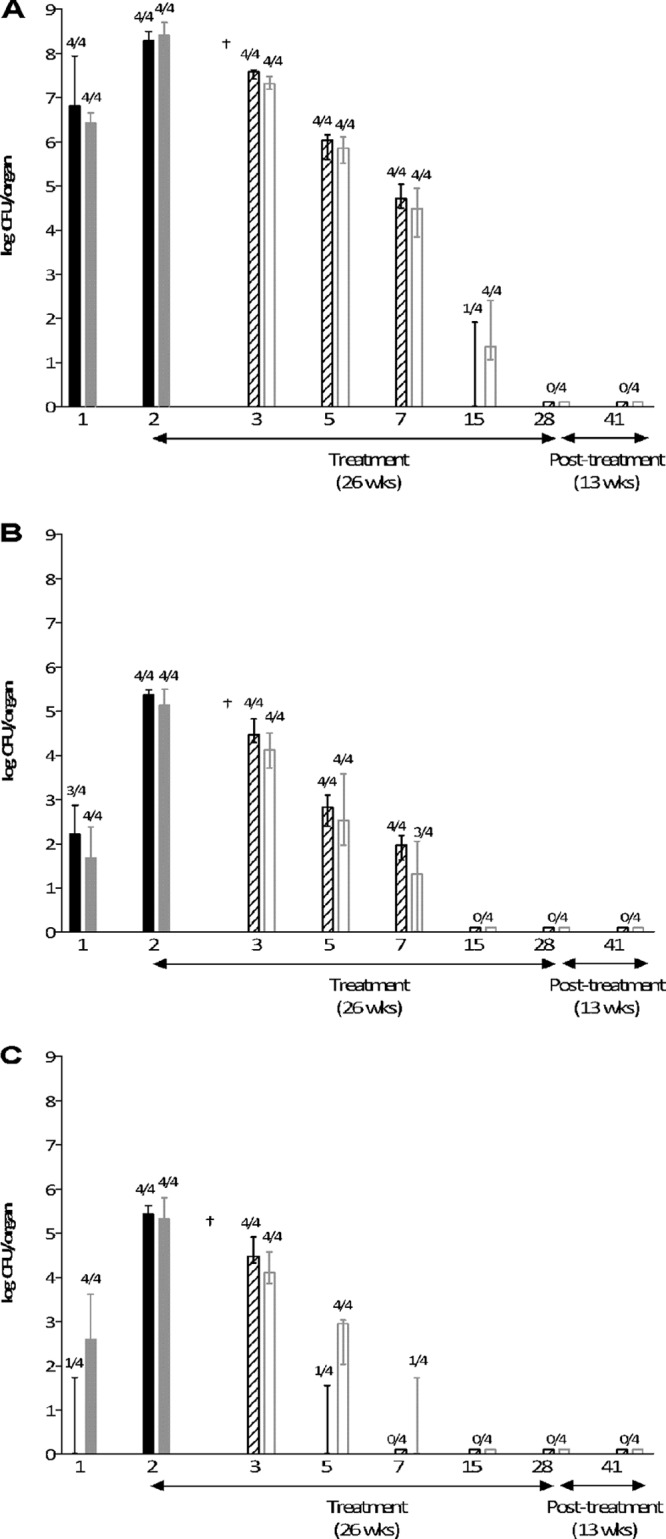
Fig 1
Fig 1
TB infection and efficacy of compliance treatment in mice infected with Beijing-1585 or EAI-1627. The mycobacterial load in lung (A), spleen (B), or liver (C) of the untreated mice, infected with Beijing-1585 (black bars) or EAI-1627 (checkered bars), is shown. Mice receiving therapy started 2 weeks after infection and continued for 26 weeks for BE-1585 (diagonally striped bars) and for EAI-1627 (open bars) are indicated. Results are expressed as median ± range (error bars) of the CFU per organ; n = 4 per time point. Numbers above bars are the numbers of culture-positive mice out of total numbers of mice at that time point. †, 4 out of 4 untreated mice died due to TB infection before this time point.
Fig 2
Fig 2
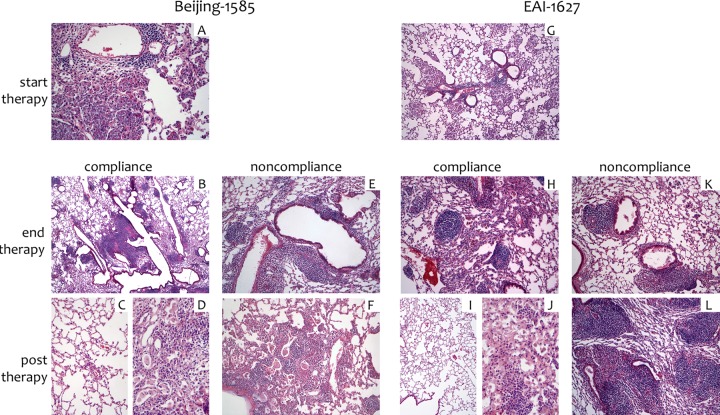
Histology. Lung tissue from mice infected with Beijing-1585 (A to F) or EAI-1627 (G to L) at week 2, start of treatment (A and G), week 28, end of compliance treatment (B and H), week 15, end of noncompliance (once per week) treatment (E and K), week 41, 13 weeks post-compliance treatment (C, D, I, and J), or week 28, 13 weeks post-noncompliance (once per week) treatment (F and L) is shown. (A) Extensive intra-alveolar accumulation of histiocytes is observed, with a peribronchiolar lymphocytic component. Original magnification, ×100. (B) Peribronchiolar infiltrates, predominantly composed of lymphocytes, are seen, admixed with a minor histiocytic component. Magnification, ×25. (C and D) Images from a single lung with highly variable histology, ranging from large areas of normal lung tissue (C) to minor areas of residual densely inflamed lung (D). Magnification, ×50. (E) A moderately dense peribronchiolar predominantly lymphocytic infiltrate is present; no intra-alveolar or interstitial inflammation is seen. Magnification, ×100. (F) A combination of an intra-alveolar histiocytic infiltrate is present with a moderately dense peribronchiolar lymphocytic component; the pattern is similar to but less extensive than the pattern observed in panel A. Magnification, ×100. (G) Intra-alveolar histiocytes with a centrilobular distribution are seen, combined with a minor lymphocytic component. Magnification, ×100. (H) A mild to moderately dense lymphocyte predominant infiltrate is present; a mild increase in alveolar macrophages is also seen. Magnification, ×50. (I and J) Images from a single lung with highly variable histology, ranging from large areas of normal lung tissue (I) (×25) to minor areas of residual densely inflamed lung (J) (×50). (K) A mild to moderately dense peribronchiolar lymphocytic infiltrate is present. Magnification, ×50. (L) A dense lymphohistiocytic infiltrate is present. Magnification, ×25.
Fig 3
Fig 3
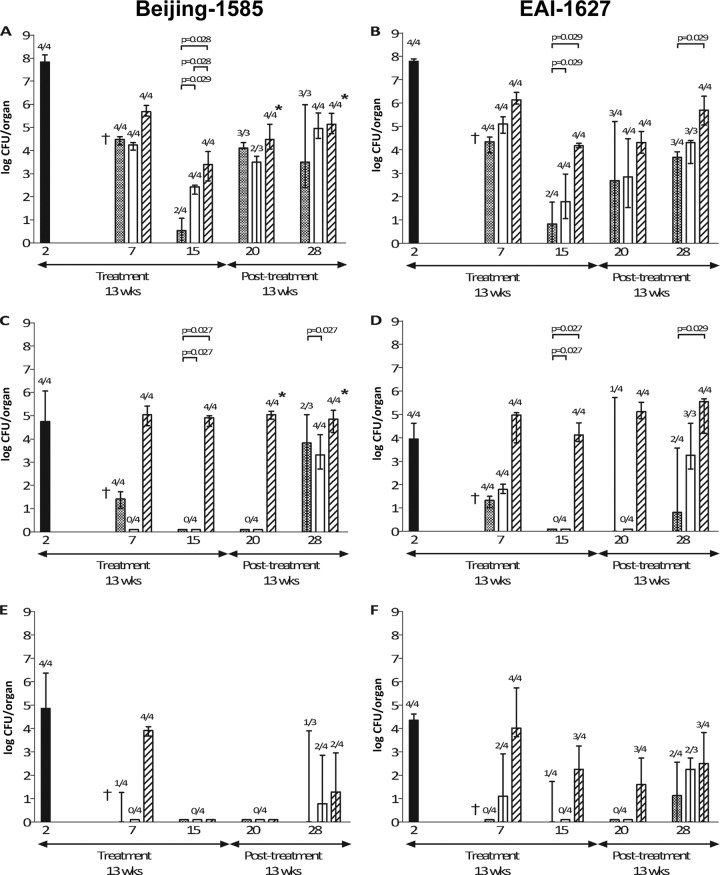
TB infection and efficacy at noncompliance treatment in mice infected with Beijing-1585 (A, C, and E) or EAI-1627 (B, D, and F). Mycobacterial loads in lung (A and B), spleen (C and D), or liver (E and F) of untreated mice (black bars) are shown. Therapy started 2 weeks after infection continued for 13 weeks. Mice received treatment five times per week (checkered bars), three times per week (open bars), or once per week (diagonally striped bars). Results are expressed as medians ± ranges (error bars) of the CFU per organ (n = 4 per time point). Numbers above bars are the numbers of culture-positive mice out of total numbers of mice at that time point. †, 4 out of 4 untreated mice died due to TB before this time point. “*” indicates the presence of isoniazid-resistant mutants. The P values of the statistical evaluation of differences between the noncompliance groups are indicated in the figure if P values were ≤0.05.
Fig 4
Fig 4
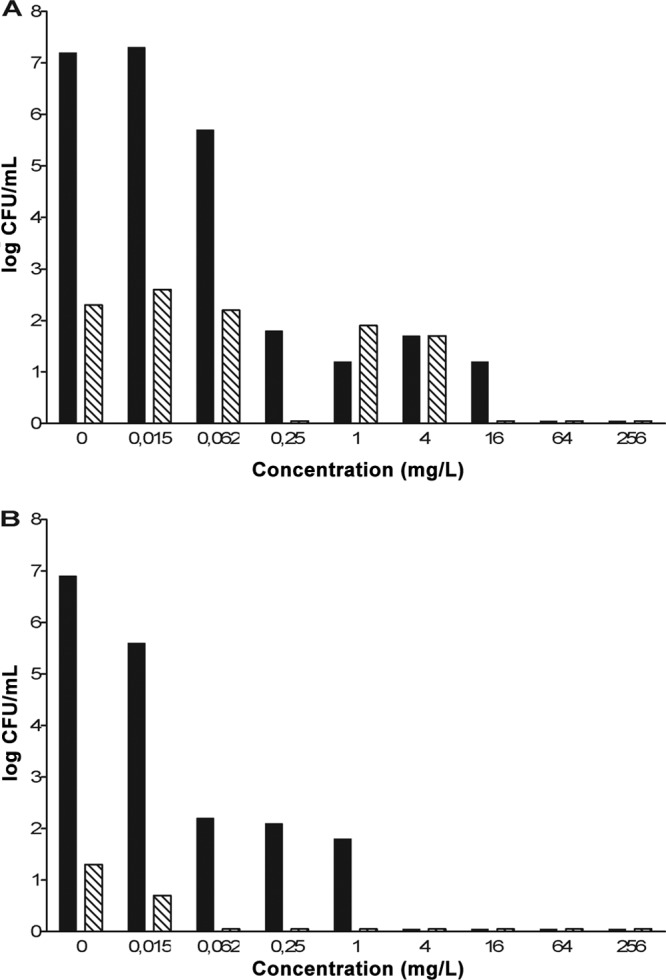
Selection of isoniazid-resistant mutants in vitro. The M. tuberculosis genotype strain Beijing-1585 (A) at a density of 7.7 × 10⁵ CFU/ml or EAI-1627 (B) at a density of 2.3 × 10⁵ CFU/ml was exposed to isoniazid at 4-fold-increasing concentrations for 6 days at 37°C. After 6 days of exposure, quantitative cultures were performed on subculture plates containing 0.4 mg/liter isoniazid (diagonally striped bars) or subculture plates without isoniazid (black bars).

References

    1. Abebe F, Bjune G. 2006. The emergence of Beijing family genotypes of Mycobacterium tuberculosis and low-level protection by bacille Calmette-Guerin (BCG) vaccines: is there a link? Clin. Exp. Immunol. 145:389–397 - PMC - PubMed
    1. Buu TN, et al. 2009. The Beijing genotype is associated with young age and multidrug-resistant tuberculosis in rural Vietnam. Int. J. Tuberc. Lung Dis. 13:900–906 - PubMed
    1. De Groote MA, et al. 2012. Importance of confirming in vivo efficacy data of novel antibacterial drug regimens against various strains of Mycobacterium tuberculosis. Antimicrob. Agents Chemother. 56:731–738 - PMC - PubMed
    1. De Steenwinkel JE, et al. 2009. Immunological parameters to define infection progression and therapy response in a well-defined tuberculosis model in mice. Int. J. Immunopathol. Pharmacol. 22:723–734 - PubMed
    1. de Steenwinkel JE, et al. 2010. Time-kill kinetics of anti-tuberculosis drugs, and emergence of resistance, in relation to metabolic activity of Mycobacterium tuberculosis. J. Antimicrob. Chemother. 65:2582–2589 - PubMed

MeSH terms