


Screening adult survivors of childhood cancer for cardiomyopathy: comparison of echocardiography and cardiac magnetic resonance imaging
- PMID: 22802310
- PMCID: PMC3671529
- DOI: 10.1200/JCO.2011.40.3584
Screening adult survivors of childhood cancer for cardiomyopathy: comparison of echocardiography and cardiac magnetic resonance imaging
Abstract
Purpose: To compare two-dimensional (2D) echocardiography, the current method of screening for treatment-related cardiomyopathy recommended by the Children's Oncology Group Guidelines, to cardiac magnetic resonance (CMR) imaging, the reference standard for left ventricular (LV) function.
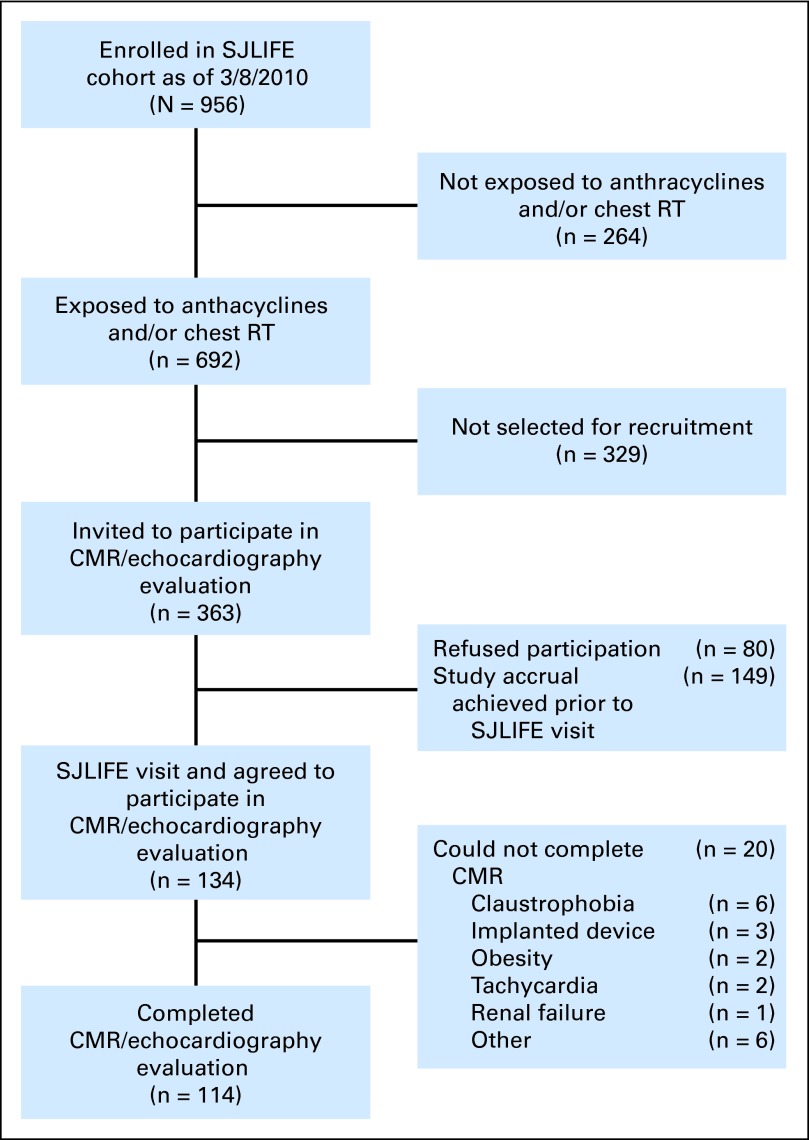
Patients and methods: Cross-sectional, contemporaneous evaluation of LV structure and function by 2D and three-dimensional (3D) echocardiography and CMR imaging in 114 adult survivors of childhood cancer currently median age 39 years (range, 22 to 53 years) exposed to anthracycline chemotherapy and/or chest-directed radiation therapy.
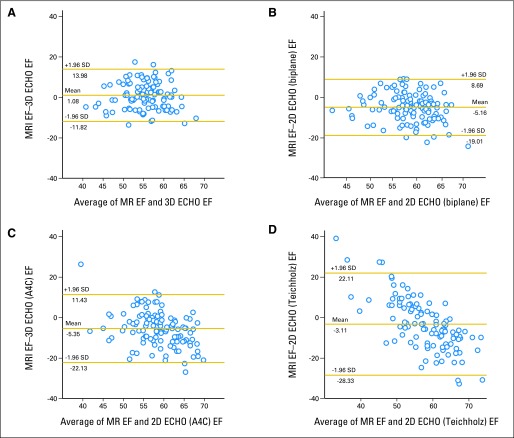
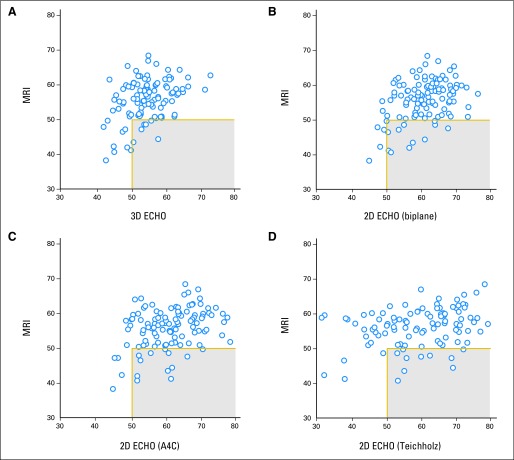
Results: In this survivor population, 14% (n = 16) had an ejection fraction (EF) less than 50% by CMR. Survivors previously undiagnosed with cardiotoxicity (n = 108) had a high prevalence of EF (32%) and cardiac mass (48%) that were more than two standard deviations below the mean of normative CMR data. 2D echocardiography overestimated the mean EF of this population by 5%. Compared with CMR, 2D echocardiography (biplane method) had a sensitivity of 25% and a false-negative rate of 75% for detection of EF less than 50%, although 3D echocardiography had 53% and 47%, respectively. Twelve survivors (11%) had an EF less than 50% by CMR but were misclassified as ≥ 50% (range, 50% to 68%) by 2D echocardiography (biplane method). Detection of cardiomyopathy was improved (sensitivity, 75%) by using a higher 2D echocardiography cutoff (EF < 60%) to detect an EF less than 50% by the reference standard CMR.
Conclusion: CMR identified a high prevalence of cardiomyopathy among adult survivors previously undiagnosed with cardiac disease. 2D echocardiography demonstrated limited screening performance. In this high-risk population, survivors with an EF 50% to 59% by 2D echocardiography should be considered for comprehensive cardiac assessment, which may include CMR.
Conflict of interest statement
Authors' disclosures of potential conflicts of interest and author contributions are found at the end of this article.
Figures
References
-
- Ries LA, Melbert D, Krapcho M, et al. Bethesda, MD: National Cancer Institute; 2008. SEER Cancer Statistics Review, 1975-2005. http://seer.cancer.gov/csr/1975_2005/
-
- Mariotto AB, Rowland JH, Yabroff KR, et al. Long-term survivors of childhood cancers in the United States. Cancer Epidemiol Biomarkers Prev. 2009;18:1033–1040. - PubMed
-
- van der Pal HJ, van Dalen EC, Hauptmann M, et al. Cardiac function in 5-year survivors of childhood cancer: A long-term follow-up study. Arch Intern Med. 2010;170:1247–1255. - PubMed
-
- Lipshultz SE, Vlach SA, Lipsitz SR, et al. Cardiac changes associated with growth hormone therapy among children treated with anthracyclines. Pediatrics. 2005;115:1613–1622. - PubMed
Publication types
MeSH terms
Substances
Grants and funding
LinkOut - more resources
Full Text Sources
Medical
