No evidence for inositol 1,4,5-trisphosphate-dependent Ca2+ release in isolated fibers of adult mouse skeletal muscle
- PMID: 22802359
- PMCID: PMC3409103
- DOI: 10.1085/jgp.201110747
No evidence for inositol 1,4,5-trisphosphate-dependent Ca2+ release in isolated fibers of adult mouse skeletal muscle
Abstract
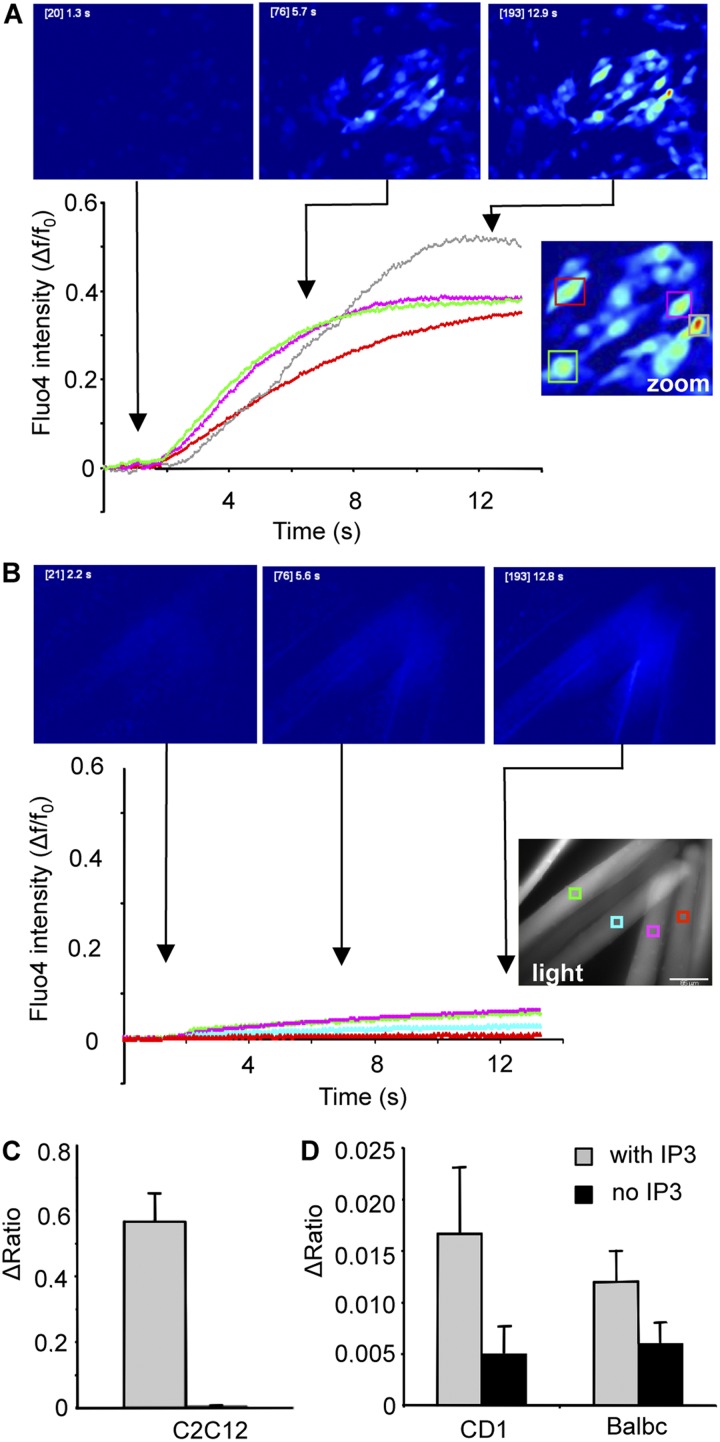
The presence and role of functional inositol 1,4,5-trisphosphate (IP(3)) receptors (IP(3)Rs) in adult skeletal muscle are controversial. The current consensus is that, in adult striated muscle, the relative amount of IP(3)Rs is too low and the kinetics of Ca(2+) release from IP(3)R is too slow compared with ryanodine receptors to contribute to the Ca(2+) transient during excitation-contraction coupling. However, it has been suggested that IP(3)-dependent Ca(2+) release may be involved in signaling cascades leading to regulation of muscle gene expression. We have reinvestigated IP(3)-dependent Ca(2+) release in isolated flexor digitorum brevis (FDB) muscle fibers from adult mice. Although Ca(2+) transients were readily induced in cultured C2C12 muscle cells by (a) UTP stimulation, (b) direct injection of IP(3), or (c) photolysis of membrane-permeant caged IP(3), no statistically significant change in calcium signal was detected in adult FDB fibers. We conclude that the IP(3)-IP(3)R system does not appear to affect global calcium levels in adult mouse skeletal muscle.
Figures


References
-
- Carrasco M.A., Riveros N., Ríos J., Müller M., Torres F., Pineda J., Lantadilla S., Jaimovich E. 2003. Depolarization-induced slow calcium transients activate early genes in skeletal muscle cells. Am. J. Physiol. Cell Physiol. 284:C1438–C1447 - PubMed
Publication types
MeSH terms
Substances
LinkOut - more resources
Full Text Sources
Miscellaneous