. 2012 Jul 31;109(31):12811-6.
doi: 10.1073/pnas.1200330109. Epub 2012 Jul 16.

Identification of olivetolic acid cyclase from Cannabis sativa reveals a unique catalytic route to plant polyketides

Affiliations

Identification of olivetolic acid cyclase from Cannabis sativa reveals a unique catalytic route to plant polyketides

Steve J Gagne et al. Proc Natl Acad Sci U S A. .

Abstract

Δ(9)-Tetrahydrocannabinol (THC) and other cannabinoids are responsible for the psychoactive and medicinal properties of Cannabis sativa L. (marijuana). The first intermediate in the cannabinoid biosynthetic pathway is proposed to be olivetolic acid (OA), an alkylresorcinolic acid that forms the polyketide nucleus of the cannabinoids. OA has been postulated to be synthesized by a type III polyketide synthase (PKS) enzyme, but so far type III PKSs from cannabis have been shown to produce catalytic byproducts instead of OA. We analyzed the transcriptome of glandular trichomes from female cannabis flowers, which are the primary site of cannabinoid biosynthesis, and searched for polyketide cyclase-like enzymes that could assist in OA cyclization. Here, we show that a type III PKS (tetraketide synthase) from cannabis trichomes requires the presence of a polyketide cyclase enzyme, olivetolic acid cyclase (OAC), which catalyzes a C2-C7 intramolecular aldol condensation with carboxylate retention to form OA. OAC is a dimeric α+β barrel (DABB) protein that is structurally similar to polyketide cyclases from Streptomyces species. OAC transcript is present at high levels in glandular trichomes, an expression profile that parallels other cannabinoid pathway enzymes. Our identification of OAC both clarifies the cannabinoid pathway and demonstrates unexpected evolutionary parallels between polyketide biosynthesis in plants and bacteria. In addition, the widespread occurrence of DABB proteins in plants suggests that polyketide cyclases may play an overlooked role in generating plant chemical diversity.


Conflict of interest statement

The authors declare no conflict of interest.

Figures
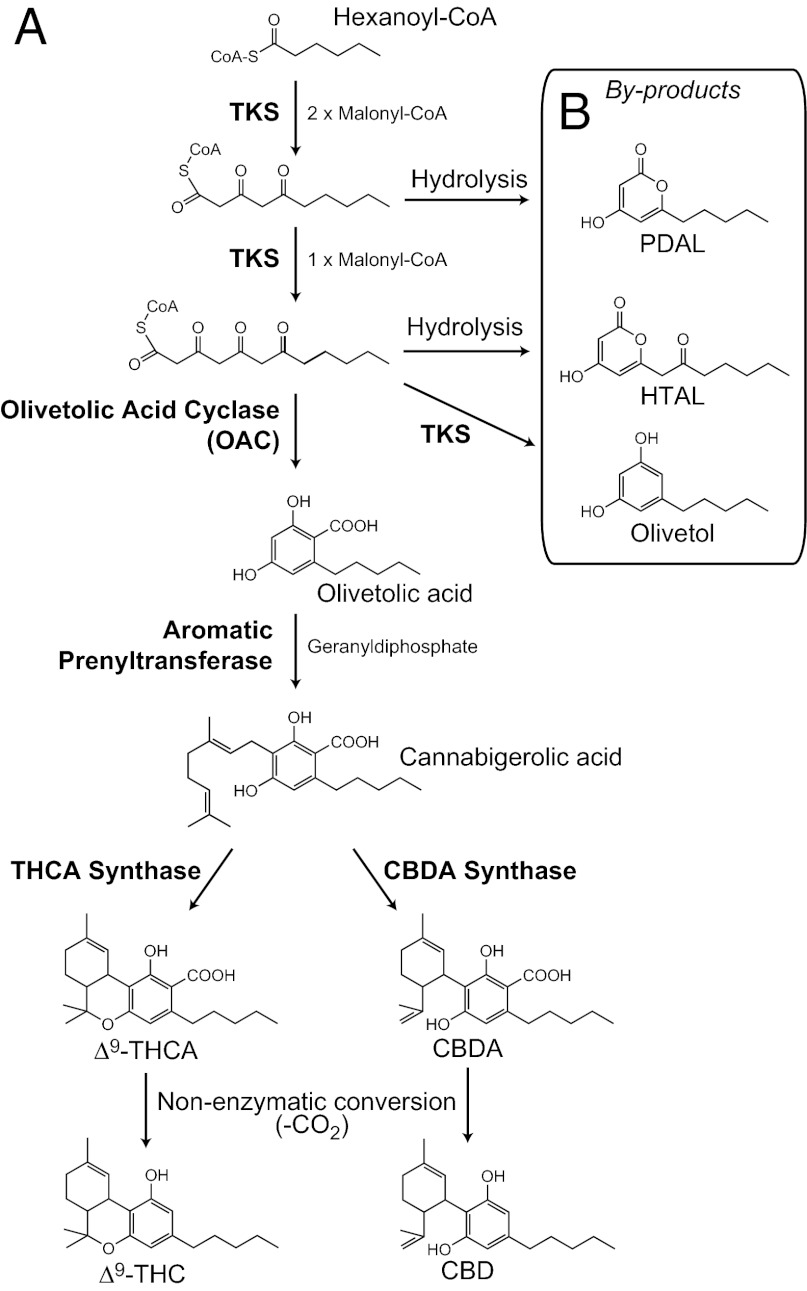
Fig. 1.
Fig. 1.
The proposed cannabinoid biosynthetic pathway. (A) The pathway leading to the major cannabinoids Δ9-tetrahydrocannabinolic acid (THCA) and cannabidiolic acid (CBDA), which decarboxylate to yield Δ9-tetrahydrocannabinol (THC) and cannabidiol (CBD), respectively. (B) Recombinant TKS enzyme produces triketide (PDAL) and tetraketide (HTAL and olivetol) by-products in vitro.
Fig. 2.
Fig. 2.
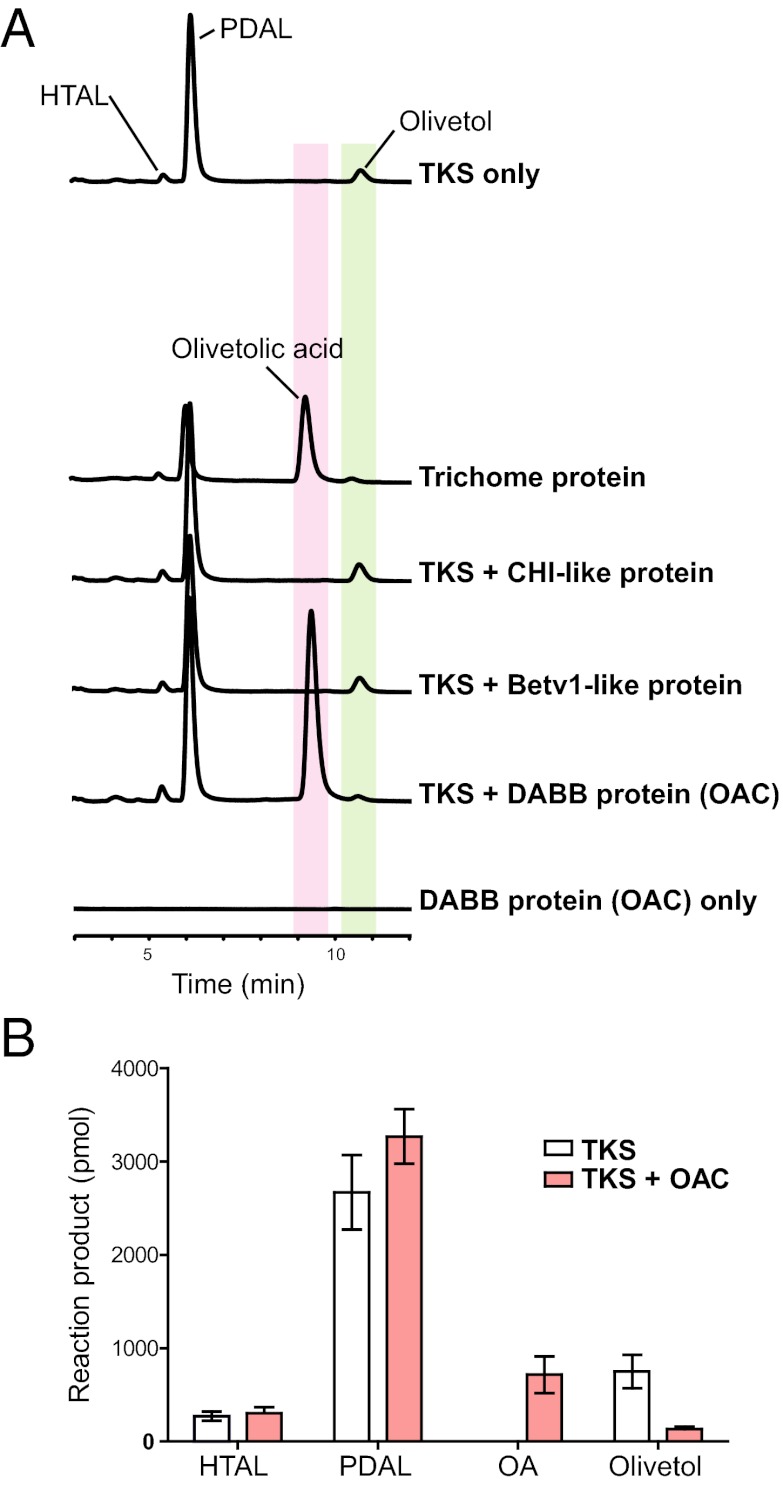
OA formation requires the presence of the DABB protein, olivetolic acid cyclase (OAC). (A) TKS produces the by-products PDAL, HTAL, and olivetol, but crude protein from hemp trichomes catalyzes OA formation. Assays of TKS together with polyketide cyclase candidate proteins shows OA is produced by the DABB protein OAC but not by Betv1-like and CHI-like proteins. (B) Comparison of polyketide product profiles in TKS assays performed with and without OAC (mean ± SD, n = 3). Reaction products in polyketide synthesis assays were analyzed by HPLC and identified by comparison with authentic standards (Fig. S6).
Fig. 3.
Fig. 3.
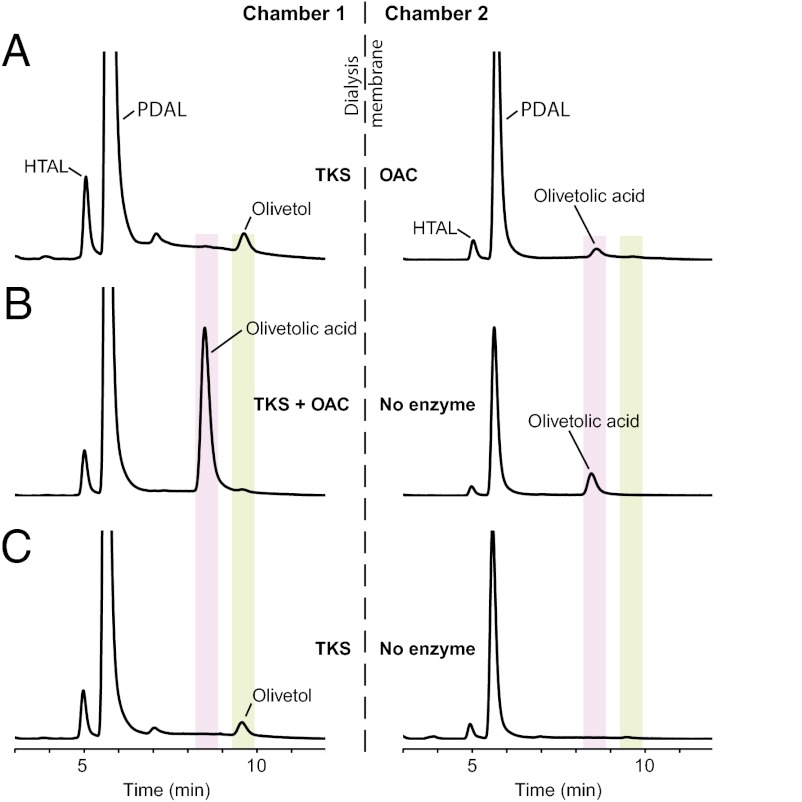
Dialysis experiments show that physical interaction of TKS and OAC is not required for OA formation. Recombinant TKS and OAC were assayed in dialysis chambers separated by a 5-kDa cutoff membrane. (A) Assays with TKS and OAC in separate chambers resulted in the formation of HTAL, PDAL, and olivetol in the TKS-containing chamber 1 and HTAL, PDAL, and OA in the OAC-containing chamber 2. (B) Positive control assays with TKS and OAC in chamber 1 and no enzyme in chamber 2 produced large amounts of OA, in addition to HTAL and PDAL. (C) Negative control assays with TKS in chamber 1 and no enzyme in chamber 2 yielded only HTAL, PDAL, and olivetol. Chromatograms were extracted at 270 nm.
Fig. 4.
Fig. 4.
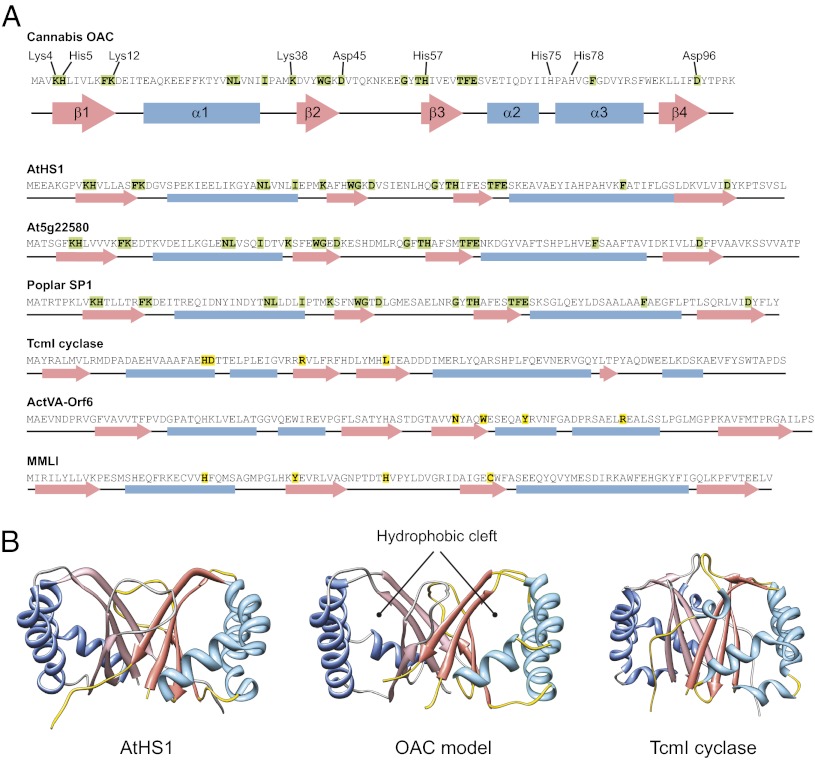
Comparison of the OAC structure with other DABB proteins. (A) A schematic representation of the secondary structures of OAC and representative DABB proteins from plants and bacteria showing the characteristic β-α-β-β-α-α-β topology. Conserved residues in the plant proteins are indicated in bold with green background. Active-site residues in bacterial DABBs are indicated in bold with yellow background. The OAC residues targeted for site-directed mutagenesis are labeled. (B) Ribbon diagrams of AtHS1 (PDB ID code 1Q53), the homology model of OAC, and TcmI cyclase (PDB ID code 1TUW). The hydrophobic cleft formed between the α-helices and β-sheets in each monomer, which is the active site of TcmI cyclase, is present in all three proteins.
Fig. 5.
Fig. 5.
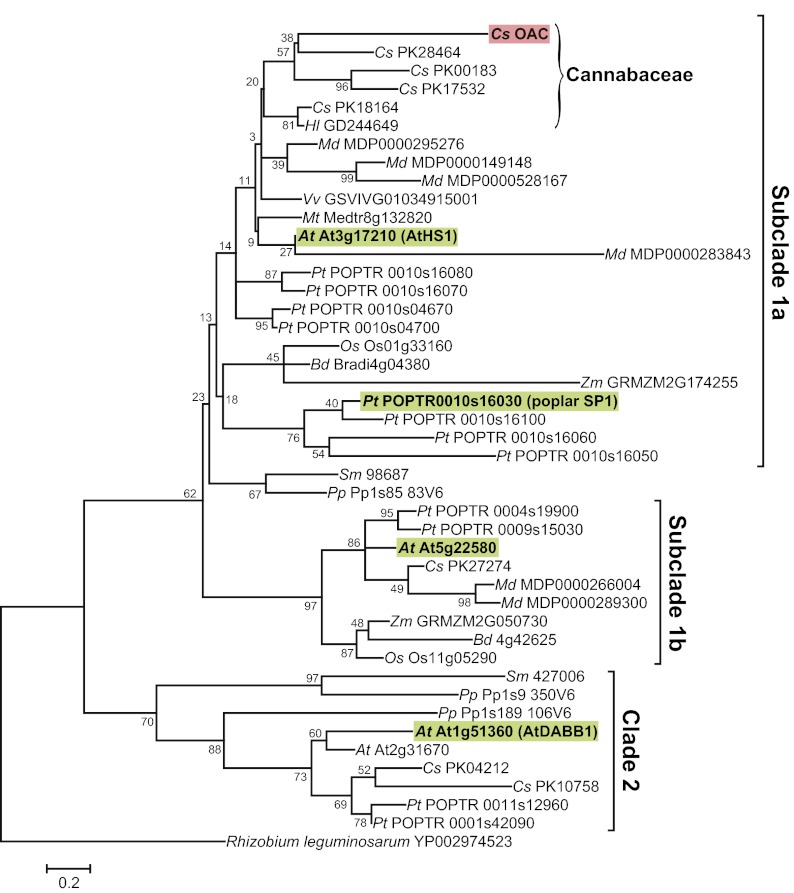
A phylogenetic tree of DABB proteins from plants inferred using the maximum-likelihood method. OAC and proteins that have been structurally or functionally characterized are highlighted. Branch lengths are proportional to the number of amino acid substitutions per site. The tree is rooted by a Rhizobium DABB protein. Species abbreviations: At, Arabidopsis thaliana; Bd, Brachypodium distachyon; Cs, Cannabis sativa; Hl, Humulus lupulus; Md, Malus domestica; Mt, Medicago truncatula; Os, Oryza sativa; Pa, Physcomitrella patens; Pt, Populus trichocarpa; Rl, Rhizobium leguminosarum; Sm, Selaginella moellendorffii; Vv, Vitis vinifera; Zm, Zea mays. The details of the sequences are provided in Table S3.

References

    1. Russo EB, et al. Phytochemical and genetic analyses of ancient cannabis from Central Asia. J Exp Bot. 2008;59:4171–4182. - PMC - PubMed
    1. United Nations Office on Drugs and Crime 2010. World Drug Report 2010 (United Nations Office on Drugs and Crime, Vienna, Austria)
    1. Elsohly MA, Slade D. Chemical constituents of marijuana: The complex mixture of natural cannabinoids. Life Sci. 2005;78:539–548. - PubMed
    1. Gaoni Y, Mechoulam R. Isolation, structure, and partial synthesis of an active constituent of hashish. J Am Chem Soc. 1964;86:1646–1647.
    1. Joy JE, Watson SJ. In: Marijuana and Medicine: Assessing the Science Base. Benson JA, editor. National Academy, Washington, DC; 1999. - PubMed

Publication types

MeSH terms

Associated data