doi: 10.1371/journal.pbio.1001353.
Epub 2012 Jul 10.
Sakshat Labs: India's virtual proteomics initiative
Affiliations
- PMID: 22802723
- PMCID: PMC3393654
- DOI: 10.1371/journal.pbio.1001353
Item in Clipboard
Sakshat Labs: India's virtual proteomics initiative
PLoS Biol.
2012.
Abstract
The first Virtual Proteomics Lab of India has been developed at the IIT Bombay as a part of the “Sakshat” Lab Project, established to develop openly accessible, high-quality educational materials on science and technology.
Conflict of interest statement
The authors have declared that no competing interests exist.
Figures
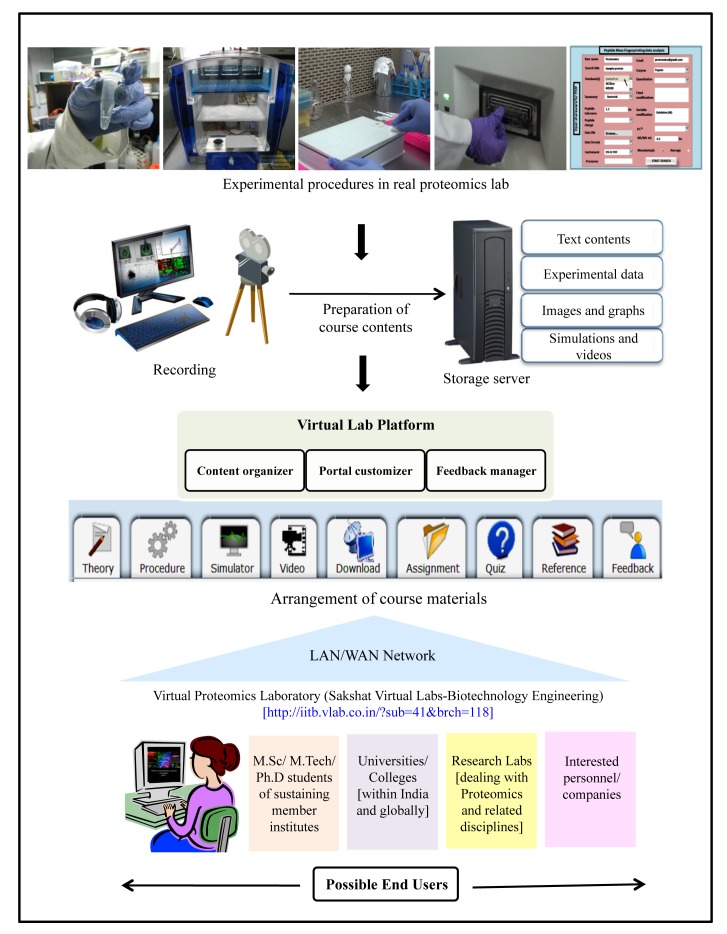
Virtualization of proteomics data and experimental procedures from “bench-side” and storage in discrete compartments on the common “Virtual Lab server” for development of the course contents. Every experiment is explained in a step-by-step manner that follows the order of the tabs: theory, experimental procedure, simulator, video, download, assignment, quiz, references, and feedback. The server is connected to the Internet by a “LAN/WAN network” that contains the gateway portal and system firewall that protects the data from being changed by unauthorized people. The end users present on the “Client Side” can access the Virtual Lab via the LAN/WAN network portal. All course materials are freely available all over the world through the Internet and intended to be used in the teaching/learning experience particularly in universities and colleges. Moreover, the course content will be interesting and valuable for research labs working in the similar fields.
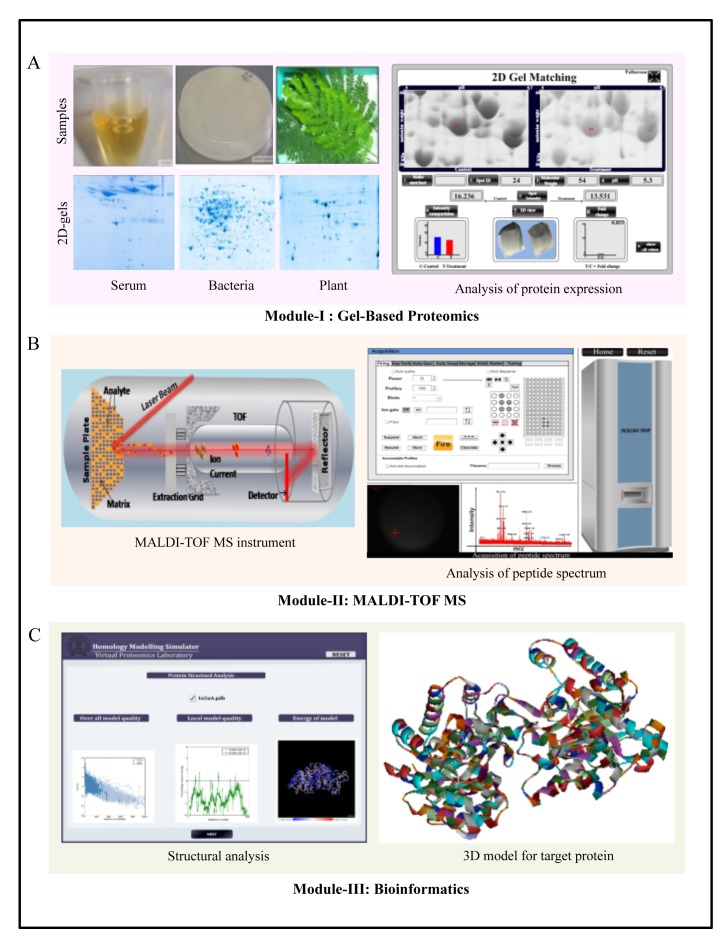
(A) Module I (an overview of gel-based proteomics) consists of three experiments: gel-based proteomics (2DE) to analyze human serum, bacterial, and plant proteome; and analysis of differential expression of proteins between test and control samples. (B) Module II (an overview of MALDI-TOF MS) is focused on MS-based proteomics and consists of five experiments: in-gel digestion of proteins for MS analysis; sample preparation for the MALDI-TOF MS analysis; MALDI-TOF instrumentation and analysis of serum proteins; MS data analysis, peptide mass fingerprinting (PMF); and molecular weight determination of intact proteins. Schematic representation of MALDI-TOF instrument and operation procedure for generating peptide/protein spectrum for protein identification. (C) Module III (an overview of bioinformatics) covers the bioinformatics tools that are commonly used in proteomics. This module includes four experiments: sequence alignment, homology modeling, functional annotation, and molecular docking. Structural analysis and 3-D modeling of target proteins has been depicted.
References
-
- Atkins D. E, Brown J. S, Hammond A. L. A review of the Open Educational Resources (OER) movement: achievements, challenges, and new opportunities. 2007. Available: http://www.hewlett.org/uploads/files/Hewlett_OER_report.pdf. Accessed 24 April 2012.
-
- OCW Consortium. OpenCourseWare Consortium website. Available: http://ocwconsortium.org/. Accessed 24 April 2012.
-
- China Open Resources for Education (CORE) CORE official website. Available: http://www.core.org.cn. Accessed 24 April 2012.
-
- Kobayashi T, Kawafuchi A. Japan Open Course Ware Consortium (JOCW): a case study in Open Educational Resources production and use in higher education. 2006. Available: http://www.oecd.org/dataoecd/61/2/37647892.pdf. Accessed 24 April 2012.
Publication types
MeSH terms
LinkOut - more resources
Full Text Sources
Miscellaneous