


DynPeak: an algorithm for pulse detection and frequency analysis in hormonal time series
- PMID: 22802933
- PMCID: PMC3389032
- DOI: 10.1371/journal.pone.0039001
DynPeak: an algorithm for pulse detection and frequency analysis in hormonal time series
Abstract
The endocrine control of the reproductive function is often studied from the analysis of luteinizing hormone (LH) pulsatile secretion by the pituitary gland. Whereas measurements in the cavernous sinus cumulate anatomical and technical difficulties, LH levels can be easily assessed from jugular blood. However, plasma levels result from a convolution process due to clearance effects when LH enters the general circulation. Simultaneous measurements comparing LH levels in the cavernous sinus and jugular blood have revealed clear differences in the pulse shape, the amplitude and the baseline. Besides, experimental sampling occurs at a relatively low frequency (typically every 10 min) with respect to LH highest frequency release (one pulse per hour) and the resulting LH measurements are noised by both experimental and assay errors. As a result, the pattern of plasma LH may be not so clearly pulsatile. Yet, reliable information on the InterPulse Intervals (IPI) is a prerequisite to study precisely the steroid feedback exerted on the pituitary level. Hence, there is a real need for robust IPI detection algorithms. In this article, we present an algorithm for the monitoring of LH pulse frequency, basing ourselves both on the available endocrinological knowledge on LH pulse (shape and duration with respect to the frequency regime) and synthetic LH data generated by a simple model. We make use of synthetic data to make clear some basic notions underlying our algorithmic choices. We focus on explaining how the process of sampling affects drastically the original pattern of secretion, and especially the amplitude of the detectable pulses. We then describe the algorithm in details and perform it on different sets of both synthetic and experimental LH time series. We further comment on how to diagnose possible outliers from the series of IPIs which is the main output of the algorithm.
Conflict of interest statement
Figures
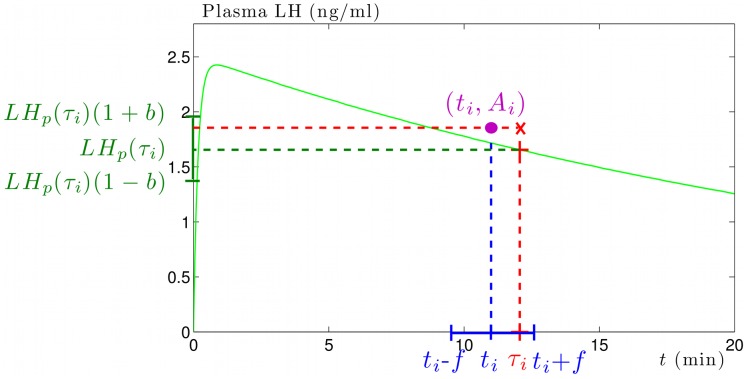
 (blue dotted line), real sampling time
  (red dotted line) randomly chosen in
  (blue interval), exact value
  of LH level at time
  (green dotted line), retrieved LH level
  (red dotted line) randomly chosen in
  (green interval). The output of the i-th step of the sampling process is the couple
  (magenta disc) of time and corresponding LH level.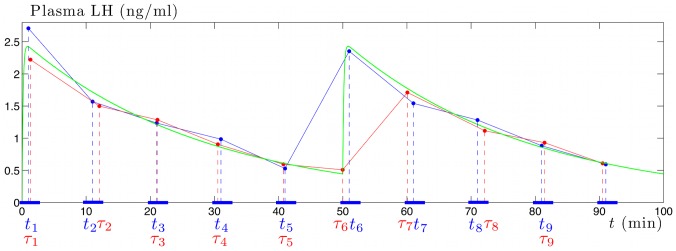
 , are the effective sampling times leading to the red-colored LH time series. The
  , are the expected sampling times leading to the blue-colored LH time series. The original, non-sampled time series corresponds to the green line. One can observe an instance of great discrepancy between the LH level measured at time
  , which corresponds to the very beginning of the ascending part of a pulse, and the LH level measured at time
  , which corresponds to the maximum of the same pulse.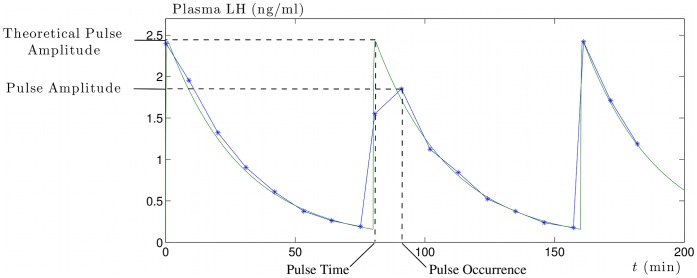
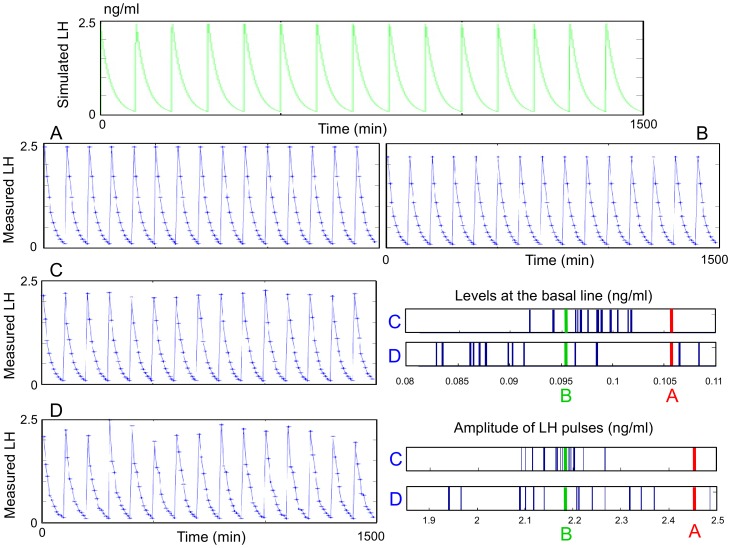
 . Top panel: theoretical continuously measured LH blood level (green curve). Panels A, B, C, D: sampling points (blue stars) of the time series obtained from the top panel signal through the sampling protocol. Panel A: first sampling time at r = 1 min, without any variability in the sampling process. Panel B: first sampling time at r = 4 min, without any variability in the sampling process. Panel C: first sampling time at r = 4 min, with variability in the sampling times
  . Panel D: first sampling time at r = 4 min, with variability both in the sampling times
  and the assays
  . The histograms correspond to the distribution of the levels at the basal line and the distribution of the amplitudes of the LH pulses, measured from the four cases A to D. The A and B time series, that only differ in the first sampling time, display constant (yet different) pulse amplitude. Red bars stand for case A (r = 1 min) value of the pulse amplitude (2.425 ng/ml) and level at the basal line (0.107 ng/ml). Green bars stand for case B (r = 4 min) value of the pulse amplitude (2.188 ng/ml) and level at the basal line (0.096 ng/ml). Blue bars stand for distributions of levels at the basal line and pulse amplitudes in case C (r = 4 min; f = 1.5 min) and case D (r = 4 min; f = 1.5 min; b = 10%, i.e. a variability of
  in the LH assays). In case D, the distributions of basal line levels (between 0.082 and 0.108 ng/ml) and pulse amplitudes (between 1.940 and 2.486 ng/ml) are wider than in case C (levels at the basal line between 0.092 and 0.101 ng/ml; pulse amplitude between 2.092 and 2.266 ng/ml), due to combined variabilities in the sampling times and assays.
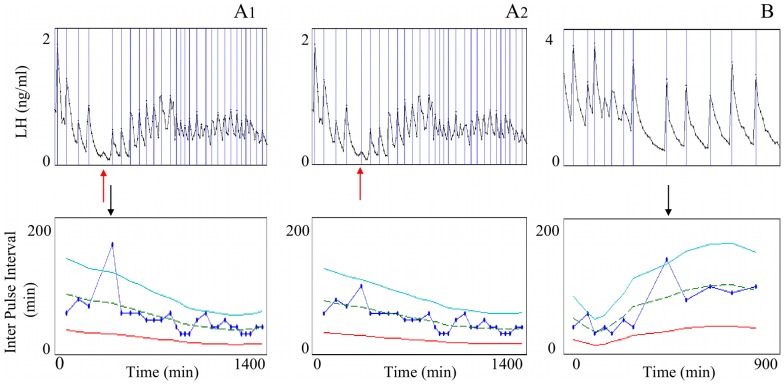
 -dependent function
  ) and upper (
 -dependent function
  ) edges of the tunnel (
 ). Black arrows: occurrences of the outliers. Case A: outlier due to a lack of detection (missed pulse designed by a red arrow); panel A1: initial IPI series with
  (default value); A2: corrected IPI series; with
  . Case B: genuine long IPI.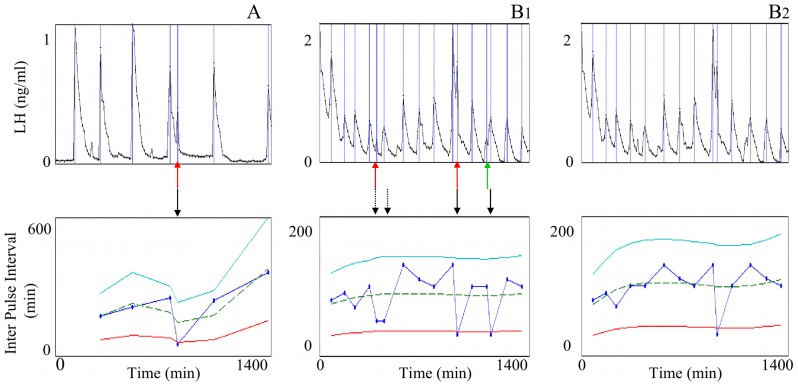
 to 0.45. Two of the three false peaks have been discarded.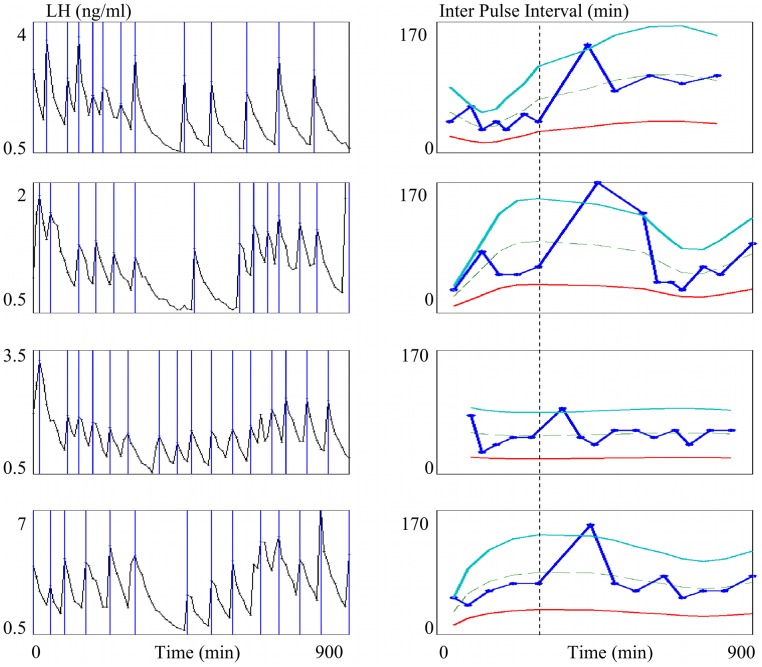
References
-
- Sollenberger M, Carlsen E, Johnson M, Veldhuis J, Evans W. Specific Physiological Regulation of Luteinizing Hormone Secretory Events Throughout the Human Menstrual Cycle: New Insights into the Pulsatile Mode of Gonadotropin Release. J Neuroendocrinol 6. 1990;(2):845–852. - PubMed
-
- Moenter S, Caraty A, Karsch F. The estradiol-induced surge of gonadotropin-releasing hormone in the ewe. Endocrinology. 1990;127:1375–1384. - PubMed
-
- Moenter S, Brand R, Karsch F. Dynamics of gonadotropin-releasing hormone (GnRH) secre- tion during the GnRH surge: insights into the mechanism of GnRH surge induction. Endocrinology. 1992;130:2978–2984. - PubMed
-
- Clarke I, Moore L, Veldhuis J. Intensive direct cavernous sinus sampling identifies high-frequency, nearly random patterns of FSH secretion in ovariectomized ewes: combined appraisal by RIA and bioassay. Endocrinology 143. 2002;(1):117–129. - PubMed
-
- Drouilhet L, Taragnat C, Fontaine J, Duittoz A, Mulsant P, et al. Endocrine Characterization of the Reproductive Axis in Highly Prolific Lacaune Sheep Homozygous for the FecLL Mutation. Biol Reprod 82. 2010;(5):815–824. - PubMed
Publication types
MeSH terms
Substances
LinkOut - more resources
Full Text Sources
Other Literature Sources
Research Materials
