Cure of hookworm infection with a cysteine protease inhibitor
- PMID: 22802972
- PMCID: PMC3389033
- DOI: 10.1371/journal.pntd.0001680
Cure of hookworm infection with a cysteine protease inhibitor
Abstract
Background: Hookworm disease is a major global health problem and principal among a number of soil-transmitted helminthiases (STHs) for the chronic disability inflicted that impacts both personal and societal productivity. Mass drug administration most often employs single-dose therapy with just two drugs of the same chemical class to which resistance is a growing concern. New chemical entities with the appropriate single-dose efficacy are needed.
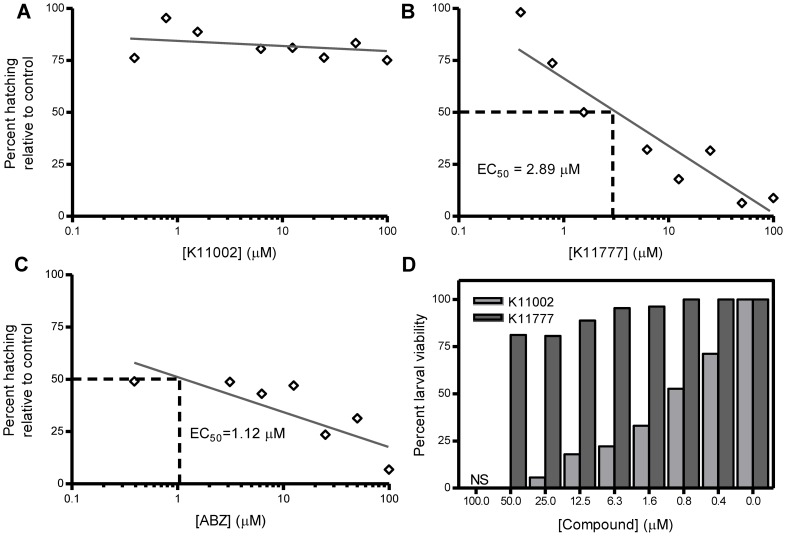
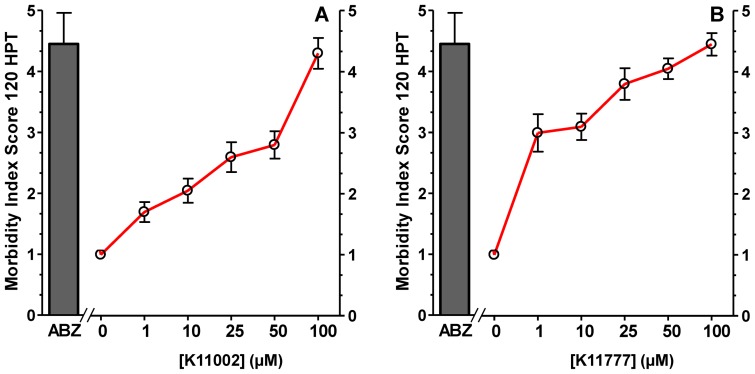
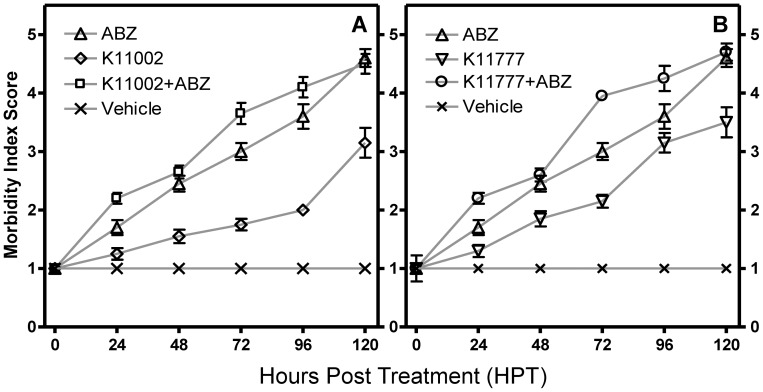
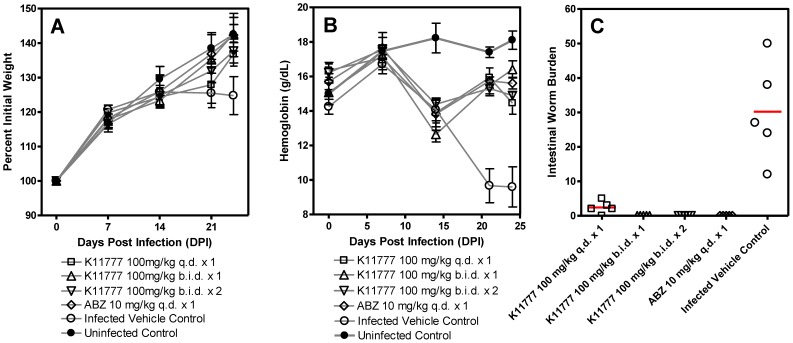
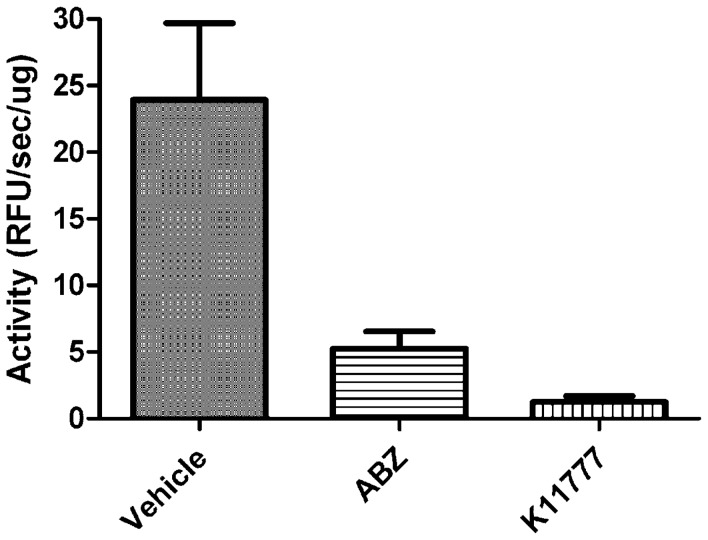
Methods and findings: Using various life-cycle stages of the hookworm Ancylostoma ceylanicum in vitro and a hamster model of infection, we report the potent, dose-dependent cidal activities of the peptidyl cysteine protease inhibitors (CPIs) K11002 (4-mopholino-carbonyl-phenylalanyl-homophenylalanyl- vinyl sulfone phenyl) and K11777 (N-methylpiperazine-phenylalanyl-homophenylalanyl-vinylsulfone phenyl). The latter is in late pre-clinical testing for submission as an Investigational New Drug (IND) with the US Federal Drug Administration as an anti-chagasic. In vitro, K11002 killed hookworm eggs but was without activity against first-stage larvae. The reverse was true for K11777 with a larvicidal potency equal to that of the current anti-hookworm drug, albendazole (ABZ). Both CPIs produced morbidity in ex vivo adult hookworms with the activity of K11777 again being at least the equivalent of ABZ. Combinations of either CPI with ABZ enhanced morbidity compared to single compounds. Strikingly, oral treatment of infected hamsters with 100 mg/kg K11777 b.i.d. (i.e., a total daily dose of 200 mg/kg) for one day cured infection: a single 100 mg/kg treatment removed >90% of worms. Treatment also reversed the otherwise fatal decrease in blood hemoglobin levels and body weights of hosts. Consistent with its mechanism of action, K11777 decreased by >95% the resident CP activity in parasites harvested from hamsters 8 h post-treatment with a single 100 mg/kg oral dose.
Conclusion: A new, oral single-dose anthelmintic that is active in an animal model of hookworm infection and that possesses a distinct mechanism of action from current anthelmintics is discovered. The data highlight both the possibility of repurposing the anti-chagasic K11777 as a treatment for hookworm infection and the opportunity to further develop CPIs as a novel anthelmintic class to target hookworms and, possibly, other helminths.
Conflict of interest statement
The authors have declare that no competing interests exist.
Figures
References
-
- Stoll NR. This wormy world. J Parasitol. 1947;33:1–18. - PubMed
-
- Keiser J, Utzinger J. The drugs we have and the drugs we need against major helminth infections. Adv Parasitol. 2010;73:197–230. - PubMed
-
- Bethony J, Brooker S, Albonico M, Geiger SM, Loukas A, et al. Soil-transmitted helminth infections: ascariasis, trichuriasis, and hookworm. Lancet. 2006;367:1521–1532. - PubMed
-
- Anten JF, Zuidema PJ. Hookworm infection in Dutch servicemen returning from West New Guinea. Trop Geogr Med. 1964;64:216–224. - PubMed
-
- Chowdhury AB, Schad GA. Ancylostoma ceylanicum: a parasite of man in Calcutta and environs. Am J Trop Med Hyg. 1972;21:300–301. - PubMed
Publication types
MeSH terms
Substances
Grants and funding
LinkOut - more resources
Full Text Sources
Other Literature Sources
Miscellaneous