. 2012;6(7):e1725.
doi: 10.1371/journal.pntd.0001725. Epub 2012 Jul 3.

Breeding sites of Phlebotomus sergenti, the sand fly vector of cutaneous leishmaniasis in the Judean Desert

Affiliations

Breeding sites of Phlebotomus sergenti, the sand fly vector of cutaneous leishmaniasis in the Judean Desert

Aviad Moncaz et al. PLoS Negl Trop Dis. 2012.

Abstract

Phlebotomine sand flies transmit Leishmania, phlebo-viruses and Bartonella to humans. A prominent gap in our knowledge of sand fly biology remains the ecology of their immature stages. Sand flies, unlike mosquitoes do not breed in water and only small numbers of larvae have been recovered from diverse habitats that provide stable temperatures, high humidity and decaying organic matter. We describe studies designed to identify and characterize sand fly breeding habitats in a Judean Desert focus of cutaneous leishmaniasis. To detect breeding habitats we constructed emergence traps comprising sand fly-proof netting covering defined areas or cave openings. Large size horizontal sticky traps within the confined spaces were used to trap the sand flies. Newly eclosed male sand flies were identified based on their un-rotated genitalia. Cumulative results show that Phlebotomus sergenti the vector of Leishmania tropica rests and breeds inside caves that are also home to rock hyraxes (the reservoir hosts of L. tropica) and several rodent species. Emerging sand flies were also trapped outside covered caves, probably arriving from other caves or from smaller, concealed cracks in the rocky ledges close by. Man-made support walls constructed with large boulders were also identified as breeding habitats for Ph. sergenti albeit less important than caves. Soil samples obtained from caves and burrows were rich in organic matter and salt content. In this study we developed and put into practice a generalized experimental scheme for identifying sand fly breeding habitats and for assessing the quantities of flies that emerge from them. An improved understanding of sand fly larval ecology should facilitate the implementation of effective control strategies of sand fly vectors of Leishmania.


Conflict of interest statement

The authors have declared that no competing interests exist.

Figures
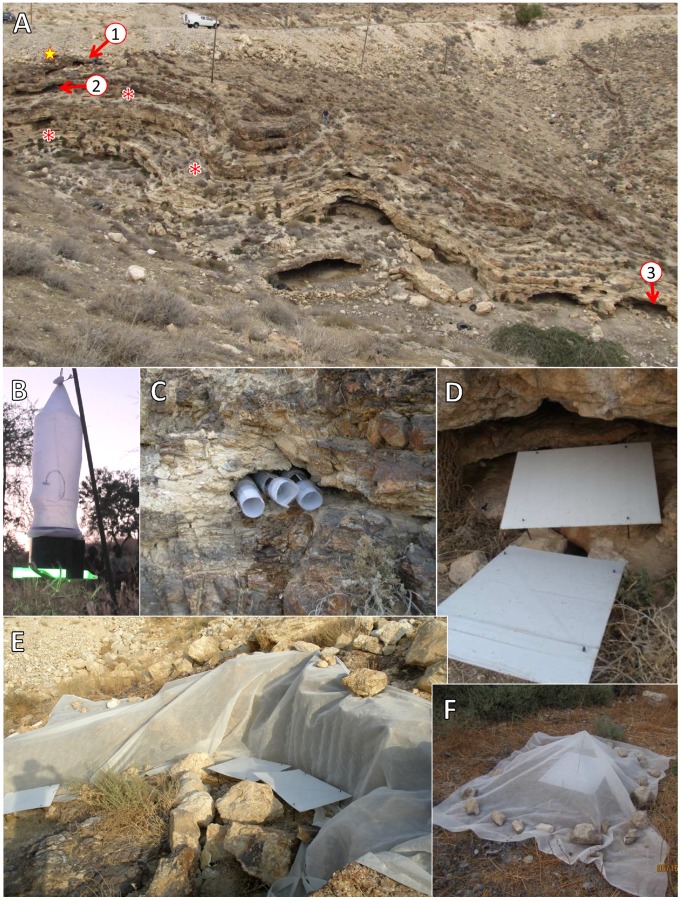
Figure 1
Figure 1. Study sites and trapping methods.
A: General view of the main study area on the outskirts of Kfar Adumim showing the three cave systems (marked 1,2, & 3 - photo taken facing north), rock slide resulting from the excavation of the road above (marked with yellow star) and rocky ledges with numerous small openings and cracks (red asterisks). B: Modified CDC light trap deployed updraft and baited with green light-stick. C: A4 sticky traps rolled up in rock crevices to trap emerging sand flies. D: Large (60×80 cm) sticky traps deployed horizontally on metal frames. E: Cave system No. 1 covered with sand fly-proof mesh to assess emergence of sand flies. Large sticky traps were deployed both inside and outside the cave(s) F: Tent-type emergence trap covering an area of approximately 2 m2 with single large sticky trap (60×80 cm) inside a sand fly proof net suspended over a central pole.
Figure 2
Figure 2. Study sites and trapping methods (contd.).
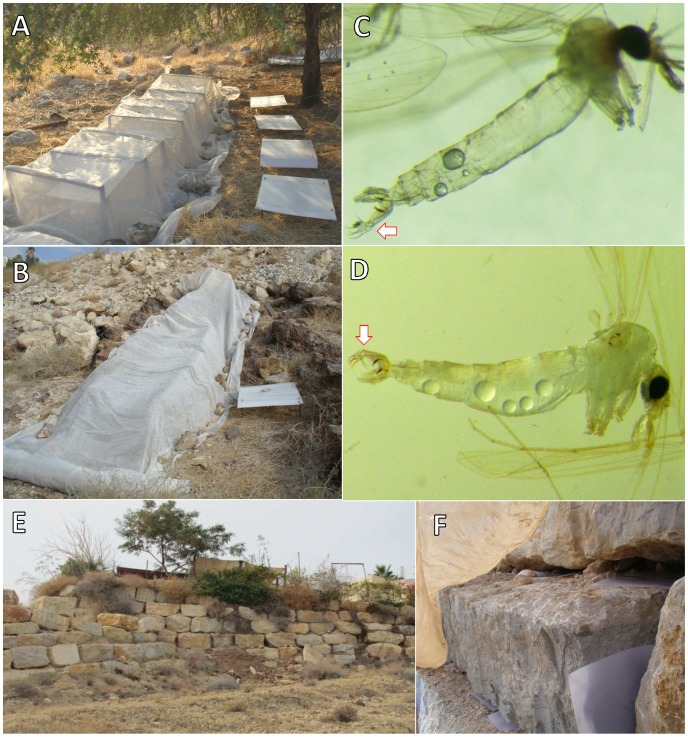
A: Tunnel emergence trap comprising four large horizontal sticky traps covered with sand fly-proof netting. Four uncovered sticky traps are included for control. B: Tunnel emergence trap placed on a slope strewn with loose rocks. One uncovered trap placed for control. C: immature (juvenile) Phlebotomus sergenti male with un-rotated external genitalia. Note the ventral orientation of the style (arrow). D: A mature Phlebotomus sergenti male with fully rotated external genitalia. Note the dorsal orientation of the style (arrow). E: Support wall below a house with an irrigated garden. F, A4 sticky traps inserted between the boulders of a support wall that was covered with a sand-fly proof mesh.
Figure 3
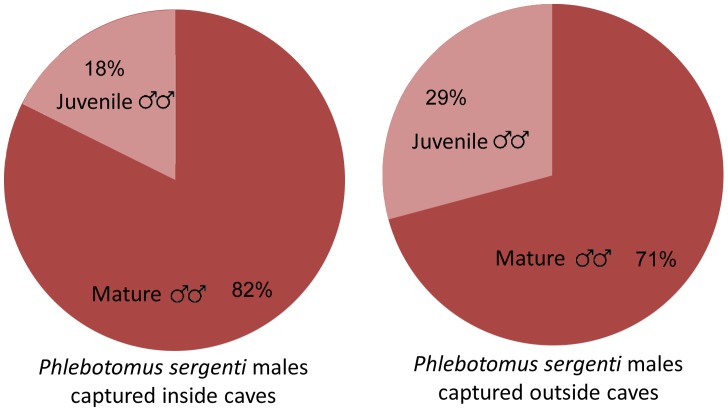
Figure 3. Percentage young males inside and outside caves.
Percentage of juvenile ( = un-rotated genitalia) male Phlebotomus sergenti in caves (Left pie) and outside caves (Right pie). The difference was highly significant (χ 2 = 49.97, P<0.0001).
Figure 4
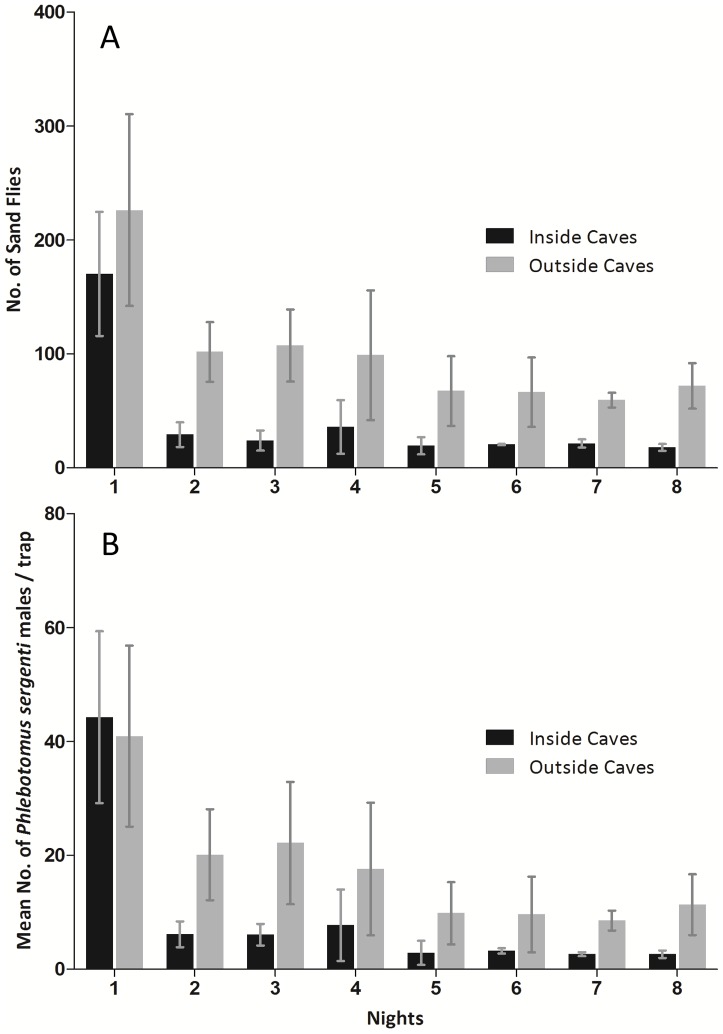
Figure 4. Sand fly catches inside and outside caves covered with sand fly-proof net.
A) Mean number nightly (±SE) of sand flies captured on sticky traps inside and outside caves. The cave openings were covered with sand fly-proof nets. Sand flies were collected daily and the traps were smeared with fresh oil. The decline in sand fly numbers trapped inside caves observed during the second night of the caves' opening being covered, was statistically significant (two tailed t test, P = 0.0056). Although a parallel decline in numbers of sand flies outside the cave after the first night was also observed, it was not statistically significant (Mann – Whitney rank sum test, P = 0.4642). B) Mean number (±SE) of Phlebotomus sergenti males per sticky trap per night captured inside and outside caves. The decline in Phlebotomus sergenti males numbers trapped inside caves observed during the second night, was statistically significant (two tailed t test, P = 0.0019).
Figure 5
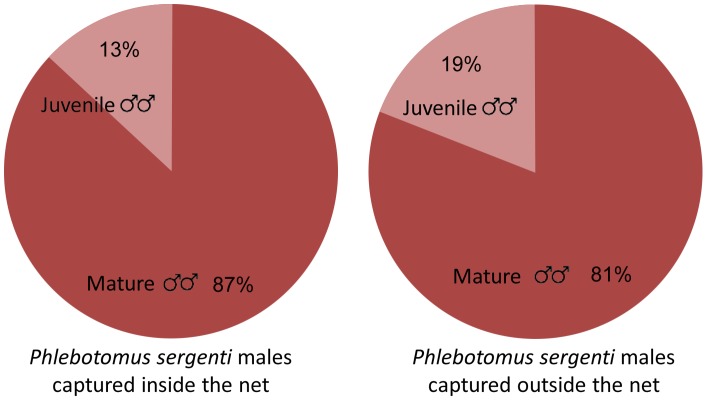
Figure 5. Percentage of young males in and near support walls.
Percentage of juvenile ( = un-rotated genitalia) male Phlebotomus sergenti in the support wall (Left pie) and outside the support wall (Right pie). The differences were not statistically significant (χ 2 = 1.402, P, ns).

References

    1. Desjeux P. The increase in risk factors for leishmaniasis worldwide. Trans R Soc Trop Med Hyg. 2001;95:239–243. - PubMed
    1. Desjeux P. Leishmaniasis: current situation and new perspectives. Comp Immunol Microbiol Infect Dis. 2004;27:305–318. - PubMed
    1. Postigo JA. Leishmaniasis in the World Health Organization Eastern Mediterranean Region. Int J Antimicrob Agents. 2010;36(Suppl 1):S62–65. - PubMed
    1. Jaffe CL, Baneth G, Abdeen ZA, Schlein Y, Warburg A. Leishmaniasis in Israel and the Palestinian Authority. Trends Parasitol. 2004;20:328–332. - PubMed
    1. Killick Kendrick R. Phlebotomine vectors of the leishmaniases: a review. Medical and Veterinary Entomology. 1990;4:1–24. - PubMed

Publication types