


Neuroprotective effects of phenolic antioxidant tBHQ associate with inhibition of FoxO3a nuclear translocation and activity
- PMID: 22804756
- PMCID: PMC3494983
- DOI: 10.1111/j.1471-4159.2012.07877.x
Neuroprotective effects of phenolic antioxidant tBHQ associate with inhibition of FoxO3a nuclear translocation and activity
Abstract
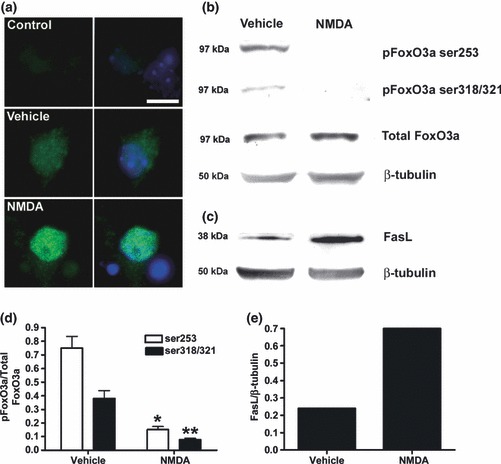
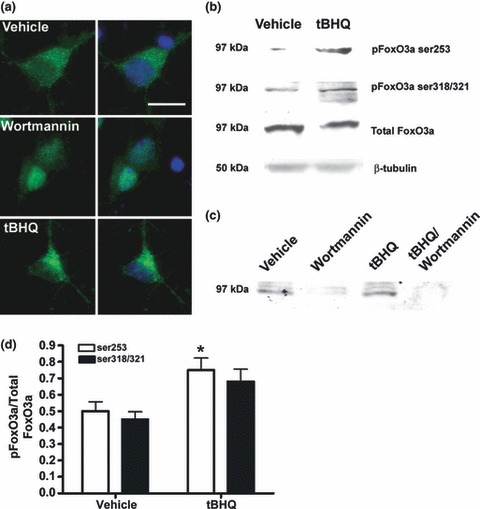
The Forkhead transcription factor, FoxO3a induces genomic death responses in neurones following translocation from the cytosol to the nucleus. Nuclear translocation of FoxO3a is triggered by trophic factor withdrawal, oxidative stress and the stimulation of extrasynaptic NMDA receptors. Receptor activation of phosphatidylinositol 3-kinase (PI3K)-Akt signalling pathways retains FoxO3a in the cytoplasm, thereby inhibiting the transcriptional activation of death-promoting genes. We hypothesized that phenolic antioxidants such as tert-Butylhydroquinone (tBHQ), which is known to stimulate PI3K-Akt signalling, would inhibit FoxO3a translocation and activity. Treatment of cultured cortical neurones with NMDA increased the nuclear localization of FoxO3a, reduced the phosphorylation of FoxO3a, increased caspase activity and up-regulated Fas ligand expression. In contrast the phenolic antioxidant, tBHQ, caused retention of FoxO3a in the cytosol coincident with enhanced PI3K- dependent phosphorylation of FoxO3a. tBHQ-induced nuclear exclusion of FoxO3a was associated with reduced FoxO-mediated transcriptional activity. Exposure of neurones to tBHQ inhibited NMDA-induced nuclear translocation of FoxO3a, prevented NMDA-induced up-regulation of FoxO-mediated transcriptional activity, blocked caspase activation and protected neurones from NMDA-induced excitotoxic death. Collectively, these data suggest that phenolic antioxidants such as tBHQ oppose stress-induced activation of FoxO3a and therefore have potential neuroprotective utility in neurodegeneration.
© 2012 The Authors. Journal of Neurochemistry © 2012 International Society for Neurochemistry.
Figures
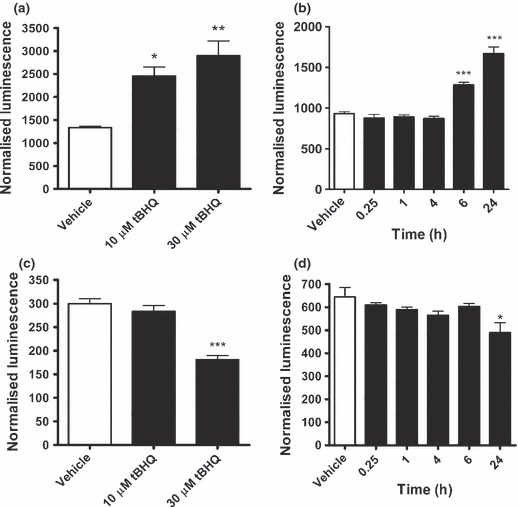


 ) or vehicle control (□) in the presence and absence of tBHQ (30 μM). Data represent mean ± SEM, analysed using one-way
  ) or vehicle control (
 ) for 24 h. Cell viability was assessed using the MTT assay where the absorbance of reduced MTT was read at 505 nm. Neurones co-treated with tBHQ were significantly protected against 100 and 300 μM NMDA insults. Data represent mean ± SEM, analysed using one-way
 References
-
- Abbott JJ, Howlett DR, Francis PT, Williams RJ. Abeta(1-42) modulation of Akt phosphorylation via alpha7 nAChR and NMDA receptors. Neurobiol. Aging. 2008;29:992–1001. - PubMed
-
- Arredondo F, Echeverry C, Abin-Carriquiry JA, Blasina F, Antúnez K, Jones DP, Go YM, Liang YL, Dajas F. After cellular internalization, quercetin causes Nrf2 nuclear translocation, increases glutathione levels, and prevents neuronal death against an oxidative insult. Free Radic. Biol. Med. 2010;49:738–747. - PubMed
-
- Bahia PK, Rattray M, Williams RJ. Dietary flavonoid (-)epicatechin stimulates phosphatidylinositol 3-kinase-dependent anti-oxidant response element activity and up-regulates glutathione in cortical astrocytes. J. Neurochem. 2008;106:2194–2204. - PubMed
-
- Biggs WH, III, Cavenee WK, Arden KC. Identification and characterization of members of the FKHR (FOX O) subclass of winged-helix transcription factors in the mouse. Mamm. Genome. 2001;12:416–425. - PubMed
Publication types
MeSH terms
Substances
Grants and funding
LinkOut - more resources
Full Text Sources
Research Materials
Miscellaneous
