


Elevated levels of 1-hydroxypyrene and N'-nitrosonornicotine in smokers with head and neck cancer: A matched control study
- PMID: 22807150
- PMCID: PMC4418651
- DOI: 10.1002/hed.23085
Elevated levels of 1-hydroxypyrene and N'-nitrosonornicotine in smokers with head and neck cancer: A matched control study
Abstract
Background: Head and neck squamous cell carcinoma (HNSCC) is associated with tobacco use. Still, most smokers do not develop HNSCC. The mechanisms of varying susceptibility to HNSCC are poorly studied to date. Tobacco metabolite research provides insight regarding the innate metabolism and excretion of carcinogens.
Methods: Smokers with HNSCC (cases) were compared with smokers without HNSCC (controls) in a matched cohort. The tobacco metabolites studied were: 1-hydroxypyrene (1-HOP), N'-nitrosonornicotine (NNN), and 4-(methylnitrosamino)-1-(3-pyridyl)-1-butanol (NNAL).
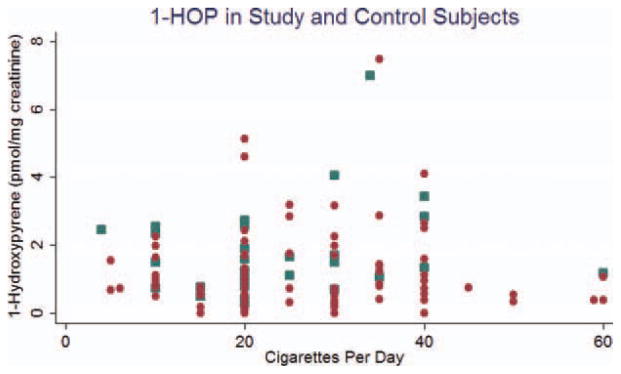
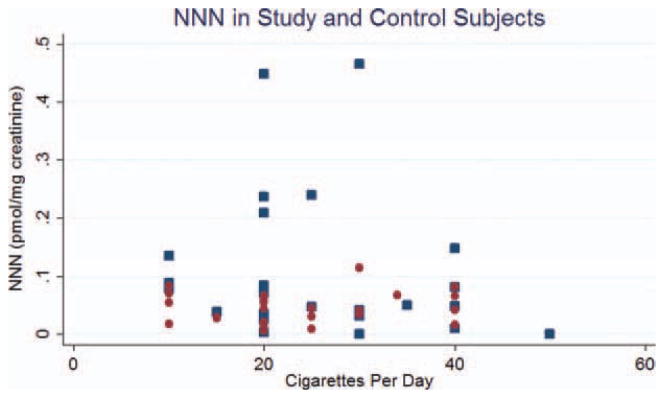
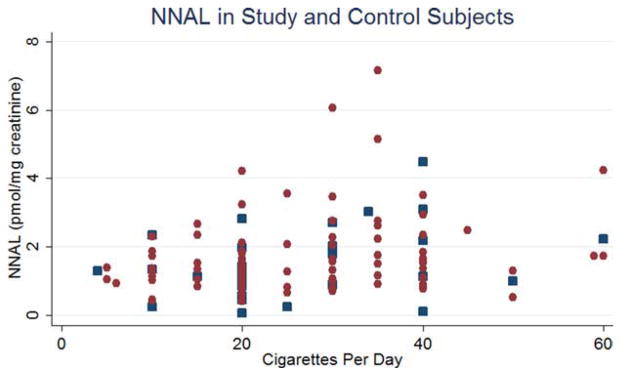
Results: In 33 subjects, mean 1-HOP was 1.82 pmol/mg creatinine versus 1.08 pmol/mg creatinine (p = .004) and mean NNN was 0.10 pmol/mg creatinine versus 0.04 pmol/mg creatinine (p = .01) in cases and controls, respectively. NNAL did not differ between groups.
Conclusions: Smokers with HNSCC have elevated urinary levels of 1-HOP and total NNN compared with matched controls, suggesting an increased effective exposure to these carcinogens. Tobacco constituent metabolites may be useful in understanding tobacco-related carcinogenesis in HNSCC.
Keywords: biomarkers; carcinogenesis; head and neck cancer; metabolites; tobacco.
Copyright © 2012 Wiley Periodicals, Inc.
Figures
References
-
- Peto R, Lopez AD, Boreham J, Thun M, Heath C, Jr, Doll R. Mortality from smoking worldwide. Br Med Bull. 1996;52:12–21. - PubMed
-
- World Health Organization. Tobacco or health: a global status report. Geneva: World Health Organization; 1997.
-
- Schlecht NF, Franco EL, Pintos J, Kowalski LP. Effect of smoking cessation and tobacco type on the risk of cancers in the upper aerodigestive tract in Brazil. Epidemiology. 1999;10:412–418. - PubMed
-
- Day GL, Blot WJ, Shore RE, et al. Second cancers following oral and pharyngeal cancers: role of tobacco and alcohol. J Natl Cancer Inst. 1994;86:131–137. - PubMed
-
- Sturgis EM, Wei Q, Spitz MR. Descriptive epidemiology and risk factors for head and neck cancer. Semin Oncol. 2004;31:726–733. - PubMed
Publication types
MeSH terms
Substances
Grants and funding
LinkOut - more resources
Full Text Sources
Medical
