


Ecology of root colonizing Massilia (Oxalobacteraceae)
- PMID: 22808103
- PMCID: PMC3394795
- DOI: 10.1371/journal.pone.0040117
Ecology of root colonizing Massilia (Oxalobacteraceae)
Abstract
Background: Ecologically meaningful classification of bacterial populations is essential for understanding the structure and function of bacterial communities. As in soils, the ecological strategy of the majority of root-colonizing bacteria is mostly unknown. Among those are Massilia (Oxalobacteraceae), a major group of rhizosphere and root colonizing bacteria of many plant species.
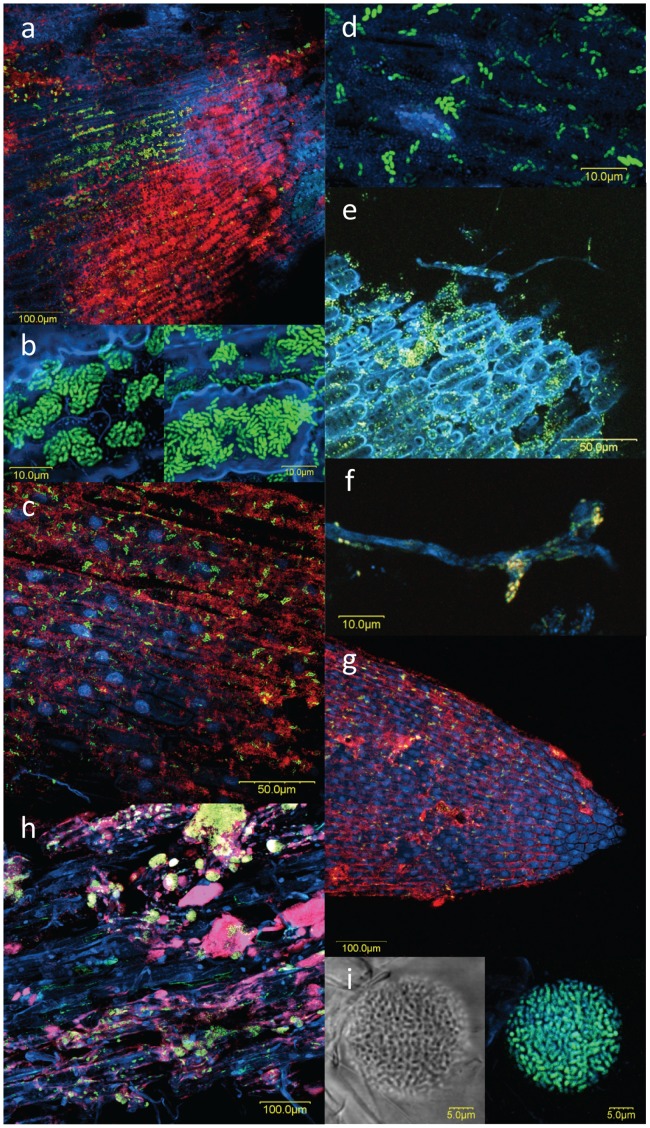
Methodology/principal findings: The ecology of Massilia was explored in cucumber root and seed, and compared to that of Agrobacterium population, using culture-independent tools, including DNA-based pyrosequencing, fluorescence in situ hybridization and quantitative real-time PCR. Seed- and root-colonizing Massilia were primarily affiliated with other members of the genus described in soil and rhizosphere. Massilia colonized and proliferated on the seed coat, radicle, roots, and also on hyphae of phytopathogenic Pythium aphanidermatum infecting seeds. High variation in Massilia abundance was found in relation to plant developmental stage, along with sensitivity to plant growth medium modification (amendment with organic matter) and potential competitors. Massilia absolute abundance and relative abundance (dominance) were positively related, and peaked (up to 85%) at early stages of succession of the root microbiome. In comparison, variation in abundance of Agrobacterium was moderate and their dominance increased at later stages of succession.
Conclusions: In accordance with contemporary models for microbial ecology classification, copiotrophic and competition-sensitive root colonization by Massilia is suggested. These bacteria exploit, in a transient way, a window of opportunity within the succession of communities within this niche.
Conflict of interest statement
Figures




References
-
- Compant S, Clément C, Sessitsch A. Plant growth-promoting bacteria in the rhizo- and endosphere of plants: Their role, colonization mechanisms involved and prospects for utilization. Soil Biol Biochem. 2010;42:669–678.
-
- Katan Y. Waisel Y, Eshel A, Kafkafi U, editors. Interactions of soilborne pathogens with roots and aboveground plant organs. 2002. pp. 949–960. Plant Roots–the Hidden Half. New York: Marcel Dekker Inc.
-
- Raaijmakers JM, Paulitz TC, Steinberg C, Alabouvette C, Moënne-Loccoz Y. The rhizosphere: a playground and battlefield for soilborne pathogens and beneficial microorganisms. Plant Soil. 2009;321:341–361.
-
- Vance CP. Waisel Y, Eshel A, Kafkafi U, editors. Root-bacteria interactions: symbiotic N2 fixation. 2002. pp. 839–868. Plant Roots–the Hidden Half. New York: Marcel Dekker Inc.
-
- De Weert S, Bloemberg GV. Gnanamanickam SS, editor. Rhizosphere competence and the role of root colonization in biocontrol. 2006. pp. 317–333. editor. Plant-Associated Bacteria. Dordrecht: Springer.
Publication types
MeSH terms
Substances
LinkOut - more resources
Full Text Sources
Research Materials
