


Challenges of loss to follow-up in tuberculosis research
- PMID: 22808114
- PMCID: PMC3395690
- DOI: 10.1371/journal.pone.0040183
Challenges of loss to follow-up in tuberculosis research
Abstract
Background: In studies evaluating methods for diagnosing tuberculosis (TB), follow-up to verify the presence or absence of active TB is crucial and high dropout rates may significantly affect the validity of the results. In a study assessing the diagnostic performance of the QuantiFERON®-TB Gold In-Tube test in TB suspect children in Tanzania, factors influencing patient adherence to attend follow-up examinations and reasons for not attending were examined.
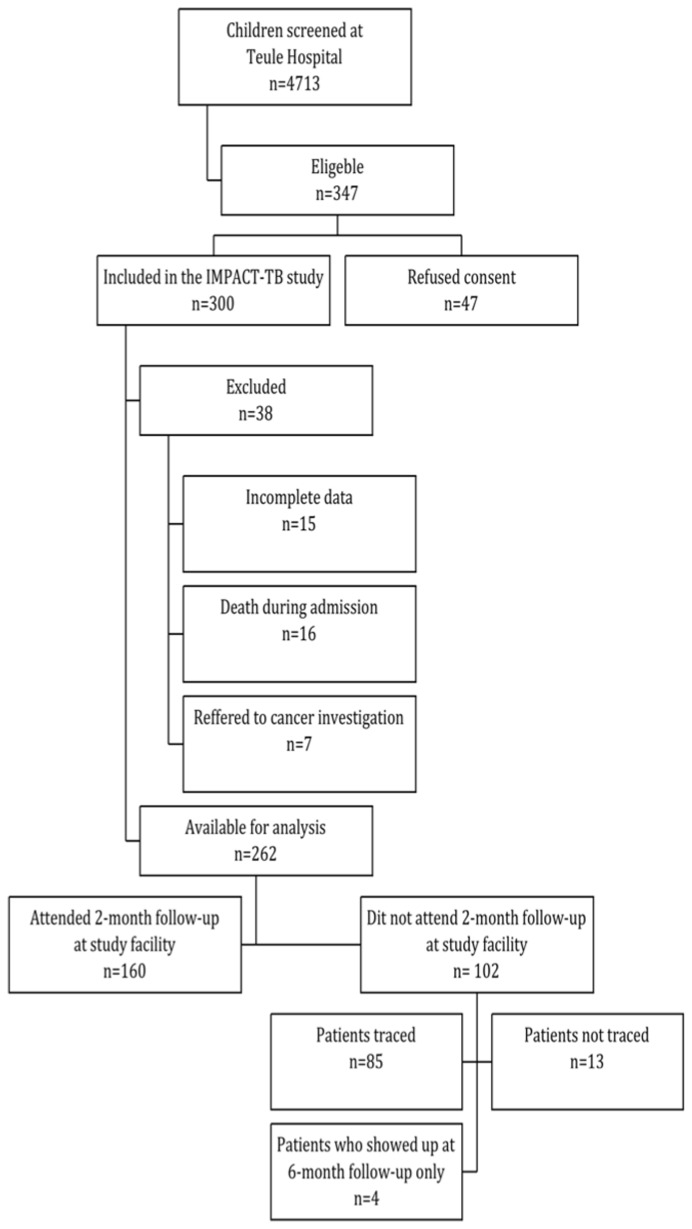
Methods: In 160 children who attended and 102 children who did not attend scheduled 2-month follow-up baseline health characteristics, demographic data and risk factors for not attending follow-up were determined. Qualitative interviews were used to understand patient and caretakers reasons for not returning for scheduled follow-up.
Results: Being treated for active tb in the dots program (OR: 4.14; 95% CI:1.99-8.62;p-value<0.001) and receiving money for the bus fare (OR:129; 95% CI 16->100;P-value<0.001) were positive predictors for attending follow-up at 2 months, and 21/85(25%) of children not attending scheduled follow-up had died. Interviews revealed that limited financial resources, i.e. lack of money for transportation and poor communication, were related to non-adherence.
Conclusion: Patients lost to follow-up is a potential problem for TB research. Receiving money for transportation to the hospital and communication is crucial for adherence to follow-up conducted at a study facility. Strategies to ensure follow-up should be part of any study protocol.
Conflict of interest statement
Figures
Similar articles
-
Successful implementation of isoniazid preventive therapy at a pediatric HIV clinic in Tanzania.BMC Infect Dis. 2020 Oct 7;20(1):738. doi: 10.1186/s12879-020-05471-z. BMC Infect Dis. 2020. PMID: 33028260 Free PMC article.
-
QuantiFERON®-TB gold in-tube performance for diagnosing active tuberculosis in children and adults in a high burden setting.PLoS One. 2012;7(7):e37851. doi: 10.1371/journal.pone.0037851. Epub 2012 Jul 12. PLoS One. 2012. PMID: 22808002 Free PMC article.
-
Longitudinal analysis of QuantiFERON-TB Gold In-Tube in children with adult household tuberculosis contact in South Africa: a prospective cohort study.PLoS One. 2011;6(10):e26787. doi: 10.1371/journal.pone.0026787. Epub 2011 Oct 31. PLoS One. 2011. PMID: 22066009 Free PMC article.
-
Latent tuberculosis diagnosis in children by using the QuantiFERON-TB Gold In-Tube test.Pediatrics. 2009 Jan;123(1):30-7. doi: 10.1542/peds.2007-3618. Pediatrics. 2009. PMID: 19117857
-
Tuberculosis Treatment Non-Adherence and Lost to Follow Up among TB Patients with or without HIV in Developing Countries: A Systematic Review.Iran J Public Health. 2015 Jan;44(1):1-11. Iran J Public Health. 2015. PMID: 26060770 Free PMC article. Review.
Cited by
-
Economic evaluation of a community health worker model for tuberculosis care in Ho Chi Minh City, Viet Nam: a mixed-methods Social Return on Investment Analysis.BMC Public Health. 2023 May 25;23(1):945. doi: 10.1186/s12889-023-15841-2. BMC Public Health. 2023. PMID: 37231468 Free PMC article.
-
Explaining patient delay in healthcare seeking and loss to diagnostic follow-up among patients with presumptive tuberculosis in Tanzania: a mixed-methods study.BMC Health Serv Res. 2019 Apr 5;19(1):217. doi: 10.1186/s12913-019-4030-4. BMC Health Serv Res. 2019. PMID: 30953502 Free PMC article.
-
Safety monitoring experience of single-low dose primaquine co-administered with artemether-lumefantrine among providers and patients in routine healthcare practice: a qualitative study in Eastern Tanzania.Malar J. 2021 Oct 9;20(1):392. doi: 10.1186/s12936-021-03921-w. Malar J. 2021. PMID: 34627236 Free PMC article.
-
Tuberculosis treatment loss to follow-up in children exposed at home: A prospective cohort study.J Glob Health. 2024 Aug 16;14:04194. doi: 10.7189/jogh.14.04194. J Glob Health. 2024. PMID: 39149829 Free PMC article.
-
Factors associated with children's health facility visits for primaquine treatment in rural Papua New Guinea.Malar J. 2019 Feb 20;18(1):42. doi: 10.1186/s12936-019-2675-4. Malar J. 2019. PMID: 30786891 Free PMC article.
References
-
- Robiner WN. Enhancing adherence in clinical research. Contemp Clin Trials. 2005;26:59–77. - PubMed
-
- Mugusi F, Josiah R, Moshi A, Chale S, Bakari M, et al. Dropouts in a long-term follow-up study involving voluntary counseling and HIV testing: experience from a cohort of police officers in Dar Es Salaam, Tanzania. J Acquir Immune Defic Syndr. 2002;30:119–123. - PubMed
-
- Karcher H, Omondi A, Odera J, Kunz A, Harms G. Risk factors for treatment denial and loss to follow-up in an antiretroviral treatment cohort in Kenya. Trop Med Int Health. 2007;12:687–694. - PubMed
Publication types
MeSH terms
LinkOut - more resources
Full Text Sources
Medical
