


Energy metabolism during repeated sets of leg press exercise leading to failure or not
- PMID: 22808209
- PMCID: PMC3396634
- DOI: 10.1371/journal.pone.0040621
Energy metabolism during repeated sets of leg press exercise leading to failure or not
Erratum in
- PLoS One. 2013;8(1). doi:10.1371/annotation/ca21efee-84a1-4031-9dcd-224af64b7753
Abstract
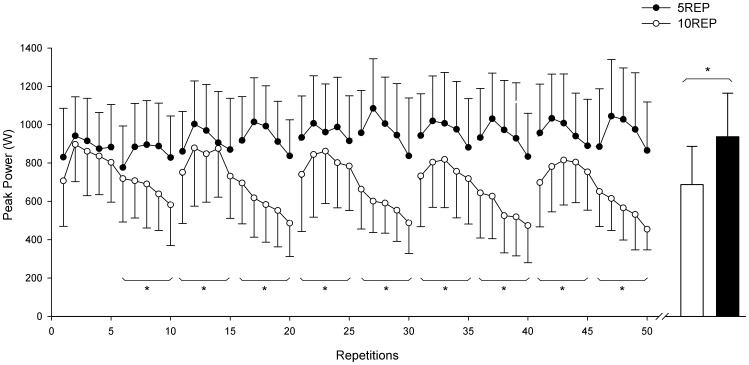
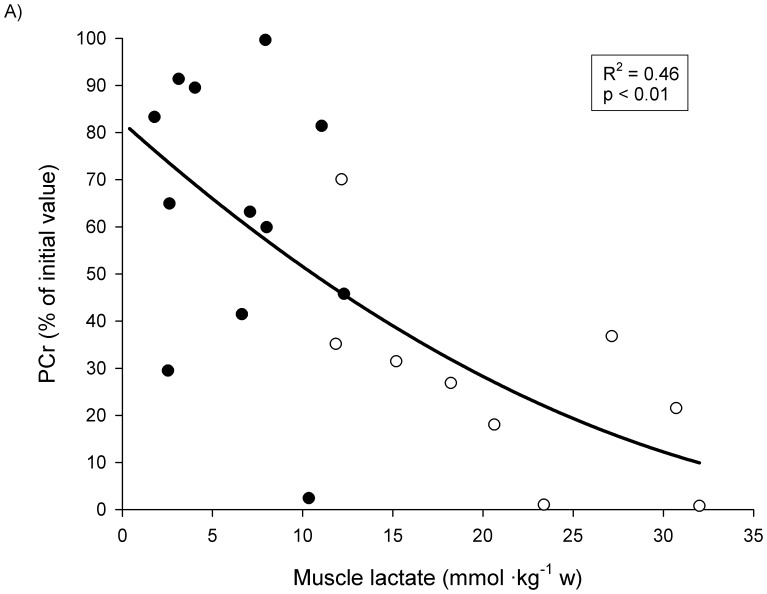
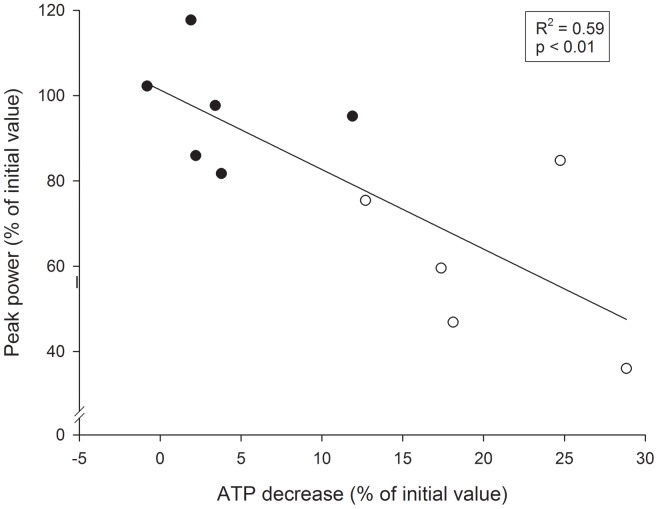
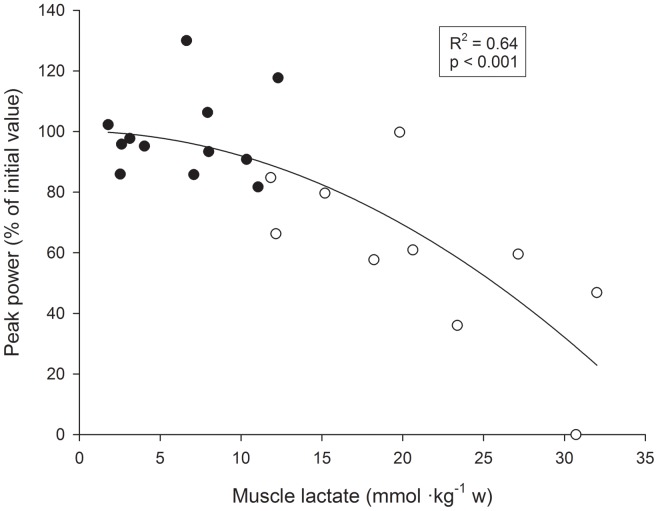
This investigation examined the influence of the number of repetitions per set on power output and muscle metabolism during leg press exercise. Six trained men (age 34 ± 6 yr) randomly performed either 5 sets of 10 repetitions (10REP), or 10 sets of 5 repetitions (5REP) of bilateral leg press exercise, with the same initial load and rest intervals between sets. Muscle biopsies (vastus lateralis) were taken before the first set, and after the first and the final sets. Compared with 5REP, 10REP resulted in a markedly greater decrease (P<0.05) of the power output, muscle PCr and ATP content, and markedly higher (P<0.05) levels of muscle lactate and IMP. Significant correlations (P<0.01) were observed between changes in muscle PCr and muscle lactate (R(2) = 0.46), between changes in muscle PCr and IMP (R(2) = 0.44) as well as between changes in power output and changes in muscle ATP (R(2) = 0.59) and lactate (R(2) = 0.64) levels. Reducing the number of repetitions per set by 50% causes a lower disruption to the energy balance in the muscle. The correlations suggest that the changes in PCr and muscle lactate mainly occur simultaneously during exercise, whereas IMP only accumulates when PCr levels are low. The decrease in ATP stores may contribute to fatigue.
Conflict of interest statement
Figures
References
-
- Kraemer WJ, Adams K, Cafarelli E, Dudley GA, Dooly C, et al. American College of Sports Medicine position stand. Progression models in resistance training for healthy adults. Med Sci Sports Exerc. 2002;34:364–380. - PubMed
-
- Hancock CR, Janssen E, Terjung RL. Contraction-mediated phosphorylation of AMPK is lower in skeletal muscle of adenylate kinase-deficient mice. J Appl Physiol 100: 406–413. 00885.2005 [pii];10.1152/japplphysiol.00885.2005 [doi] 2006. - PubMed
-
- Winder WW, Hardie DG. AMP-activated protein kinase, a metabolic master switch: possible roles in type 2 diabetes. Am J Physiol. 1999;277:E1–10. - PubMed
-
- McCartney N, Spriet LL, Heigenhauser GJ, Kowalchuk JM, Sutton JR, et al. Muscle power and metabolism in maximal intermittent exercise. J Appl Physiol. 1986;60:1164–1169. - PubMed
