


Mouse-adapted H9N2 influenza A virus PB2 protein M147L and E627K mutations are critical for high virulence
- PMID: 22808250
- PMCID: PMC3393695
- DOI: 10.1371/journal.pone.0040752
Mouse-adapted H9N2 influenza A virus PB2 protein M147L and E627K mutations are critical for high virulence
Abstract
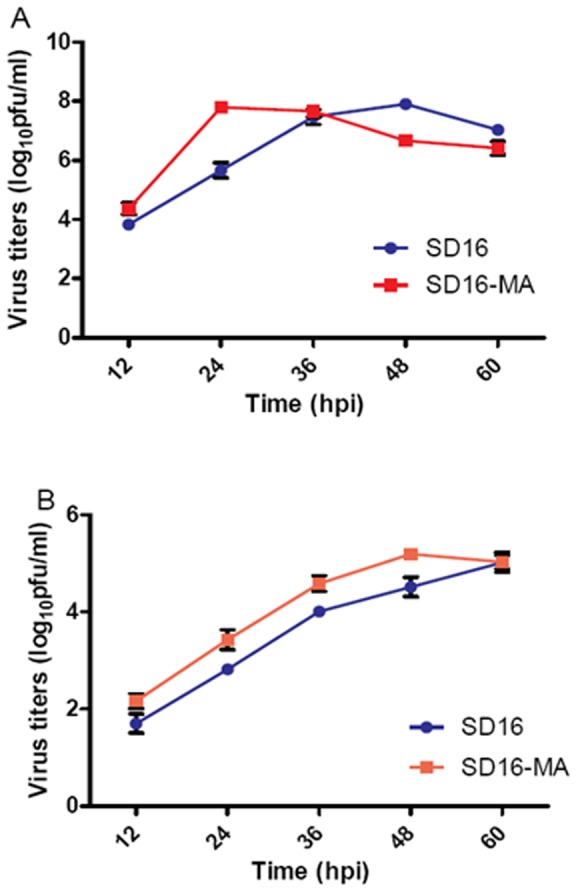
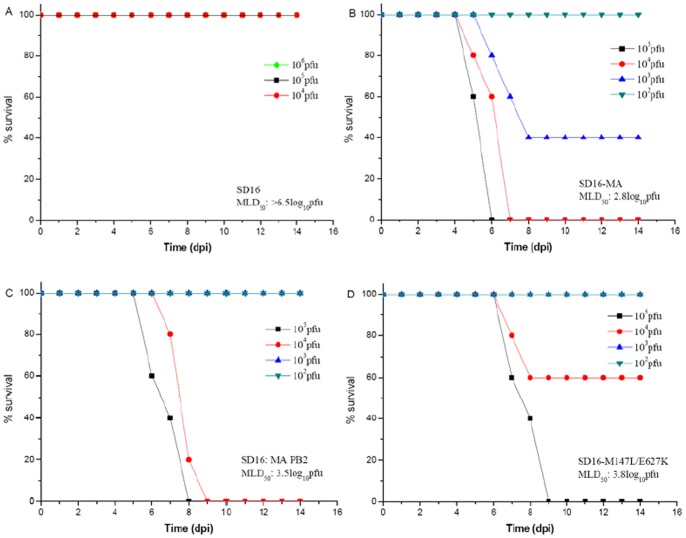
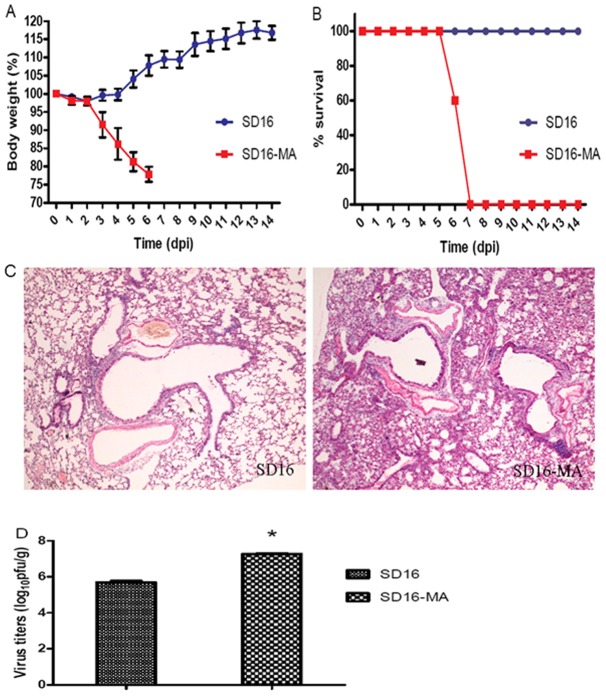
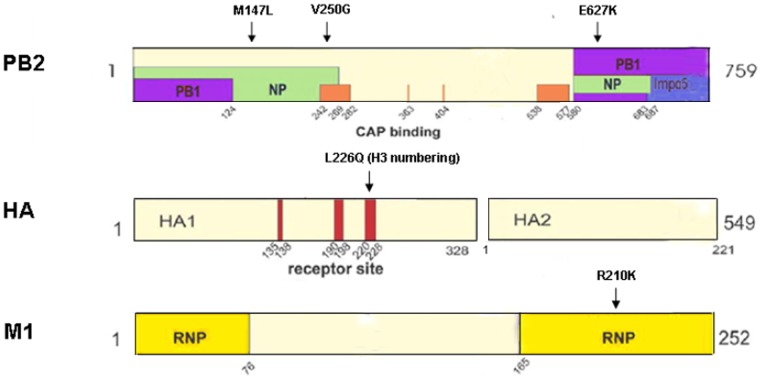
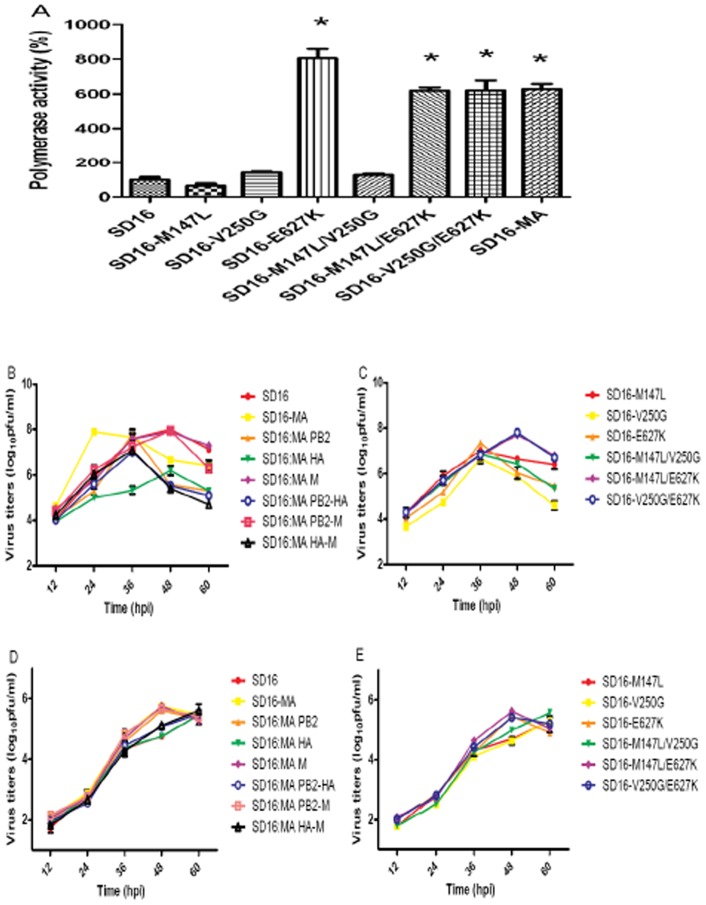
H9N2 influenza viruses have been circulating worldwide in multiple avian species and have repeatedly infected humans to cause typical disease. The continued avian-to-human interspecies transmission of H9N2 viruses raises concerns about the possibility of viral adaption with increased virulence for humans. To investigate the genetic basis of H9N2 influenza virus host range and pathogenicity in mammals, we generated a mouse-adapted H9N2 virus (SD16-MA) that possessed significantly higher virulence than wide-type virus (SD16). Increased virulence was detectable after 8 sequential lung passages in mice. Five amino acid substitutions were found in the genome of SD16-MA compared with SD16 virus: PB2 (M147L, V250G and E627K), HA (L226Q) and M1 (R210K). Assessments of replication in mice showed that all of the SD16-MA PB2, HA and M1 genome segments increased virus replication; however, only the mouse-adapted PB2 significantly increased virulence. Although the PB2 E627K amino acid substitution enhanced viral polymerase activity and replication, none of the single mutations of mouse adapted PB2 could confer increased virulence on the SD16 backbone. The combination of M147L and E627K significantly enhanced viral replication ability and virulence in mice. Thus, our results show that the combination of PB2 amino acids at position 147 and 627 is critical for the increased pathogenicity of H9N2 influenza virus in mammalian host.
Conflict of interest statement
Figures
Similar articles
-
Molecular basis of efficient replication and pathogenicity of H9N2 avian influenza viruses in mice.PLoS One. 2012;7(6):e40118. doi: 10.1371/journal.pone.0040118. Epub 2012 Jun 29. PLoS One. 2012. PMID: 22768236 Free PMC article.
-
Rapid emergence of a PB2-E627K substitution confers a virulent phenotype to an H9N2 avian influenza virus during adoption in mice.Arch Virol. 2015 May;160(5):1267-77. doi: 10.1007/s00705-015-2383-5. Epub 2015 Mar 19. Arch Virol. 2015. PMID: 25782865
-
Mouse-adapted H9N2 avian influenza virus causes systemic infection in mice.Virol J. 2019 Nov 12;16(1):135. doi: 10.1186/s12985-019-1227-4. Virol J. 2019. PMID: 31718675 Free PMC article.
-
Adaptation of avian influenza A virus polymerase in mammals to overcome the host species barrier.J Virol. 2013 Jul;87(13):7200-9. doi: 10.1128/JVI.00980-13. Epub 2013 Apr 24. J Virol. 2013. PMID: 23616660 Free PMC article. Review.
-
Molecular determinants of pathogenicity in the polymerase complex.Curr Top Microbiol Immunol. 2014;385:35-60. doi: 10.1007/82_2014_386. Curr Top Microbiol Immunol. 2014. PMID: 25033751 Review.
Cited by
-
Two Genetically Similar H9N2 Influenza A Viruses Show Different Pathogenicity in Mice.Front Microbiol. 2016 Nov 4;7:1737. doi: 10.3389/fmicb.2016.01737. eCollection 2016. Front Microbiol. 2016. PMID: 27867373 Free PMC article.
-
Genetic and Antigenic Characteristics of Highly Pathogenic Avian Influenza A(H5N8) Viruses Circulating in Domestic Poultry in Egypt, 2017-2021.Microorganisms. 2022 Mar 9;10(3):595. doi: 10.3390/microorganisms10030595. Microorganisms. 2022. PMID: 35336170 Free PMC article.
-
Genetic and antigenic characterization of avian influenza H9N2 viruses during 2016 in Iraq.Open Vet J. 2019 Jul;9(2):164-171. doi: 10.4314/ovj.v9i2.12. Epub 2019 Jun 12. Open Vet J. 2019. PMID: 31360657 Free PMC article.
-
Rapid emergence of a virulent PB2 E627K variant during adaptation of highly pathogenic avian influenza H7N7 virus to mice.Virol J. 2013 Sep 5;10:276. doi: 10.1186/1743-422X-10-276. Virol J. 2013. PMID: 24007444 Free PMC article.
-
Large-scale sequence analysis reveals novel human-adaptive markers in PB2 segment of seasonal influenza A viruses.Emerg Microbes Infect. 2018 Mar 29;7(1):47. doi: 10.1038/s41426-018-0050-0. Emerg Microbes Infect. 2018. PMID: 29593225 Free PMC article.
References
-
- Panshin A, Golender N, Davidson I, Nagar S, Garsia M, et al. Variability of NS1 proteins among H9N2 avian influenza viruses isolated in Israel during 2000–2009. Virus Genes. 2010;41:396–405. - PubMed
-
- Abolnik C, Gerdes GH, Sinclair M, Ganzevoort BW, Kitching JP, et al. Phylogenetic analysis of influenza A viruses (H6N8, H1N8, H4N2, H9N2, H10N7) isolated from wild birds, ducks, and ostriches in South Africa from 2007 to 2009. Avian Dis. 2010;54:313–322. - PubMed
-
- Sun Y, Pu J, Jiang Z, Guan T, Xia Y, et al. Genotypic evolution and antigenic drift of H9N2 influenza viruses in China from 1994 to 2008. Vet Microbiol. 2010. - PubMed
-
- Cong YL, Pu J, Liu QF, Wang S, Zhang GZ, et al. Antigenic and genetic characterization of H9N2 swine influenza viruses in China. J Gen Virol. 2007;88:2035–2041. - PubMed
Publication types
MeSH terms
Substances
LinkOut - more resources
Full Text Sources
