


Live-birth rates after HP-hMG stimulation in the long GnRH agonist protocol: association with mid-follicular hCG and progesterone concentrations, but not with LH concentrations
- PMID: 22809021
- PMCID: PMC3518295
- DOI: 10.3109/09513590.2012.705379
Live-birth rates after HP-hMG stimulation in the long GnRH agonist protocol: association with mid-follicular hCG and progesterone concentrations, but not with LH concentrations
Abstract
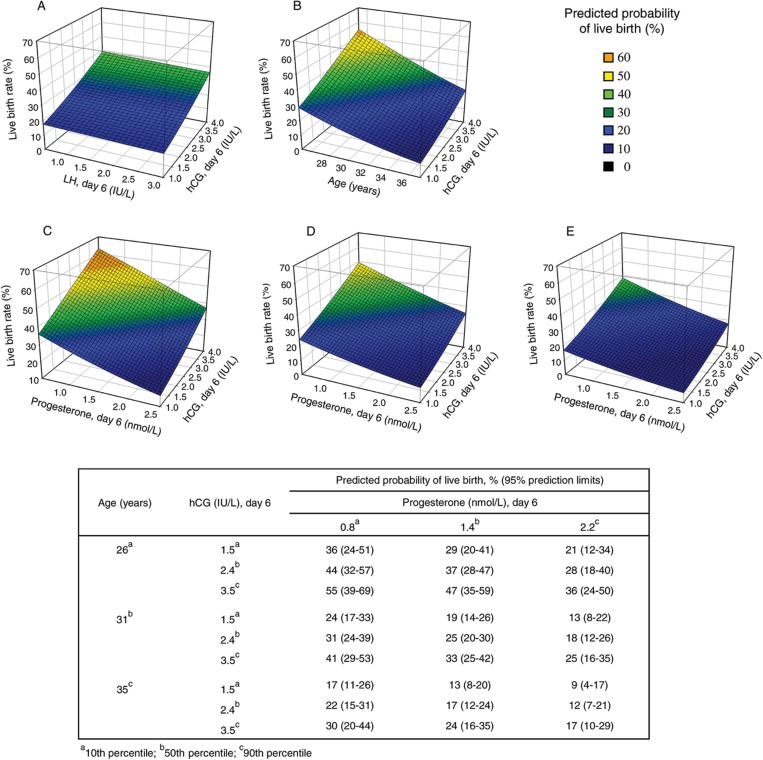
The aim of this retrospective study was to investigate the impact of endogenous and exogenous luteinizing hormone (LH) activity on treatment outcome, when taking into consideration potential confounding variables. Data were derived from IVF patients (n = 358) stimulated with highly purified menotrophin (HP-hMG) in a long gonadotrophin-releasing hormone (GnRH) agonist protocol. Simple retrospective logistic regression analysis showed that the mid-follicular exogenous concentrations of human chorionic gonadotrophin (hCG) (p = 0.027), provided by the HP-hMG preparation, and female age (p = 0.009) were significantly associated with live-birth rate, while the mid-follicular progesterone concentration (p = 0.075), the estradiol concentration on last stimulation day (p = 0.075) and number of embryos transferred (p = 0.071) were borderline significant. Endogenous LH was not associated with live-birth rate; neither at start of stimulation (p = 0.123), nor in the mid-follicular phase (p = 0.933) or on the last day of stimulation (p = 0.589). In the multiple regression analysis of life birth, mid-follicular hCG (p = 0.016) was identified as a positive predictor, and age (p = 0.004) and mid-follicular progesterone (p = 0.029) as negative predictors. In conclusion, mid-follicular concentrations of exogenous hCG and progesterone, but not endogenous LH, are associated with live-birth rate in IVF patients treated with HP-hMG in a long GnRH agonist cycle.
Figures
References
-
- Balasch J, Fábregues F, Casamitjana R, Peñarrubia J, Vanrell JA. A pharmacokinetic and endocrine comparison of recombinant follicle-stimulating hormone and human menopausal gonadotrophin in polycystic ovary syndrome. Reprod Biomed Online. 2003;6:296–301. - PubMed
-
- Fleming R, Lloyd F, Herbert M, Fenwick J, Griffiths T, Murdoch A. Effects of profound suppression of luteinizing hormone during ovarian stimulation on follicular activity, oocyte and embryo function in cycles stimulated with purified follicle stimulating hormone. Hum Reprod. 1998;13:1788–1792. - PubMed
-
- Griesinger G, Dawson A, Schultze-Mosgau A, Finas D, Diedrich K, Felberbaum R. Assessment of luteinizing hormone level in the gonadotropin-releasing hormone antagonist protocol. Fertil Steril. 2006;85:791–793. - PubMed
-
- Strehler E, Abt M, El-Danasouri I, De Santo M, Sterzik K. Impact of recombinant follicle-stimulating hormone and human menopausal gonadotropins on in vitro fertilization outcome. Fertil Steril. 2001;75:332–336. - PubMed
-
- Westergaard LG, Erb K, Laursen SB, Rex S, Rasmussen PE. Human menopausal gonadotropin versus recombinant follicle-stimulating hormone in normogonadotropic women down-regulated with a gonadotropin-releasing hormone agonist who were undergoing in vitro fertilization and intracytoplasmic sperm injection: a prospective randomized study. Fertil Steril. 2001;76:543–549. - PubMed
MeSH terms
Substances
LinkOut - more resources
Full Text Sources
Medical
Research Materials
Miscellaneous
