


Antioxidant and antimicrobial activities of ethyl acetate extract, fractions and compounds from stem bark of Albizia adianthifolia (Mimosoideae)
- PMID: 22809287
- PMCID: PMC3488965
- DOI: 10.1186/1472-6882-12-99
Antioxidant and antimicrobial activities of ethyl acetate extract, fractions and compounds from stem bark of Albizia adianthifolia (Mimosoideae)
Abstract
Background: Albizia adianthifolia is used traditionally in Cameroon to treat several ailments, including infectious and associated diseases. This work was therefore designed to investigate the antioxidant and antimicrobial activities of ethyl acetate extract, fractions and compounds isolated from the stem bark of this plant.
Methods: The plant extract was prepared by maceration in ethyl acetate. Its fractionation was done by column chromatography and the structures of isolated compounds were elucidated using spectroscopic data in conjunction with literature data. The 1,1-diphenyl-2-picrylhydrazyl (DPPH) and trolox equivalent antioxidant capacity (TEAC) assays were used to detect the antioxidant activity. Broth micro-dilution method was used for antimicrobial test. Total phenol content was determined spectrophotometrically in the extracts by using Folin-Ciocalteu method.
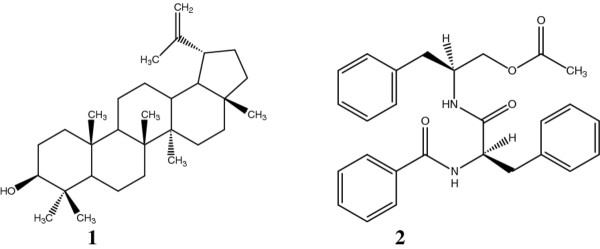
Results: The fractionation of the extract afforded two known compounds: lupeol (1) and aurantiamide acetate (2) together with two mixtures of fatty acids: oleic acid and n-hexadecanoic acid (B₁); n-hexadecanoic acid, octadecanoic acid and docosanoic acid (B₂). Aurantiamide acetate was the most active compound. The total phenol concentration expressed as gallic acid equivalents (GAE) was found to vary from 1.50 to 13.49 μg/ml in the extracts. The antioxidant activities were well correlated with the total phenol content (R² = 0.946 for the TEAC method and R² = 0.980 for the DPPH free-radical scavenging assay).
Conclusions: Our results clearly reveal that the ethyl acetate extract from the stem bark of A. adianthifolia possesses antioxidant and antimicrobial principles. The antioxidant activity of this extract as well as that of compound 2 are being reported herein for the first time. These results provide promising baseline information for the potential use of this plant as well as compound 2 in the treatment of oxidative damage and infections associated with the studied microorganisms.
Figures


References
-
- Zabala NQ. Albizia and Paraserianthes species. Proceedings of an international workshop held in Bislig, Suriqao; del Sur, Philippines; 1997. pp. 13–19.
-
- Watt JM, Breyer-Brandwyk MG. The medicinal and poisonous plants of Southern and Easthern Africa. 2. Livingstone, London; 1962.
-
- Van-Wyk BE, Gerick N. People’s plants: a guide to useful plants of Southern Africa. Briza publications, Pretoria; 2000.
-
- Candy HA, Brookes KB, Bull JR, Mc Garry EJ, Mc Garry JM. Flavonoids of Albizia adianthifolia. Phytochemistry. 1978;17:1681–1682. doi: 10.1016/S0031-9422(00)94678-8. - DOI
Publication types
MeSH terms
Substances
LinkOut - more resources
Full Text Sources
Medical
