


Potential association between coronary artery disease and the inflammatory biomarker YKL-40 in asymptomatic patients with type 2 diabetes mellitus
- PMID: 22809439
- PMCID: PMC3410768
- DOI: 10.1186/1475-2840-11-84
Potential association between coronary artery disease and the inflammatory biomarker YKL-40 in asymptomatic patients with type 2 diabetes mellitus
Abstract
Background: Inflammation plays an important role in coronary artery disease from the initiation of endothelial dysfunction to plaque formation to final rupture of the plaque. In this study, we investigated the potential pathophysiological and clinical relevance of novel cytokines secreted from various cells including adipocytes, endothelial cells, and inflammatory cells, in predicting coronary artery disease (CAD) in asymptomatic subjects with type 2 diabetes mellitus.
Methods: We enrolled a total of 70 asymptomatic type 2 diabetic patients without a documented history of cardiovascular disease, and determined serum levels of chemerin, omentin-1, YKL-40, and sCD26. We performed coronary computed tomographic angiography (cCTA) in all subjects, and defined coronary artery stenosis ≥ 50 % as significant CAD in this study.
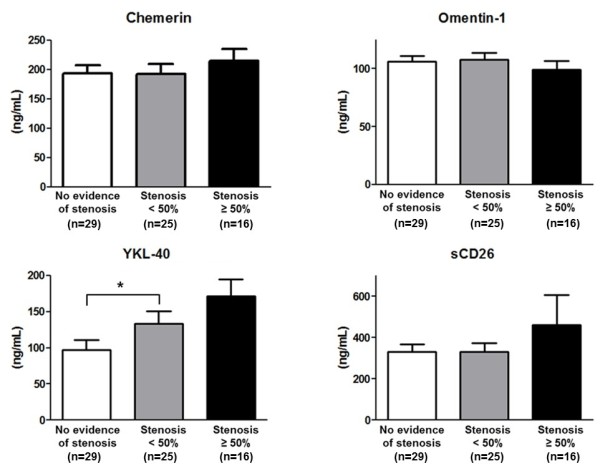
Results: Subjects were classified into two groups: patients with suspected coronary artery stenosis on cCTA (group I, n = 41) and patients without any evidence of stenosis on cCTA (group II, n = 29). Group I showed significantly higher YLK-40 levels and lower HDL-C levels than group II (p = 0.038, 0.036, respectively). Levels of chemerin, omentin-1, and sCD26 were not significantly different between the two groups. Serum YKL-40 levels were positively correlated with systolic/diastolic BP, fasting/postprandial triglyceride levels, and Framingham risk score. Furthermore, YKL-40 levels showed moderate correlation with the degree of coronary artery stenosis and the coronary artery calcium score determined from cCTA. In multivariate logistic analysis, after adjusting for age, gender, smoking history, hypertension, and LDL-cholesterol, YLK-40 levels showed only borderline significance.
Conclusions: YKL-40, which is secreted primarily from inflammatory cells, was associated with several CVD risk factors and was elevated in type 2 diabetic patients with suspected coronary artery stensosis on cCTA. These results suggest the possibility that the inflammatory biomarker YKL-40 might be associated with coronary artery disease in asymptomatic patients with type 2 diabetes mellitus.
Figures
References
-
- Grundy SM, Cleeman JI, Merz CN, Brewer HB, Clark LT, Hunninghake DB, Pasternak RC, Smith SC, Stone NJ. Implications of recent clinical trials for the National Cholesterol Education Program Adult Treatment Panel III guidelines. Circulation. 2004;110:227–239. doi: 10.1161/01.CIR.0000133317.49796.0E. - DOI - PubMed
-
- Seon CS, Min KW, Lee SY, Nho KW, Park SH, Koo BK, Han KA. Cardiovascular Risk Assessment with Vascular Function, Carotid Atherosclerosis and the UKPDS Risk Engine in Korean Patients with Newly Diagnosed Type 2 Diabetes. Diab Metab J. 2011;35:619–627. doi: 10.4093/dmj.2011.35.6.619. - DOI - PMC - PubMed
Publication types
MeSH terms
Substances
LinkOut - more resources
Full Text Sources
Medical
Miscellaneous
