


Vitamin D supplementation as an adjuvant therapy for patients with T2DM: an 18-month prospective interventional study
- PMID: 22809461
- PMCID: PMC3461474
- DOI: 10.1186/1475-2840-11-85
Vitamin D supplementation as an adjuvant therapy for patients with T2DM: an 18-month prospective interventional study
Abstract
Background: Vitamin D deficiency has been associated with impaired human insulin action, suggesting a role in the pathogenesis of diabetes mellitus type 2 (T2DM). In this prospective interventional study we investigated the effects of vitamin D3 supplementation on the metabolic profiles of Saudi T2DM subjects pre- and post-vitamin D supplementation over an 18-month period.
Methods: T2DM Saudi subjects (men, N = 34: Age: 56.6 ± 8.7 yr, BMI, 29.1 ± 3.3 kg/m2; women, N = 58: Age: 51.2 ± 10.6 yr, BMI 34.3 ± 4.9 kg/m2;) were recruited and given 2000 IU vitamin D3 daily for 18 months. Anthropometrics and fasting blood were collected (0, 6, 12, 18 months) to monitor serum 25-hydroxyvitamin D using specific ELISA, and to determine metabolic profiles by standard methods.
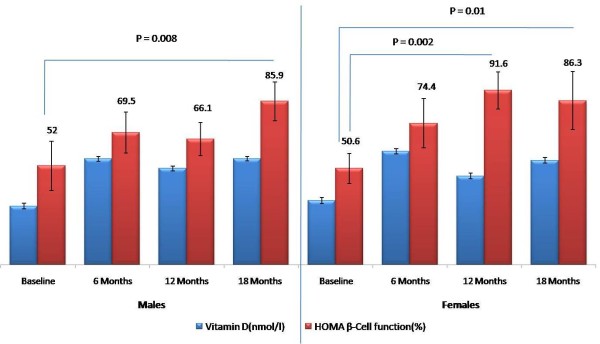
Results: In all subjects there was a significant increase in mean 25-hydroxyvitamin D levels from baseline (32.2 ± 1.5 nmol/L) to 18 months (54.7 ± 1.5 nmol/L; p < 0.001), as well as serum calcium (baseline = 2.3 ± 0.23 mmol/L vs. 18 months = 2.6 ± 0.1 mmol/L; p = 0.003). A significant decrease in LDL- (baseline = 4.4 ± 0.8 mmol/L vs. 18 months = 3.6 ± 0.8 mmol/L, p < 0.001] and total cholesterol (baseline = 5.4 ± 0.2 mmol/L vs. 18 months = 4.9 ± 0.3 mmol/L, p < 0.001) were noted, as well as a significant improvement in HOMA-β function (p = 0.002). Majority of the improvements elicited were more prominent in women than men.
Conclusion: In the Saudi T2DM population receiving oral Vitamin D3 supplementation (2000 IU/day), circulating 25-hydroxyvitamin D levels remained below normal 18 months after the onset of treatment. Yet, this "suboptimal" supplementation significantly improved lipid profile with a favorable change in HDL/LDL ratio, and HOMA-β function, which were more pronounced in T2DM females.
Figures
References
-
- Forouhi NG, Ye Z, Rickard AP, Khaw KT, Luben R, Langenberg C, Wareham NJ. Circulating 25-hydroxyvitamin D concentration and the risk of type 2 diabetes: results from the European Prospective Investigation into Cancer (EPIC)-Norfolk cohort and updated meta-analysis of prospective studies. Diabetologia. 2012;55:2173–2182. - PubMed
-
- Akin F, Ayça B, Köse N, Duran M, Sar M, Uysal OK, Karakukcu C, Arinc H, Covic A, Goldsmith D, Okçün B, Kanbay M. Serum vitamin D levels are independently associated with severity of coronary artery disease. J Investig Med. 2012. [Epub ahead of print] - PubMed
-
- Mathieu C, Badenhoop K. Vitamin D and type 1 diabetes mellitus: state of the art. Trends Endocrinol Metab. 2005;16:261–266. - PubMed
-
- Mattila C, Knekt P, Männistö S, Rissanen H, Laaksonen MA, Montonen J, Reunanen A. Serum 25-hydroxyvitamin D concentration and subsequent risk of type 2 diabetes. Diabetes Care. 2007;30:2569–2570. - PubMed
MeSH terms
Substances
LinkOut - more resources
Full Text Sources
Medical
