


Post-traumatic stress disorder and medication adherence: results from the Mind Your Heart study
- PMID: 22809686
- PMCID: PMC3485414
- DOI: 10.1016/j.jpsychires.2012.06.011
Post-traumatic stress disorder and medication adherence: results from the Mind Your Heart study
Abstract
Background: Patients with post-traumatic stress disorder (PTSD) are at increased risk for adverse outcomes from comorbid medical conditions. Medication non-adherence is a potential mechanism explaining this increased risk.
Methods: We examined the association between PTSD and medication adherence in a cross-sectional study of 724 patients recruited from two Department of Veterans Affairs Medical Centers between 2008 and 2010. PTSD was assessed using the Clinician Administered PTSD Scale. Medication adherence was assessed using a standardized questionnaire. Ordinal logistic regression models were used to calculate the odds ratios (ORs) for medication non-adherence in patients with versus without PTSD, adjusting for potential confounders.
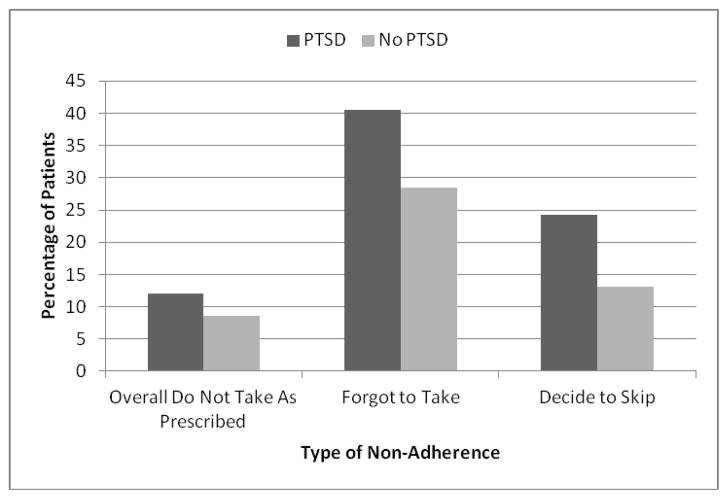
Results: A total of 252 patients (35%) had PTSD. Twelve percent of patients with PTSD reported not taking their medications as prescribed compared to 9% of patients without PTSD (unadjusted OR 1.85, 95% CI 1.37-2.50, P<0.001). Forty-one percent of patients with PTSD compared to 29% of patients without PTSD reported forgetting medications (unadjusted OR 1.90, 95% CI 1.44-2.52, P<0.001). Patients with PTSD were also more likely to report skipping medications (24% versus 13%; unadjusted OR 2.01, 95% CI 1.44-2.82, P<0.001). The association between PTSD and non-adherence remained significant after adjusting for demographics, depression, alcohol use, social support, and medical comorbidities (adjusted OR 1.47, 95% CI 1.03-2.10, P=0.04 for not taking medications as prescribed and 1.95, 95% CI 1.31-2.91, P=0.001 for skipping medications).
Conclusions: PTSD was associated with medication non-adherence independent of psychiatric and medical comorbidities. Medication non-adherence may contribute to the increased morbidity and mortality observed in patients with PTSD.
Copyright © 2012 Elsevier Ltd. All rights reserved.
Conflict of interest statement
Figures
References
-
- Kessler RC. Posttraumatic stress disorder: The burden to the individual and to society. J Clin Psychiatry. 2000;61(Suppl 5):4–12. discussion 13–14. - PubMed
-
- Kessler RC, Sonnega A, Bromet E, Hughes M, Nelson CB. Posttraumatic stress disorder in the national comorbidity survey. Arch Gen Psychiatry. 1995;52:1048–1060. - PubMed
-
- Boscarino JA. Posttraumatic stress disorder and mortality among u.S. Army veterans 30 years after military service. Ann Epidemiol. 2006;16:248–256. - PubMed
-
- Friedman MJ. Acknowledging the psychiatric cost of war. N Engl J Med. 2004;351:75–77. - PubMed
