RadRAT: a radiation risk assessment tool for lifetime cancer risk projection
- PMID: 22810503
- PMCID: PMC3816370
- DOI: 10.1088/0952-4746/32/3/205
RadRAT: a radiation risk assessment tool for lifetime cancer risk projection
Abstract
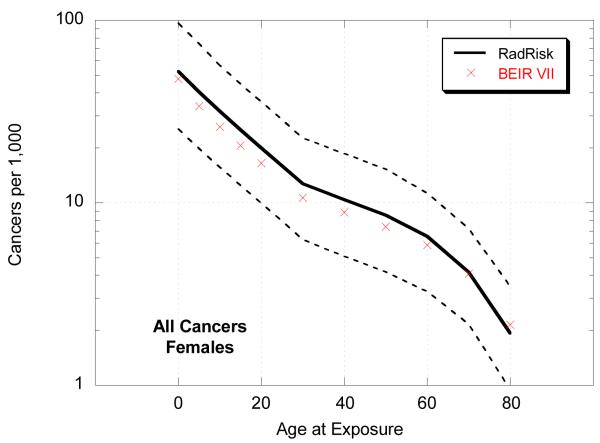
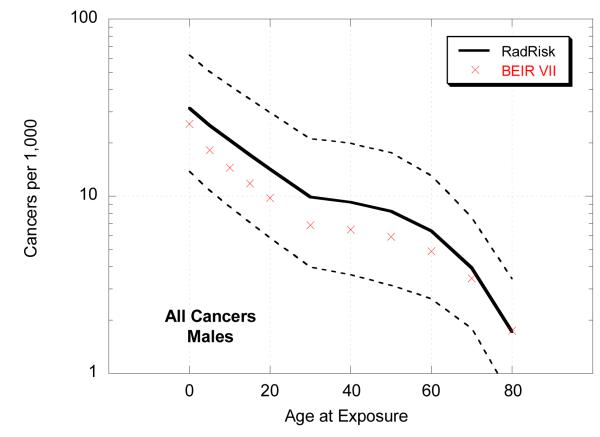
Risk projection methods allow for timely assessment of the potential magnitude of radiation-related cancer risks following low-dose radiation exposures. The estimation of such risks directly through observational studies would generally require infeasibly large studies and long-term follow-up to achieve reasonable statistical power. We developed an online radiation risk assessment tool (RadRAT) which can be used to estimate the lifetime risk of radiation-related cancer with uncertainty intervals following a user-specified exposure history (https://irep.nci.nih.gov/radrat). The uncertainty intervals constitute a key component of the program because of the various assumptions that are involved in such calculations. The risk models used in RadRAT are broadly based on those developed by the BEIR VII committee for estimating lifetime risk following low-dose radiation exposure of the US population for eleven site-specific cancers. We developed new risk models for seven additional cancer sites, oral, oesophagus, gallbladder, pancreas, rectum, kidney and brain/central nervous system (CNS) cancers, using data from Japanese atomic bomb survivors. The lifetime risk estimates are slightly higher for RadRAT than for BEIR VII across all exposure ages mostly because the weighting of the excess relative risk and excess absolute risk models was conducted on an arithmetic rather than a logarithmic scale. The calculator can be used to estimate lifetime cancer risk from both uniform and non-uniform doses that are acute or chronic. It is most appropriate for low-LET radiation doses < 1 Gy, and for individuals with life-expectancy and cancer rates similar to the general population in the US.
Figures
References
-
- Land CE. Estimating cancer risks from low doses of ionizing radiation. Science. 1980;209:1197–203. - PubMed
-
- Berrington de Gonzalez A, Darby S. Risk of cancer from diagnostic X-rays: estimates for the UK and 14 other countries. Lancet. 2004;363:345–351. - PubMed
-
- Darby SC. The Contribution of natural ionizing radiation to cancer mortality in the US. In: Brugge J, Curran T, Harlow E, McComick F, editors. The Origins of Human Cancer. Cold Spring Harbor Laboratory Press; New York: 1991.
-
- National Research Council (NRC) Committee to Assess Health Risks from Exposure to Low Levels of Ionizing Radiation . Health Risks from Exposure to Low Levels of Ionizing Radiation: BEIR VII Phase 2. National Academy of Sciences; Washington, DC: 2005. - PubMed
Publication types
MeSH terms
Grants and funding
LinkOut - more resources
Full Text Sources