


Anatomic location of PET-positive aortocaval nodes in patients with locally advanced cervical cancer: implications for surgical staging
- PMID: 22810967
- PMCID: PMC4283482
- DOI: 10.1097/IGC.0b013e31825e523a
Anatomic location of PET-positive aortocaval nodes in patients with locally advanced cervical cancer: implications for surgical staging
Abstract
Objective: Pathologic evaluation of aortocaval nodes in patients with locally advanced cervical cancer in an effort to better tailor radiotherapy has gained popularity. We sought to determine which aortocaval nodes should be sampled during surgical staging procedures.
Methods: From 2004 to 2011, 246 patients with locally advanced cervical cancer underwent positron emission tomography (PET) before definitive chemoradiation. We reviewed the imaging studies to determine the location of PET-positive aortocaval nodes in relationship to the inferior mesenteric artery (IMA).
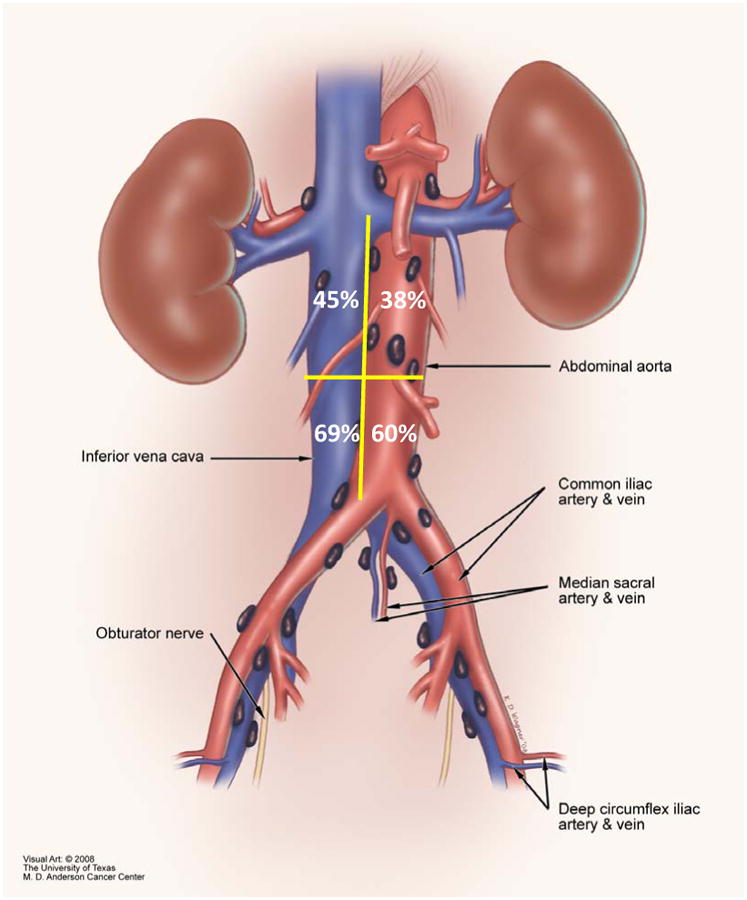
Results: Forty-two patients (17%) had PET images suggesting aortocaval metastasis. Ten patients had stage IB, 1 had stage IIA, 13 had stage IIB, 13 had stage IIIB, and 5 had stage IV disease. Of these 42 patients, 39 (93%) had FDG-avid pelvic nodes, 1 (2%) had PET-negative pelvic nodes but FDG-avid common iliac nodes, and 2 (5%) had direct spread to the aortocaval nodes. Three patients (7%) had FDG-avid aortocaval nodes above the IMA without FDG-avid nodes between the aortic bifurcation and IMA. All 3 of these patients also had FDG-avid nodes in the pelvis. Nineteen patients (45%) had FDG-avid nodes above and below the IMA, and 20 (48%) had FDG-avid nodes below the IMA only.
Conclusions: This hypothesis-generating study revealed that a small number of patients have PET-positive aortocaval nodes above the IMA only. For patients undergoing surgical staging for locally advanced cervical cancer, dissection to the renal vessels may be necessary. A future international, randomized study will prospectively evaluate the locations of pathologically positive aortocaval lymph nodes.
Figures
Comment in
-
Oncology scan - gynecological cancers: new treatments, old treatments, imaging, and meta-analyses.Int J Radiat Oncol Biol Phys. 2013 Jun 1;86(2):207-10. doi: 10.1016/j.ijrobp.2013.01.026. Int J Radiat Oncol Biol Phys. 2013. PMID: 23643375 No abstract available.
References
-
- Leblanc E, Narducci F, Frumovitz M, et al. Therapeutic value of pretherapeutic extraperitoneal laparoscopic staging of locally advanced cervical carcinoma. Gynecol Oncol. 2007;105:304–311. - PubMed
-
- Havrilesky LJ, Kulasingam SL, Matchar DB, et al. FDG-PET for management of cervical and ovarian cancer. Gynecol Oncol. 2005;97:183–191. - PubMed
-
- Lavoue V, Bats AS, Darai E. Pelvic and para-aortic lymphadenectomy are required to stage locally advanced cervical cancer. Gynecol Oncol. 2008;109:427–428. author reply 428-429. - PubMed
-
- Marnitz S, Kohler C, Roth C, et al. Is there a benefit of pretreatment laparoscopic transperitoneal surgical staging in patients with advanced cervical cancer? Gynecol Oncol. 2005;99:536–544. - PubMed
