. 2012 Oct 1;303(7):E832-40.
doi: 10.1152/ajpendo.00002.2012. Epub 2012 Jul 17.

Molecular inflammation and adipose tissue matrix remodeling precede physiological adaptations to pregnancy

Affiliations

Molecular inflammation and adipose tissue matrix remodeling precede physiological adaptations to pregnancy

Veronica Resi et al. Am J Physiol Endocrinol Metab. .

Abstract

Changes in adipose tissue metabolism are central to adaptation of whole body energy homeostasis to pregnancy. To gain insight into the molecular mechanisms supporting tissue remodeling, we have characterized the longitudinal changes of the adipose transcriptome in human pregnancy. Healthy nonobese women recruited pregravid were followed in early (8-12 wk) and in late (36-38 wk) pregnancy. Adipose tissue biopsies were obtained in the fasting state from the gluteal depot. The adipose transcriptome was examined via whole genome DNA microarray. Expression of immune-related genes and extracellular matrix components was measured using real-time RT-PCR. Adipose mass, adipocyte size, and cell number increased in late pregnancy compared with pregravid measurements (P < 0.001) but remained unchanged in early pregnancy. The adipose transcriptome evolved during pregnancy with 10-15% of genes being differently expressed compared with pregravid. Functional gene cluster analysis revealed that the early molecular changes affected immune responses, angiogenesis, matrix remodeling, and lipid biosynthesis. Increased expression of macrophage markers (CD68, CD14, and the mannose-6 phosphate receptor) emphasized the recruitment of the immune network in both early and late pregnancy. The TLR4/NF-κB signaling pathway was enhanced specifically in relation to inflammatory adipokines and chemokines genes. We conclude that early recruitment of metabolic and immune molecular networks precedes the appearance of pregnancy-related physiological changes in adipose tissue. This biphasic pattern suggests that physiological inflammation is an early step preceding the development of insulin resistance, which peaks in late pregnancy.


Figures
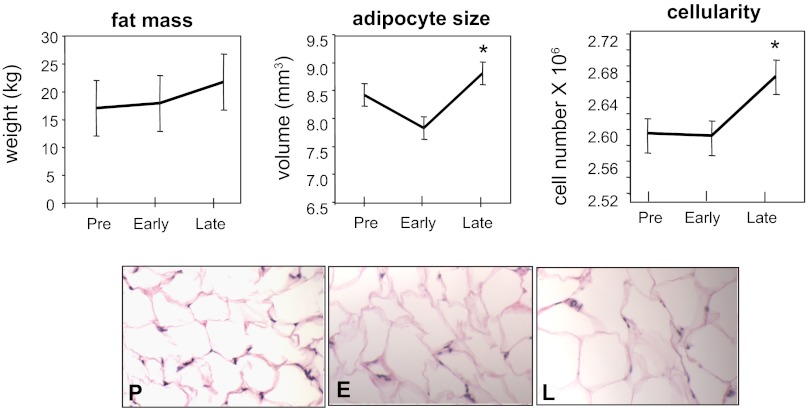
Fig. 1.
Fig. 1.
Morphological changes in adipose tissue in human pregnancy. Top: total adipose tissue mass, adipocyte size, and number of adipocytes prior to and during healthy uncomplicated pregnancy. Early: 8–11 wk of gestation; late: 34–36 wk of gestation. Statistical significance: *P < 0.05 vs. pregravid. Results are means ± SD for 11 women. Bottom: immunohistochemistry of subcutaneous gluteal adipose tissue sections. Initial magnification, ×20. P, pregravid; E, early pregnancy (8–12 wk); L, late pregnancy (34–36 wk).
Fig. 2.
Fig. 2.
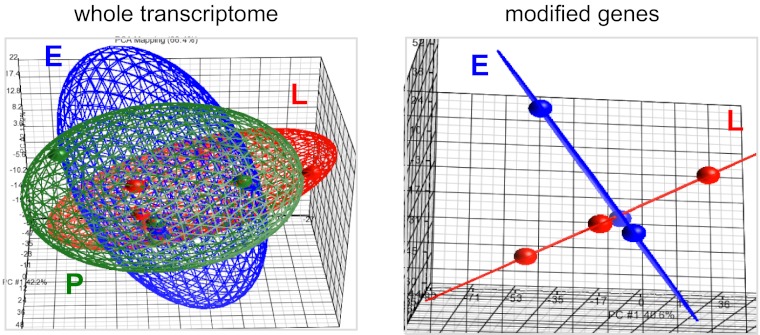
Three-dimensional scatter plot principal component analysis (PCA) of the adipose tissue transcriptome. Gluteal adipose tissue obtained longitudinally in P, E, and L from 6 of the 11 women. Full cohort was processed for microarray analysis. A: analysis of full data set (n = 22, 277 genes) showed overlap in transcriptome profiles before and during pregnancy. B: analysis of the genes modified significantly in E and L (n = 1,807 genes) compared with pregravid showed a distinctive pattern at each stage of pregnancy. Each knot represents 1 microarray data set.
Fig. 3.
Fig. 3.
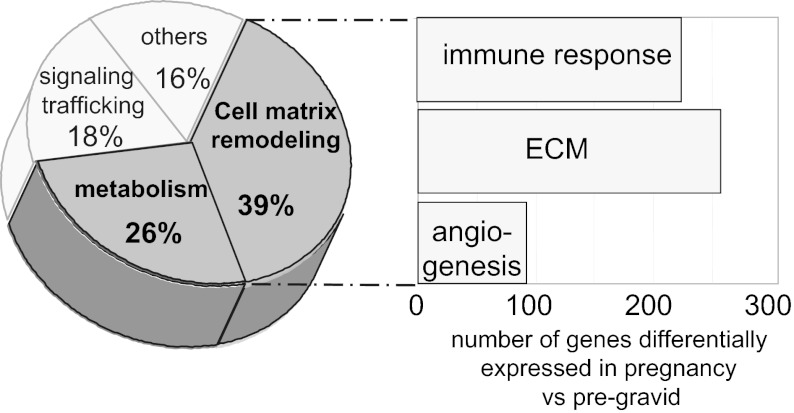
Transcriptional changes in adipose tissue during pregnancy. Functional analysis of the genes whose expression was modified during pregnancy compared with pregravid identified 4 main gene clusters based on biological annotation of their DNA sequences. ECM, extracellular matrix.
Fig. 4.
Fig. 4.
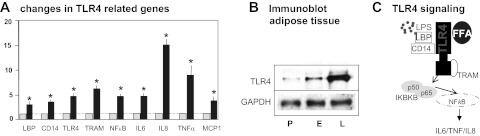
Pregnancy-related changes in adipose tissue Toll-like receptor 4 (TLR4) network. Genes implicated in TLR4 signaling pathways were selected from the lists in Table 2. A: mRNA levels were measured by quantitative RT-PCR analysis of adipose tissue from early pregnancy. Real-time threshold cycle (CT) values were normalized to actin and expressed in fold change vs. pregravid. B: immnublot longitudinal analysis of TLR4 protein content in adipose tissue at P, E, and L. C: diagram of the molecular pathways related to TLR4 activation identified with gene ontology analysis. Statistical significance: *P < 0.05. Gray bars, pregravid; black bars, early pregnancy; n = 6 independent determinations. LPS, lipopolysaccharide; LBP, lipopolysaccharide-binding protein; FFA, free fatty acid; TRAM, TRIF-related adaptor protein; IKBKB, inhibitor of κ-light polypeptide gene enhancer.
Fig. 5.
Fig. 5.
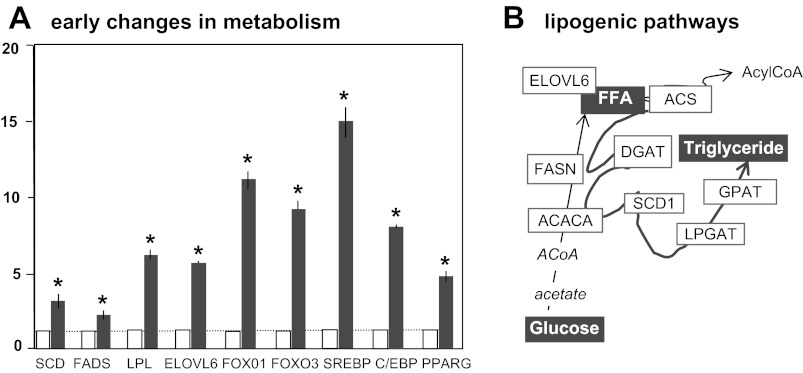
Pregnancy-related changes in adipose tissue metabolic pathways. mRNA levels of adipose-specific enzymes and transcription factors selected from Table 2 were measured by quantitative RT-PCR analysis. Real-time CT values were normalized to actin and expressed in fold change vs. pregravid. B: diagram of the molecular pathways identified with gene ontology analysis of differentially regulated genes in early pregnancy. Statistical significance: *P < 0.05. Open bars, pregravid; filled bars, early pregnancy for n = 6 independent determinations. ELOVL6, elongation of very long chain fatty acids protein 6; ACS, acyl-CoA synthetase; FASN, fatty acid synthase; DGAT, diacylglycerol acyltransferase; ACACA, acetyl-CoA carboxylase-1α; SCD, stearoyl-CoA desaturase; GPAT, glycerol phosphate acyltransferase; LPGAT, lisophosphatidylglycerol acyltransferase; ACoA, acetyl-CoA; FADS, fatty acid desaturase; LPL, lipoprotein lipase; FOXO, forkhead box O; SREBP, sterol regulatory element-binding protein; C/EBP, CCAAT/enhancer-binding protein; PPARγ, peroxisome proliferator-activated receptor-γ.
Fig. 6.
Fig. 6.
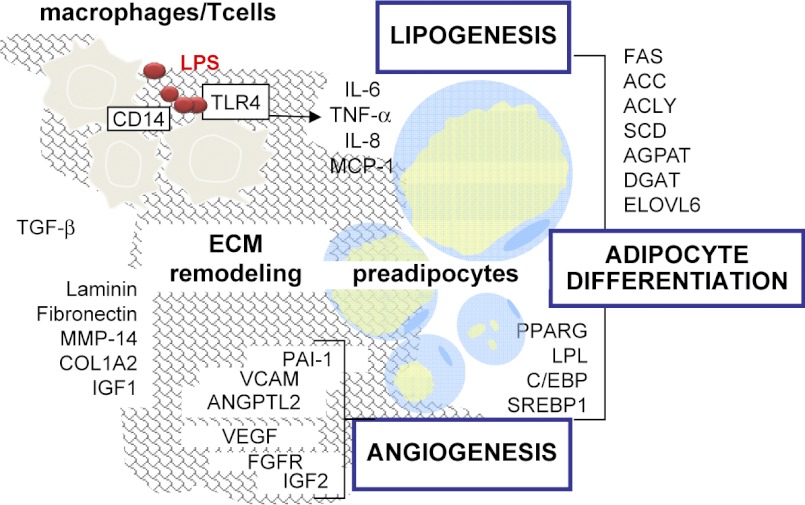
Model of functional networks contributing to adipose tissue remodeling in human pregnancy. Transcriptional activation patterns suggest that molecular networks from several adjacent cell types cooperate with the adipose tissue remodeling during pregnancy. ECM components and angiogenic factors are needed for vascular and adipocyte growth. Lipogenic genes and transcription factors are required for cell differentiation and lipid storage. Macrophages infiltrated between the stromal cells produce proinflammatory cytokines IL-6, IL-8, and TNF, which may 1) enhance neovascularization and 2) facilitate the development of insulin resistance. ACC, acetyl-CoA carboxylase; MCP-1, monocyte chemoattractant protein-1; ACLY, ATP citrate lyase; AGPAT, acylglycerol-3-phosphate acyltransferase; MMP-14, metalloproteinase-14; COL1A2, collagen type 1 α2; PAI-1, plasminogen activator inhibitor-1; VCAM, vascular cell adhesion molecule-1, ANGPTL2, angiopoietin-like 2; FGFR2, fibroblast growth factor receptor 2.

References

    1. Averill MM, Kerkhoff C, Bornfeldt KE. S100A8 and S100A9 in cardiovascular biology and disease. Arterioscler Thromb Vasc Biol 32: 223–229, 2012 - PMC - PubMed
    1. Basu S, Haghiac M, Surace P, Challier JC, Guerre-Millo M, Singh K, Waters T, Minium J, Presley L, Catalano PM, Hauguel-de Mouzon S. Pregravid obesity associates with increased maternal endotoxemia and metabolic inflammation. Obesity (Silver Spring) 19: 476–482, 2011 - PMC - PubMed
    1. Battaglia FC, Meschia G. Principal substrates of fetal metabolism. Physiol Rev 58: 499–527, 1978 - PubMed
    1. Björntorp P. Growth hormone, insulin-like growth factor-I and lipid metabolism: interactions with sex steroids. Horm Res 46: 188–191, 1996 - PubMed
    1. Baranova IN, Bocharov AV, Vishnyakova TG, Kurlander R, Chen Z, Fu D, Arias IM, Csako G, Patterson AP, Eggerman TL. CD36 is a novel serum amyloid A (SAA) receptor mediating SAA binding and SAA-induced signaling in human and rodent cells. J Biol Chem 285: 8492–8506, 2010 - PMC - PubMed

Publication types

MeSH terms