


Control and augmentation of long-term plasmid transgene expression in vivo in murine muscle tissue and ex vivo in patient mesenchymal tissue
- PMID: 22811595
- PMCID: PMC3395381
- DOI: 10.1155/2012/379845
Control and augmentation of long-term plasmid transgene expression in vivo in murine muscle tissue and ex vivo in patient mesenchymal tissue
Abstract
Purpose: In vivo gene therapy directed at tissues of mesenchymal origin could potentially augment healing. We aimed to assess the duration and magnitude of transene expression in vivo in mice and ex vivo in human tissues.
Methods: Using bioluminescence imaging, plasmid and adenoviral vector-based transgene expression in murine quadriceps in vivo was examined. Temporal control was assessed using a doxycycline-inducible system. An ex vivo model was developed and optimised using murine tissue, and applied in ex vivo human tissue.
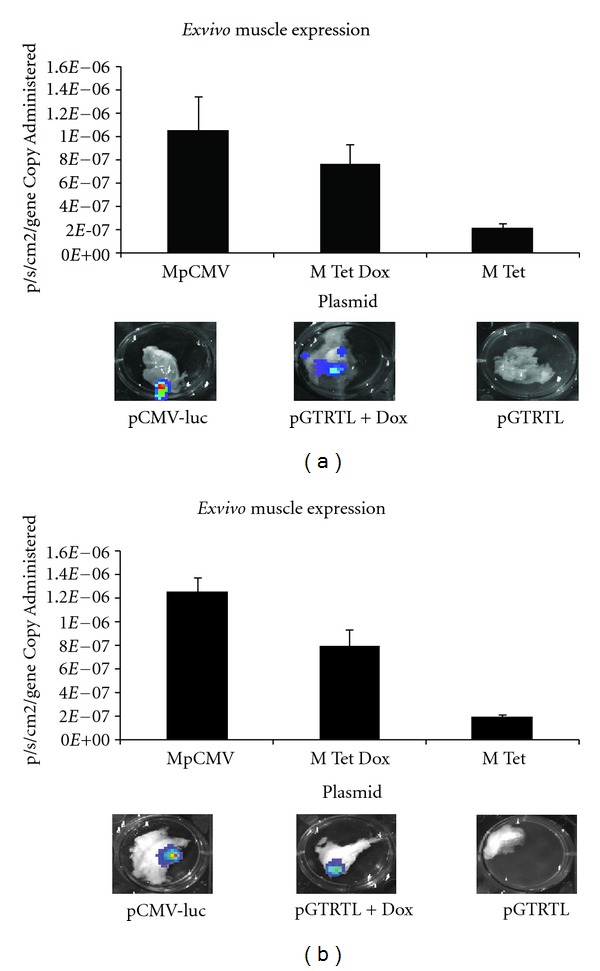
Results: In vivo plasmid-based transgene expression did not silence in murine muscle, unlike in liver. Although maximum luciferase expression was higher in muscle with adenoviral delivery compared with plasmid, expression reduced over time. The inducible promoter cassette successfully regulated gene expression with maximum levels a factor of 11 greater than baseline. Expression was re-induced to a similar level on a temporal basis. Luciferase expression was readily detected ex vivo in human muscle and tendon.
Conclusions: Plasmid constructs resulted in long-term in vivo gene expression in skeletal muscle, in a controllable fashion utilising an inducible promoter in combination with oral agents. Successful plasmid gene transfection in human ex vivo mesenchymal tissue was demonstrated for the first time.
Figures


References
-
- Evans CH. Orthopaedics: gene therapy’s dark horse. Gene Therapy. 2004;11(4):p. 343. - PubMed
-
- Hannallah D, Peterson B, Lieberman JR, Fu FH, Huard J. Gene therapy in orthopaedic surgery. Instructional Course Lectures. 2003;52:753–768. - PubMed
-
- Hildebrand K, Frank C. Ligaments: structure, function and response to injury and repairin. In: Dee R, et al., editors. Principles of Orthopaedic Practice. New York, NY, USA: McGraw-Hill; 1997. pp. 109–117.
-
- Kloen P, Di Paola M, Borens O, et al. BMP signaling components are expressed in human fracture callus. Bone. 2003;33(3):362–371. - PubMed
-
- Bolt P, Clerk AN, Luu HH, et al. BMP-14 gene therapy increases tendon tensile strength in a rat model of achilles tendon injury. Journal of Bone and Joint Surgery—Series A. 2007;89(6):1315–1320. - PubMed
Publication types
MeSH terms
Substances
LinkOut - more resources
Full Text Sources
